SUPRACITE

AST × Starlink / Satellite Cellular Draft

AST × Starlink: two ways to reach the same phone

Both use phased arrays. AST unfolds a much larger radio surface; Starlink’s early design puts a cellular base station in orbit. Compare antenna area, signal correction and handover against the same engineering problems.

Public draft · Research through 2026-09-14 · Updated 2026-09-15. This article is in review; findings and wording may change.

Watch an overview 1:35Narrated patent drawings · Captions included

A short summary of this article, with synthetic narration. The full analysis and sources follow below. Download video.

Read the video transcript

Same phone. Different satellites.
Put the same ordinary phone under AST and Starlink. Its antenna and battery stay small. The satellites have to do the extra work.

About ten times the array area.
Using 2024-era figures, AST's array has roughly ten times the stated area. Larger area can help hear a weak phone. It does not translate directly into speed.

Where does the base station live?
In the architectures compared here, AST keeps baseband units on Earth. Starlink's early design puts the cellular base station aboard the satellite. Same radio job, different location.

More surface. More shape to control.
AST's large surface also has to unfold and hold its shape. One patent corrects it mechanically, then adjusts phase for the remaining distortion. Starlink's smaller early array does not prove it needs no calibration.

Two phones. Different residuals.
Both face timing and frequency errors as satellites move. AST's cited disclosure targets tolerable residuals across a cell. Starlink's cited claim adds coarse and fine correction for each phone.

Satellites move. You stay put.
AST describes changing satellite paths while retaining the tracking-area code. Starlink maps a moving beam and a time to a ground location. That mapping is only part of keeping a call alive.

Same phone. Same test.
A fair comparison uses the same phone, spectrum, and load, at the beam edge and through a satellite change. The records explain different engineering choices. A performance winner still needs a matched test.

Explore the AST SpaceMobile patent families
People in this article · 1

Verified participation in the records cited here. Open a name for the full profile, or a PDF link for the original evidence page.

Two ways to hear the same weak phone

Put the same phone under two satellites. It has the same small antenna and the same battery. AST and Starlink must make the space end of the connection do the extra work. The first visible difference is how much antenna they put there; the next is where they put the cellular base station.413

Both use phased arrays. AST’s first five BlueBirds unfold a much larger radio surface than the early Starlink Direct-to-Cell array SpaceX documented in January 2024. In the network designs examined here, AST’s gateway keeps the baseband units on Earth, while Starlink puts the LTE base station in orbit. Those choices change how each system collects the signal, corrects it and hands it to the next satellite.1613311

Follow one connection through those decisions: hear the phone, keep the beam useful, interpret its signal and maintain the call.

How different are the antennas?

Start with the radio surface facing Earth. SpaceX specified 2.7 × 2.3 metres for its early V2mini Direct-to-Cell phased array: a rectangular footprint of about 6.2 m². AST gives 693 square feet, or about 64.4 m², for BlueBird 1–5. That is roughly ten times the stated physical array area. These are company disclosures for two 2024-era designs; this calculation compares their geometry.1316
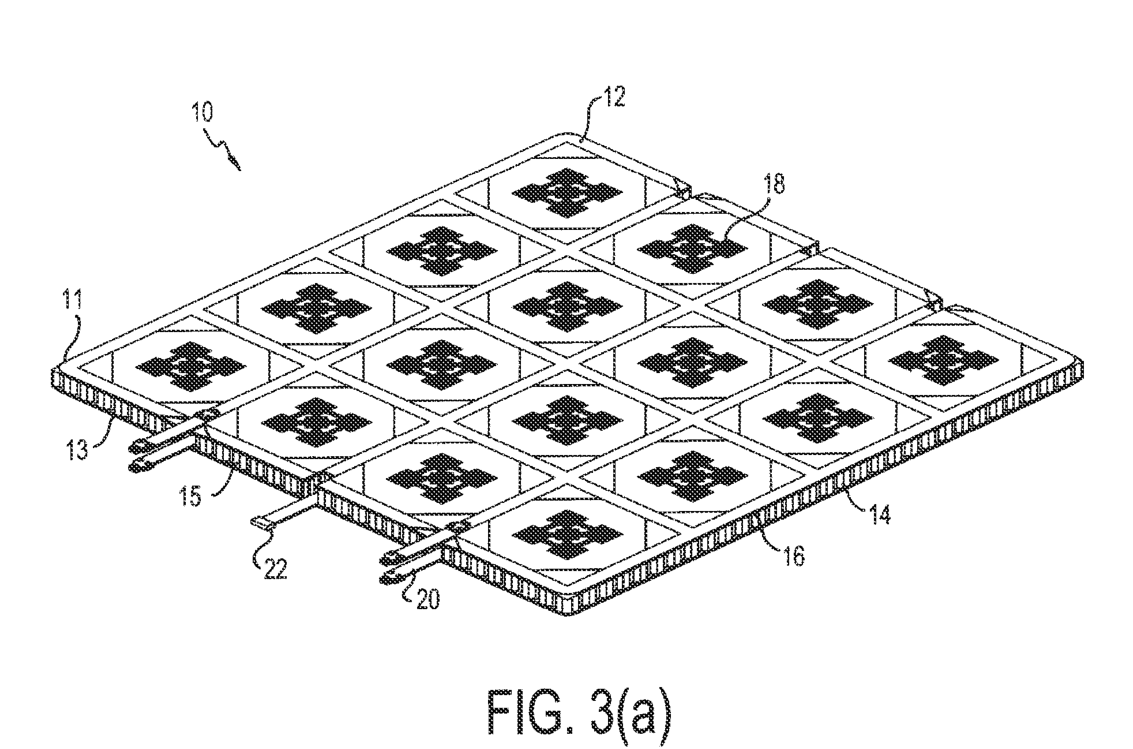
Original tile drawing with antenna elements and connectors at its edges.
Connectors, layers and the radiating face share a small space. Fig.3(a), original drawings, PDF p.3. Application 18/409,510 Inspect original PDF

A phased array combines signals from many elements, with controlled relative phase so they reinforce in a chosen direction. At the same wavelength, a larger effective aperture can provide more gain and a narrower beam. For the same received power density, a larger effective receiving area collects more signal. That gives AST’s larger surface a concrete potential benefit: more margin for hearing the weak phone and more spatial selectivity.17

The physical outline alone does not give us the effective aperture, receiver noise, operating band or beam pattern. A tenfold area ratio therefore cannot be carried over as a tenfold speed result. SpaceX’s disclosed response to the weak-phone problem combines its smaller array with custom radio silicon, sensitive receivers and high-powered transmitters.1317

The size comparison must also keep moving with the hardware. AST describes nearly 2,400 sq ft arrays for its next generation; SpaceX now describes a proposed Starlink Mobile V2 with thousands of spatial beams and much higher throughput. The January 2024 dimensions are a dated reference point, not a specification for that newer Starlink generation.718

What does AST pay for the larger surface?

A much larger surface has to fit inside a launcher, unfold and preserve the relationships between its radiating elements. AST’s deployment patent shows antenna assemblies packed into a stack, with connectors releasing stored energy to open them. Its oscillation patent follows the next problem: a light, extended structure can flex, changing the signal path between its elements and the phone.21
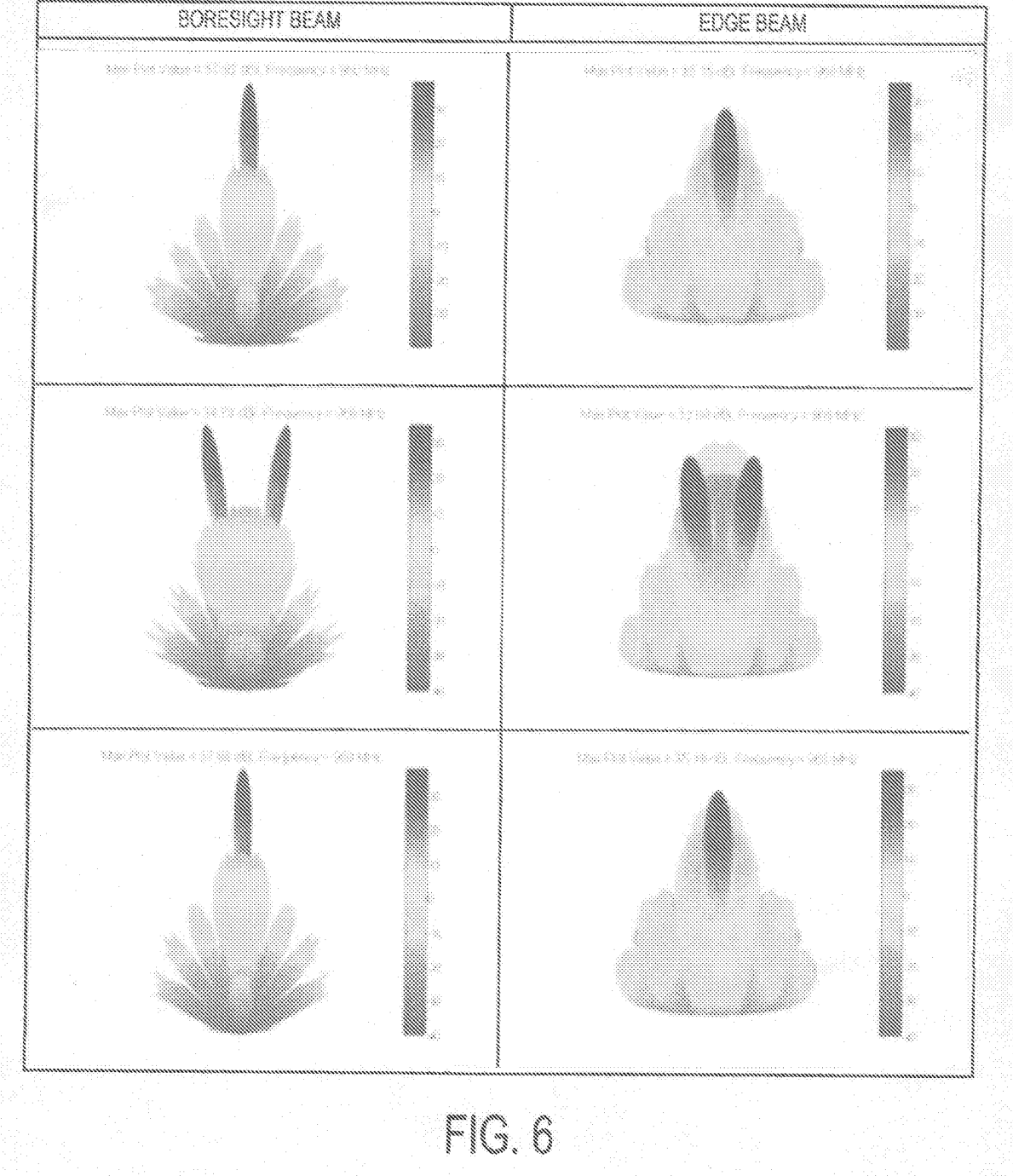
Six original radiation-pattern plots comparing nominal, deformed and compensated boresight and edge beams.
Read down the rows: nominal array, bent array, and compensated array. Fig.6, original replacement drawings, PDF p.6. The specification describes expected radiation patterns. Application 17/175,428 Inspect original PDF

This is where the aperture advantage becomes a control problem. AST’s illustrated radiation patterns compare the intended surface, the deformed surface and a compensated case. The issued claim requires a sequence: apply mechanical force, measure the displacement left over, then correct phase. The marked amendment matters because it makes physical correction part of the claimed answer; the electronics are not asked to compensate for an arbitrarily distorted array.156

SpaceX’s smaller early array was designed around the V2mini platform. AST’s selected patents expose the extra deployment and shape-control work involved in its large modular aperture. That is the supported contrast. We have no equivalent Starlink structural-compensation record in this comparison, so we cannot conclude that its array is perfectly rigid or needs no calibration.1321

The operational question is how much useful gain and beam shape each array retains while it scans and flexes. AST’s record makes that constraint unusually visible.1

Same radio job, different location

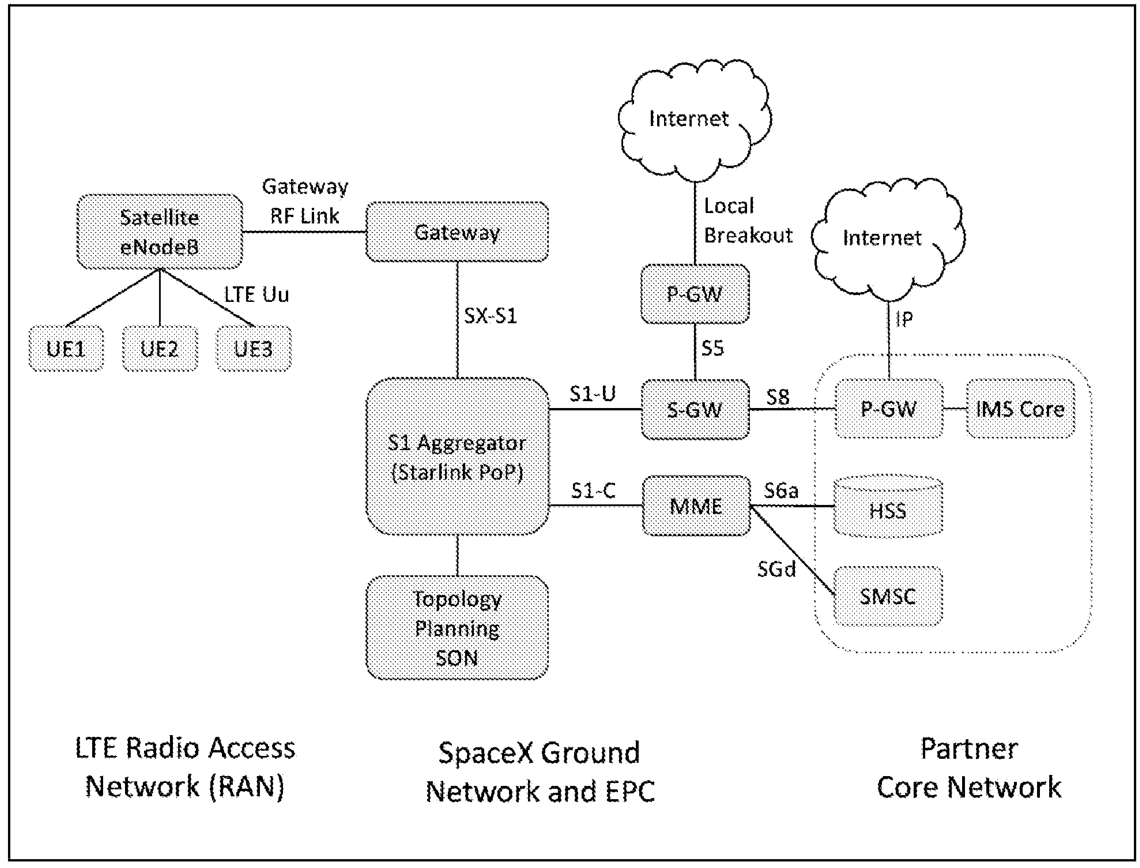
Follow the phone’s signal past the antenna. In the AST gateway drawing, baseband units on the ground process the cell signals, with satellite links relaying them between gateway and handset. In Starlink’s early network drawing, the LTE base station—the eNodeB—is aboard the satellite, and onward traffic travels through the Starlink network to the carrier. Both deliver cellular service; the base-station processing sits on opposite sides of the feeder link.341411
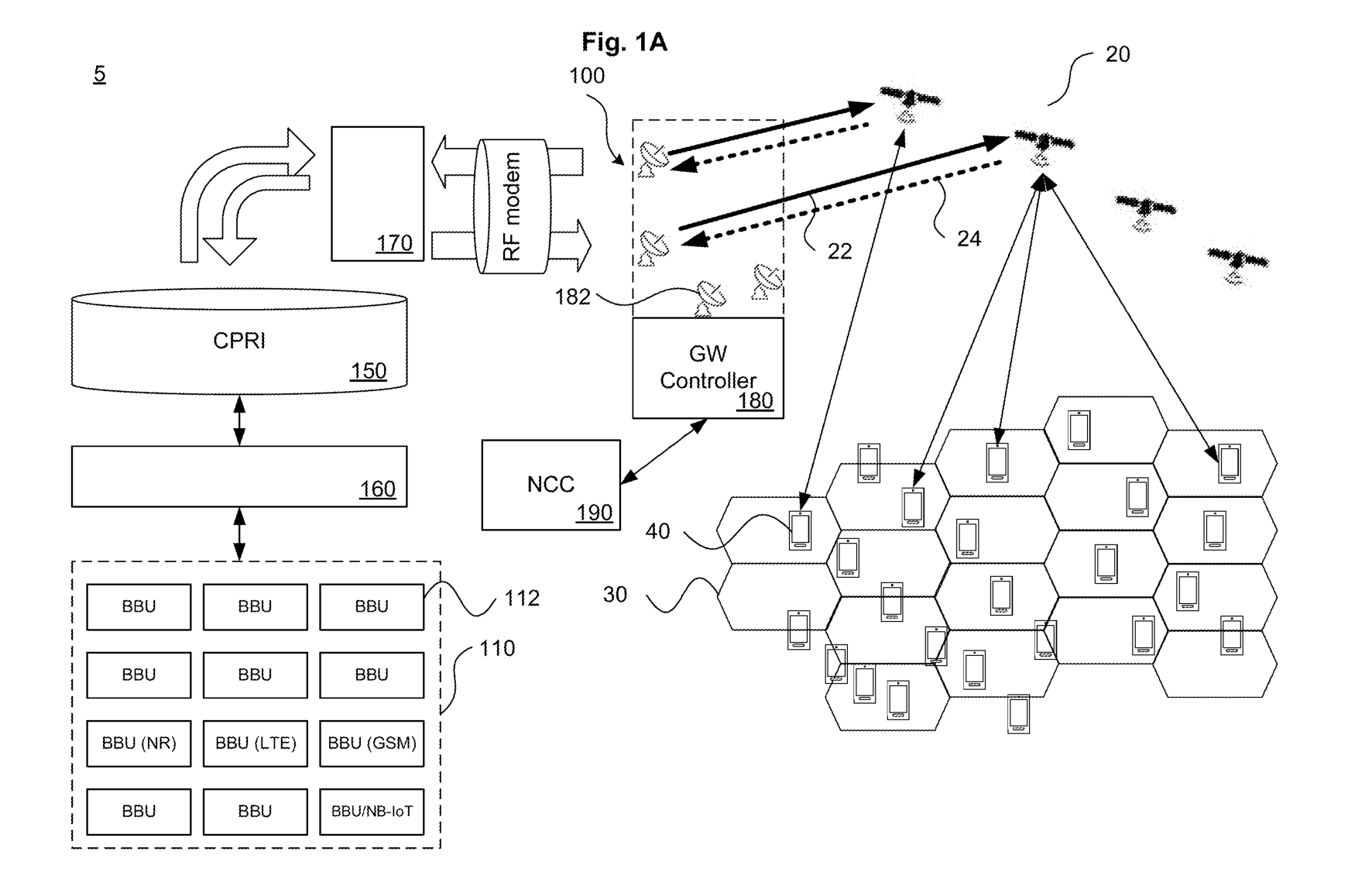
Original CPRI network drawing, upright, with gateway baseband units, satellite links and ordinary phones.
The bank of baseband units is at lower left; the phones and ground cells are at right. Fig.1A, original drawings, PDF p.1, rotated clockwise. Application 18/196,556 Inspect original PDF
Original 2022 network diagram: satellite eNodeB, SpaceX ground network and partner core network.
The base station is already in orbit on this early drawing. Fig.3 from the provisional specification, PDF p.10; cropped from the archived original. Application 63/412,309 Inspect original PDF

The practical difference is what must remain coordinated. AST’s disclosed gateway exchanges radio-signal data and control information associated with particular cells and satellite paths. Its shared buffers keep those associations together as the route changes. Starlink’s depicted satellite performs the cellular base-station work before carrying the traffic onward. Ground-based coordination is central to the AST drawing; working base-station hardware in orbit is central to the Starlink drawing.31411

That suggests different maintenance and transport tradeoffs. Ground baseband equipment can be physically serviced on Earth, but the radio path to it includes the moving spacecraft and feeder link. Putting the base station in orbit puts more of that processing at the receiving satellite, but also puts that hardware beyond routine hands-on repair. These are consequences of the depicted placement, not measured cost or reliability results.311

AST’s specification also permits some operations at a control satellite. The distinction is the location of the baseband units in these particular architectures; neither network puts every operation in just one place.3

Two phones in one beam still need different corrections

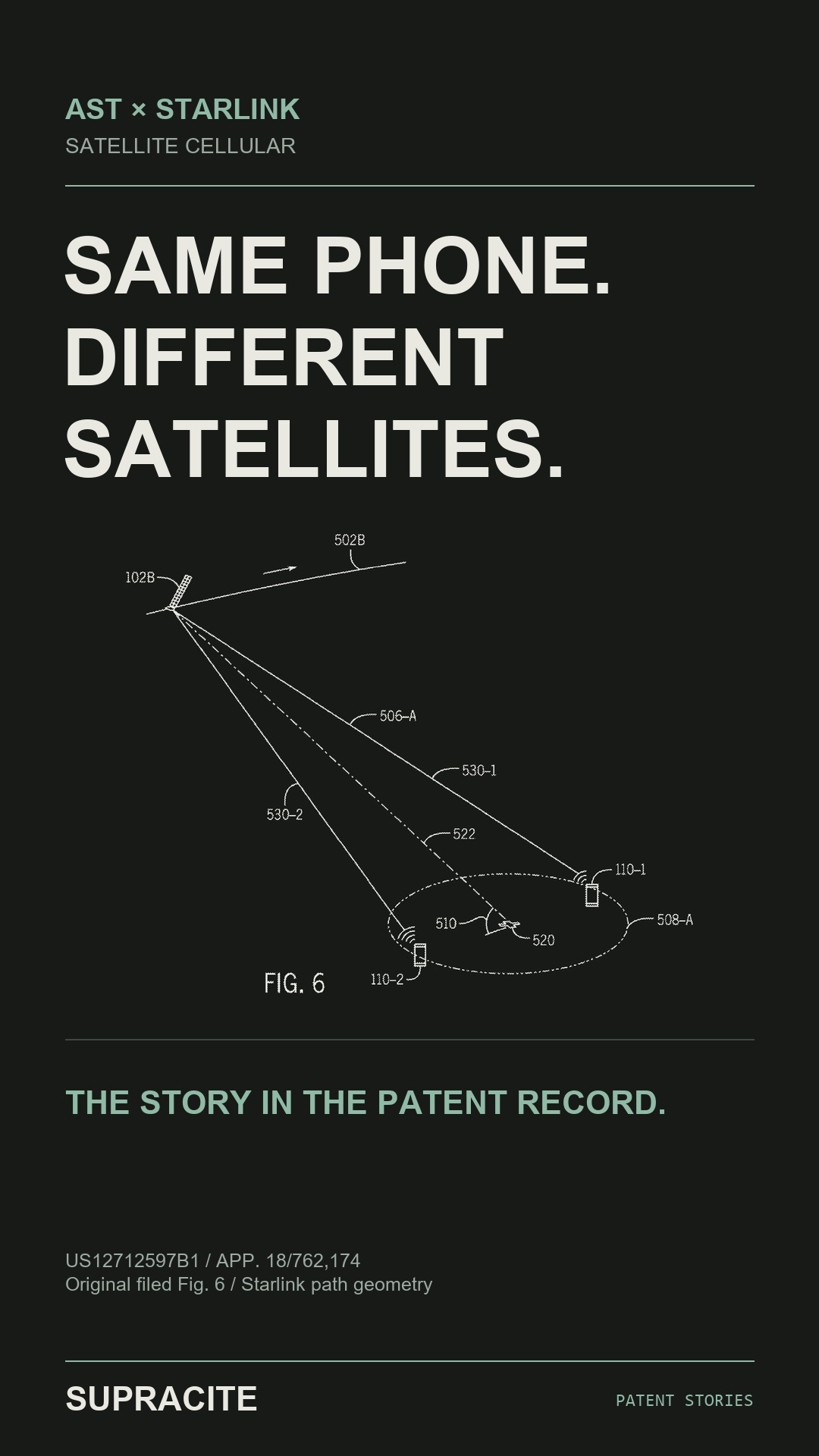
A satellite can correct its signal for the center of a ground cell. The trouble is that your phone may be near the edge. Its path to the moving spacecraft differs from the reference path, leaving an error after that shared correction. Both AST and Starlink address this same geometry.49
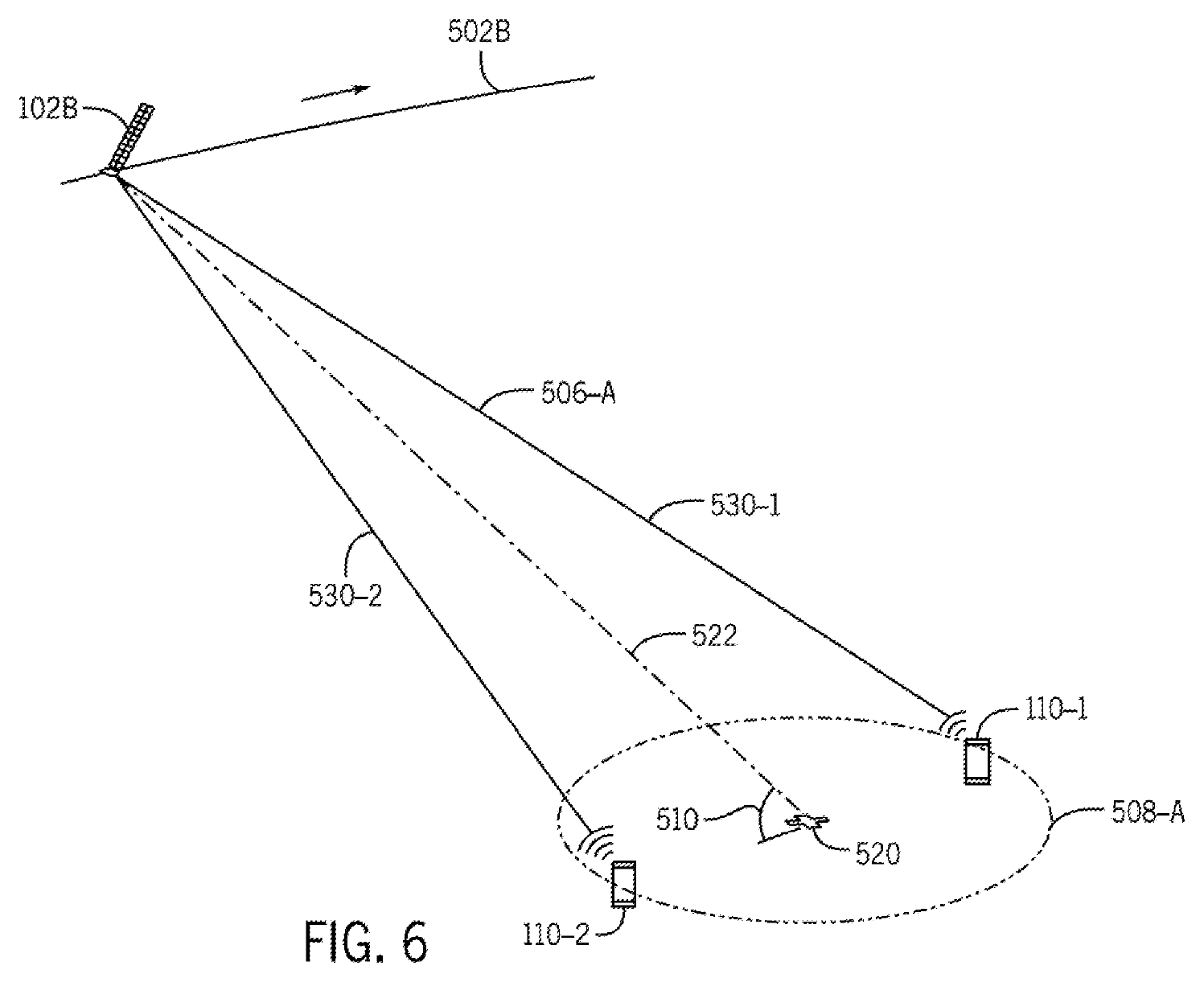
Original Fig.6 showing a moving satellite, two phones and a central cell reference location with different slant paths.
The dashed path ends at the reference location; the solid paths end at different phones. One reference correction leaves different residuals. Fig.6, original drawings, PDF p.7; rotated clockwise. Application 18/762,174 Inspect original PDF

AST’s handover disclosure has the gateway normalize delay and Doppler to the cell center. It places the center phone near the midpoint of the timing-advance range and describes keeping the edge phone’s remaining timing and frequency error within the range its radio can handle. Starlink’s Doppler patent also begins with a cell reference location, but then explicitly estimates coarse and fine portions of the remaining Doppler shift for an individual phone and removes them at the satellite receiver.49

The useful contrast is what happens after the common reference correction. AST’s cited passage describes engineering the cell and compensation so the residual stays tolerable. Starlink’s cited claim specifies an additional per-phone residual estimator. This is more precise than saying one system “solves Doppler” and the other does not. The AST passage is not a complete inventory of every receiver correction it may use.49

The first request to join the network exposes a related difference in the records. AST describes adapting the base-station procedure to the longer path, including access-response timing. Starlink’s access patent goes inside the detector: it uses a coarse arrival-time estimate to choose among candidate timing/frequency pairs from the phone’s preamble. Procedure adaptation and signal detection are two layers of the same access problem; neither description proves that the other network lacks that layer.48

How do you change satellites without moving the subscriber?

A stationary subscriber creates two different jobs for a moving constellation: keep an active call on a usable radio path, and retain a sensible address for finding the phone later. Both records try to preserve continuity on the ground while changing the machinery overhead.410
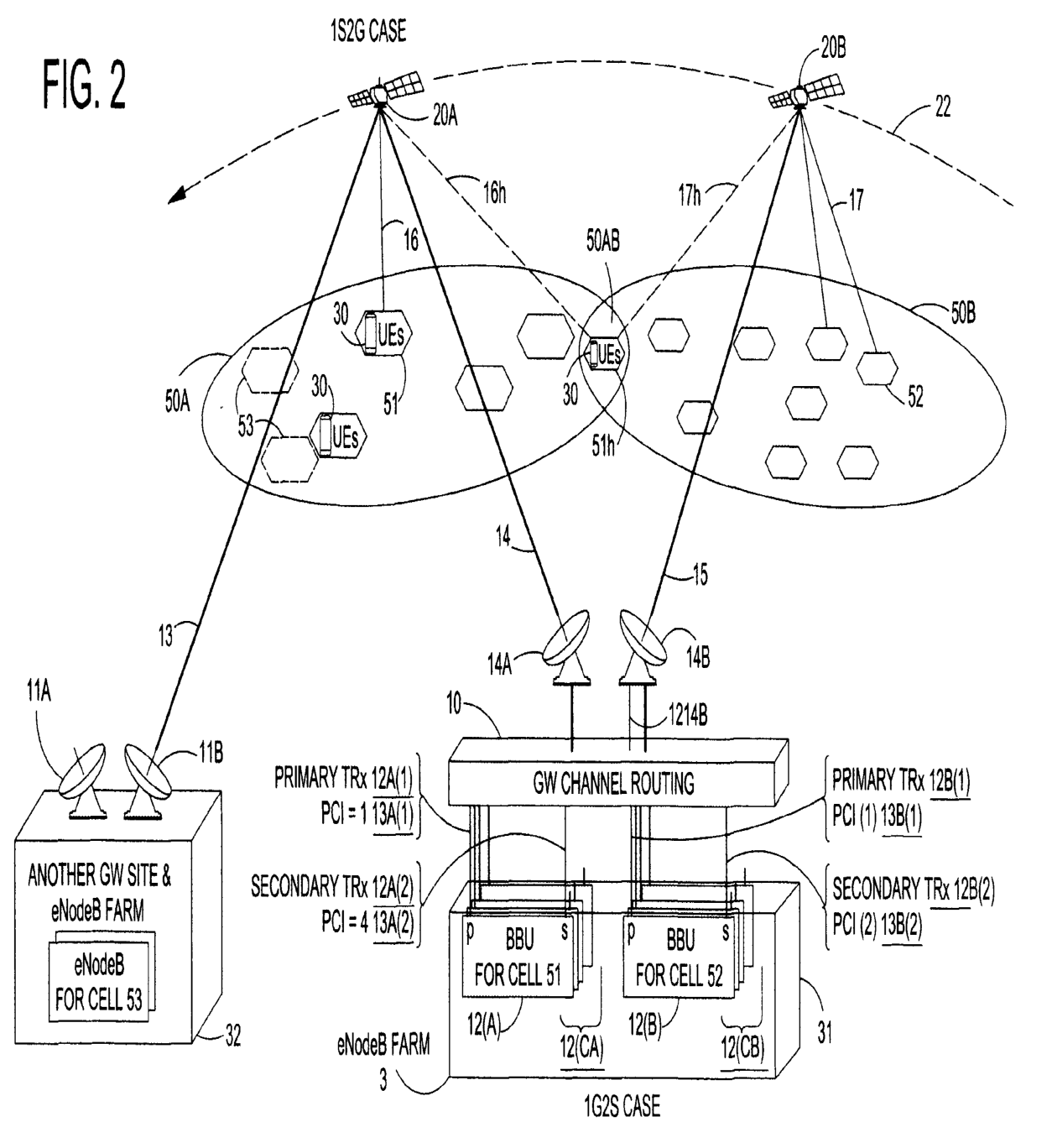
Setting and rising satellites with overlapping beams and two gateway radio paths.
Two satellite paths meet over the handover cell. Fig.2, original replacement drawings, PDF p.2. Application 17/583,992 Inspect original PDF
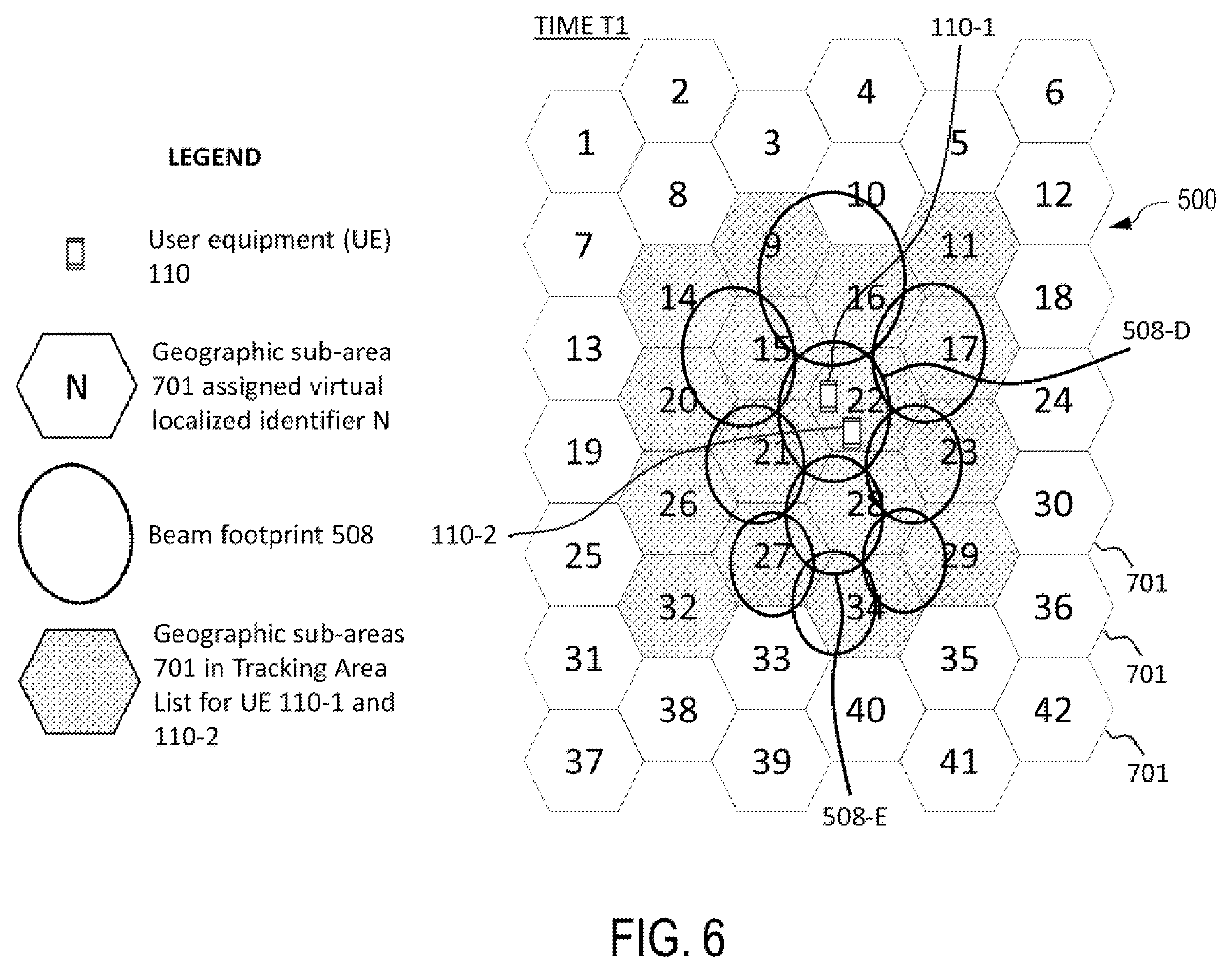
Original Fig.6 distinguishes hexagonal geographic sub-areas and virtual identifiers from elliptical satellite beam footprints.
The hexagons provide the geographic reference. The ellipses show the radio coverage at one time. Fig.6, original mapping drawings, PDF p.7; rotated clockwise. Application 18/375,319 Inspect original PDF

AST’s handover example gives the overlapping cell two satellite paths with different physical cell identities. The gateway arranges the transfer from the setting satellite to the rising one, while the core retains the tracking-area or location-area code. The radio identity changes, but the subscriber does not have to acquire a new geographic identity merely because the satellite changed.415

Starlink’s mapping patent makes that separation explicit through a different mechanism: a beam identifier plus a time maps to a ground-area identifier. Its tracking-area notes explain how a stationary phone can avoid repeated location updates as the beams pass. AST’s example preserves the tracking code across a coordinated radio-path transfer; Starlink’s mapping supplies a time-dependent translation between moving beams and ground locations.1012194

That comparison also marks a boundary. AST’s described two-path procedure tells us how active users are transferred. Starlink’s geographic map tells us how location identifiers are maintained; it is not, by itself, the complete active-call handover procedure. The common test is whether a stationary user can keep a call and remain reachable without unnecessary signaling as satellites pass.410

Does the bigger antenna mean the faster service?

More effective aperture can improve the link under matched conditions. Service capacity also depends on spectrum, power, interference, receiver performance, active beams and the users sharing them.1749

AST’s next-generation page describes a nearly 2,400 sq ft array, an AST5000 processor and a target above 150 Mbps per coverage cell. SpaceX’s newer Mobile V2 page describes thousands of beams and around twenty times the throughput capability of its first generation. These are company targets with different denominators. Neither statement is a matched measurement of an individual subscriber’s rate.718

For a revealing comparison, put the same handset under comparable spectrum, elevation and load, then measure both its uplink and downlink. Repeat while it moves toward a beam edge and while the serving satellite changes. That would test the antenna margin, the correction strategy and the handover together. Peak rate alone would miss the very places where the two architectures differ.49

The current evidence supports a comparison of those engineering choices. A performance winner still requires the same task under the same conditions.

The tradeoff follows the signal

The clearest physical distinction is aperture: AST’s first BlueBirds expose far more antenna area than the early Direct-to-Cell array described by SpaceX. The clearest network distinction in the selected drawings is baseband placement: AST coordinates it from the gateway, while Starlink carries the base station in orbit. One comparison concerns collecting the signal; the other concerns where that signal becomes cellular traffic.1613311

Those choices lead to different questions. Can AST preserve useful gain and beam shape across its large, flexible surface while coordinating the changing feeder paths? Can Starlink’s receiver and orbital base station make its disclosed aperture useful at the difficult edges of coverage and through transfers? Both must still handle shape, timing, frequency, interference and continuity; the records give us different levels of detail for each.14910

That is the comparison worth following as both generations advance: how effectively each turns its antenna, processing and moving radio paths into a dependable connection for the same ordinary phone.

Evidence notes, claim details and open questions

Record scope and comparison limits

This revision reorganizes the existing patent analysis around matched engineering problems and adds dated antenna dimensions and newer company-generation descriptions. The 64.4 m² figure is 693 sq ft × 0.09290304; the early Starlink footprint is 2.7 m × 2.3 m = 6.21 m². Their ratio is approximately 10.4. These calculations compare stated physical area, not effective RF aperture, gain, throughput or complete spacecraft size.1613

The patent evidence remains the four AST grants and three Starlink grants in the companion investigations, with the cited original drawings and selected prosecution records. Patent embodiments are kept distinct from flight-hardware disclosures. The Starlink Mobile V2 projection is separate from the earlier V2mini payload; a shared version number should not merge the two generations.71813

The September 14 acquisition recheck confirms 216 of 216 Starlink files held and 1462 of 1,464 AST files held, with no pending, processing or failed OCR in either set. Two large AST search-notes records remain uncollected. The comparison relies on its specific cited records; available OCR across the larger families does not mean every file has been read.

Native diagrams are available for all four selected AST families and Starlink’s mapping family. Two undated AST PCT records remain omitted from the drawings. The access and Doppler family panels preserve the previously identified provisional-link conflicts. This revision leaves those original exports and coverage notes intact.

Sources and original records

  1. US12040553B1 — Compensating oscillations in a large-aperture phased array antenna

    Application 17/175,428 · Publication US12040553B1

    Issued claims 1 and 21; specification on mechanical correction followed by residual phase correction; Figs.3–9. PDF pp.18–19 claims; Fig.6 p.8.

    Original record. Issued claims, specification examples, applicant arguments and examiner conclusions are distinguished in the text.

    Retrieved 2026-09-14

    Elsewhere in this application

    These links establish participation in another cited document from this application.

    Original-file fingerprint8a59b14672246ccdcc4a67172ee6d9e911dca2c20a9cb403648268973d4d78af
  2. US12280894B2 — Low Earth orbit mechanical deployable structure

    Application 18/409,510 · Publication US12280894B2

    Issued claims 1 and 10, PDF pp.12–13; Figs.2 and 3, and associated specification. Independent claims separately address connectors on different layers and gap-free edge contact.

    Original record. Issued claims, specification examples, applicant arguments and examiner conclusions are distinguished in the text.

    Retrieved 2026-09-14

    Elsewhere in this application

    These links establish participation in another cited document from this application.

    Original-file fingerprinte3af1e2ebd32e8882ca8fcc57c18291474c0dbc2dcfa50df90f0467c4f7bd88a
  3. US12368504B2 — CPRI satellite communication system and method

    Application 18/196,556 · Publication US12368504B2

    Claims 1 and 8, PDF p.10; Figs.1A–2, PDF pp.2–4. Specification explains cell-associated buffers, gateway baseband units and alternative implementation locations.

    Original record. Issued claims, specification examples, applicant arguments and examiner conclusions are distinguished in the text.

    Retrieved 2026-09-14

    Elsewhere in this application

    These links establish participation in another cited document from this application.

    Original-file fingerprinta00fa63a3daf4505fec4313fdff2e68968e3a2c272c0bfd5cc96200be79dc92e
  4. US12401395B2 — Satellite radio access network beam and gateway seamless handover

    Application 17/583,992 · Publication US12401395B2

    Claims 1 and 17–19, PDF pp.21–22; Fig.2 p.4. Specification discusses two RF ports/PCIs, active versus idle cells, delay normalization and make-before-break handover. Comparison passages: specification discussion of Fig.2 and beam handover (two PCIs with retained TAC/LAC); Fig.3 delay/Doppler normalization to the cell center; base-station adjustments for PRACH and round-trip delay.

    Original record. Issued claims, specification examples, applicant arguments and examiner conclusions are distinguished in the text.

    Retrieved 2026-09-14

    Elsewhere in this application

    These links establish participation in another cited document from this application.

    Original-file fingerprintc40a3117ad060ebd2cbc8f75cd5a325f0b4a1c98de03ea6d6f19b0649d571021
  5. Oscillation — August 2021 claim amendment

    Application 17/175,428

    PDF p.1: system claim 1 adds mechanical correction and residual displacement; p.5: method claim 21 clarified. Markup checked against the original page.

    Original record. Issued claims, specification examples, applicant arguments and examiner conclusions are distinguished in the text.

    Retrieved 2026-09-14

    Elsewhere in this application

    These links establish participation in another cited document from this application.

    Original-file fingerprint1e9e1da445dccfa8652370d7b3be5e40031fe21375d77849bfa0c4d0eb8f0a03
  6. Oscillation — August 2021 applicant response

    Application 17/175,428

    PDF pp.1–2: system claim aligned with allowed method claim; residual correction explained. Signature p.3: Peter S. Weissman, registration 40,220, Blank Rome LLP.

    Original record. Issued claims, specification examples, applicant arguments and examiner conclusions are distinguished in the text.

    Retrieved 2026-09-14

    People in this record

    Original-file fingerprint1b4a5132d83aba30898edac96ae9c97d679b6a6d16632d5ae6ba807de8214dd0
  7. AST — next-generation BlueBird

    Company page checked September 14, 2026: next-generation array nearly 2,400 square feet versus 693 for first-generation BlueBird; AST5000 and peak per-cell targets.

    Company descriptions and targets; not independent performance measurements.

    Retrieved 2026-09-14

  8. US12695500B1 — Systems and methods for detecting cellular service access requests from terrestrial user equipment at a satellite

    Application 18/627,815 · Publication US12695500B1

    Issued claim 1, PDF pp.44–45 (cols.50–51); specification discussion of Fig.10 and candidate time/frequency pairs. Front page: application 18/627,815, filed April 5, 2024; provisional 63/461,830, April 25, 2023.

    Original USPTO publication archived; issued or published claim text distinguished from specification examples and from implementation in the commercial service.

    Retrieved 2026-09-14

    Elsewhere in this application

    These links establish participation in another cited document from this application.

    Original-file fingerprint77348465e1ce7cef0d18d7654c9b1aa97a4da1d3f5a06b090157b958edde3039
  9. US12712597B1 — Systems and methods for managing doppler shift in cellular service signals from terrestrial user equipment at a satellite

    Application 18/762,174 · Publication US12712597B1

    Issued claim 1, PDF p.37 (col.40); dependent claims 2–6, PDF p.38. Specification accompanying Figs.6 and 8–10 explains residual Doppler, reference signals and coarse/fine estimates. Front page: application 18/762,174 and provisional 63/531,470.

    Original USPTO publication archived; issued or published claim text distinguished from specification examples and from implementation in the commercial service.

    Retrieved 2026-09-14

    Elsewhere in this application

    These links establish participation in another cited document from this application.

    Original-file fingerprintdd3b4128a96b9ffa14a34a34748e5a9e59722baebfa0c70e97d1151b859a4235
  10. US12542605B1 — SYSTEMS AND METHODS FOR MAPPING GEOGRAPHIC SUB-AREAS TO SATELLITE-BASED BASE STATION PLATFORMS IN A CELLULAR NETWORK

    Application 18/375,319 · Publication US12542605B1

    Issued claim 1, PDF p.33 (cols.39–40); independent claim 37, PDF pp.35–36. Figs.6 and 9A–9B and accompanying description explain geographic sub-areas, tracking lists, paging and moving beams. Front-page continuity data.

    Original USPTO publication archived; issued or published claim text distinguished from specification examples and from implementation in the commercial service.

    Retrieved 2026-09-14

    Elsewhere in this application

    These links establish participation in another cited document from this application.

    Original-file fingerprint8328c48cc33a8f3ab2f994a7e22db964e7dba2159f103a2a6c0496dc2ed5fff5
  11. SpaceX early Direct to Cell system memo — provisional specification

    Application 63/412,309

    Application 63/412,309, specification, PDF pp.7–10 (onboard eNodeB, Doppler, timing, architecture); pp.13–15 (spectrum and capacity). Filed September 30, 2022. Historical proposal, not current service specifications.

    Original file-history record, with dates and proposal/issued-claim distinctions retained.

    Retrieved 2026-09-14

    Original-file fingerprintb7578362c6c1eaab09ed3f7d2bc07e1362a62313d9cd6c736eda8d9dd270afb8
  12. TAC Planning — provisional working notes

    Application 63/520,882

    Application 63/520,882, specification, PDF pp.1–5: stationary-phone objective, tracking-list limit, paging tradeoff, stationary and moving examples.

    Original file-history record, with dates and proposal/issued-claim distinctions retained.

    Retrieved 2026-09-14

    Original-file fingerprint79fe21f8a804a53064eca3113e2ecd3e0cca1e7888eda89150a272cbc7f4caf1
  13. SpaceX — First Direct-to-Cell text messages, January 2024

    January 2024 update, PDF p.2: 2.7 m × 2.3 m phased arrays on V2mini, custom silicon, sensitive receivers, high-powered transmitters and onboard LTE modem; p.3: laser backhaul.

    Dated company technical description. Antenna dimensions refer to the early V2mini Direct-to-Cell payload; roadmap dates are not treated as evidence of later delivery.

    Retrieved 2026-09-14

  14. CPRI — original gateway drawings

    Application 18/196,556

    Fig.1A, PDF p.1, rotated 90° clockwise for reading.

    Original record. Issued claims, specification examples, applicant arguments and examiner conclusions are distinguished in the text.

    Retrieved 2026-09-14

    Elsewhere in this application

    These links establish participation in another cited document from this application.

    Original-file fingerprint3c963371d8ee447a8e042797906842e7e3fe90a4665e6cc090b89783c68e5356
  15. Handover — original replacement drawings

    Application 17/583,992

    Fig.2, PDF p.2; two satellite paths and gateway baseband units. Original replacement sheet is already upright.

    Original record. Issued claims, specification examples, applicant arguments and examiner conclusions are distinguished in the text.

    Retrieved 2026-09-14

    Elsewhere in this application

    These links establish participation in another cited document from this application.

    Original-file fingerprint71c75a87587dd33746514ee0e6b3f235d35c974030f4506d8212b9b96513fb49
  16. AST SpaceMobile — BlueBird 1–5: deployed antenna area

    Unfolding in Orbit and BlueBird 1–5 at a Glance: 693 sq ft phased array; September 12, 2024 launch.

    Company-reported first-generation physical array area. Used with the dated SpaceX dimensions for a geometric comparison, not a measured RF or throughput ratio.

    Retrieved 2026-09-14

  17. Analog Devices — phased-array aperture, gain and beamwidth

    Beamwidth; antenna gain, directivity and aperture; coherent combining and steering.

    General antenna principles explain the conditional consequences of aperture size. This source does not characterize either company’s flight hardware.

    Retrieved 2026-09-14

  18. SpaceX — Starlink Mobile and its proposed V2 generation

    Future of Starlink Mobile; Engineered by SpaceX. V2: thousands of spatial beams, around 20× first-generation throughput capability, planned Starship deployment.

    Company projections for a newer generation, distinct from the January 2024 V2mini payload dimensions and from measured service performance.

    Retrieved 2026-09-14

  19. Geographic-mapping original drawings — Fig.6

    Application 18/375,319

    Application 18/375,319; drawings filed September 29, 2023; Fig.6, PDF p.7.

    Ground sub-areas, beam footprints and tracking-area lists. Rotated 90° clockwise; margins/header cropped.

    Retrieved 2026-09-14

    Original-file fingerprint2367ccf712f642954ecf8a8656f689cf3b09c8e45aedccca95f448f2b3573541