A very ordinary message
You leave the last patch of cell coverage with a message still waiting to send: “Running late. Everything’s fine.” The phone in your hand has no dish to unfold. The receiver it needs may now be hundreds of kilometers away, moving across the sky at roughly 7.7 kilometers per second—the speed SpaceX described for its early Direct-to-Cell satellites.16
That is the appealing part of this story: an ordinary message can require an extraordinary amount of machinery. SpaceX reported its first texts between unmodified phones and these satellites on January 8, 2024. Three recently issued patents let us look inside the less visible work: recognizing a phone’s request, correcting its drifting radio signal, and remembering where to look when the next message arrives.16123
The phone stays familiar. Much of the adaptation moves into the satellite and the network behind it. The records describe a coherent engineering approach; they do not establish that every claimed step is running in today’s commercial service.123
The tower went into orbit
Figure 1A lays out the route: phones talk to a satellite, which connects onward through the satellite and ground network to the carrier’s core. In its January 2024 account, SpaceX described an onboard LTE modem, laser backhaul and phased-array antennas measuring 2.7 by 2.3 meters on the early V2mini Direct-to-Cell payload. It contrasted that receiving hardware with a phone transmitting at just 0.2 watts. Those are dated hardware details, not dimensions asserted for every later generation.165
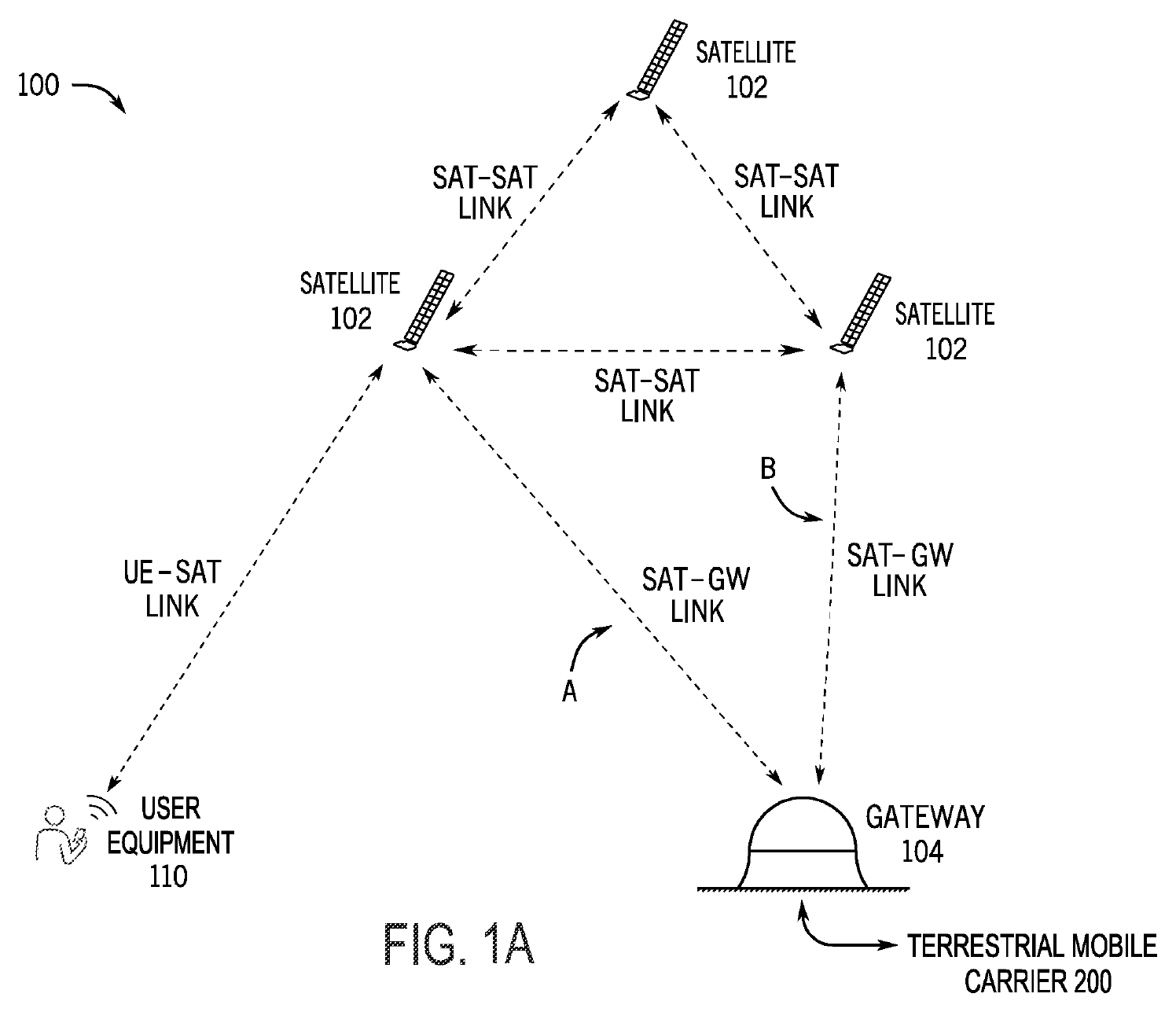
A bigger antenna helps with a weak signal. It does not, on its own, make that signal arrive at the expected time or frequency. The patents take up those mismatches inside the cellular protocol: the satellite has to make sense of a phone behaving like a phone.12
First, hear the knock
Before sending useful data, a phone requests room to transmit. US12695500B1 examines this first knock on the door: a short access preamble sent in a designated random-access interval. Orbital motion makes both its arrival time and its frequency uncertain. The detector diagram splits the task among a coarse estimator, a sequence-root detector and a selector.16
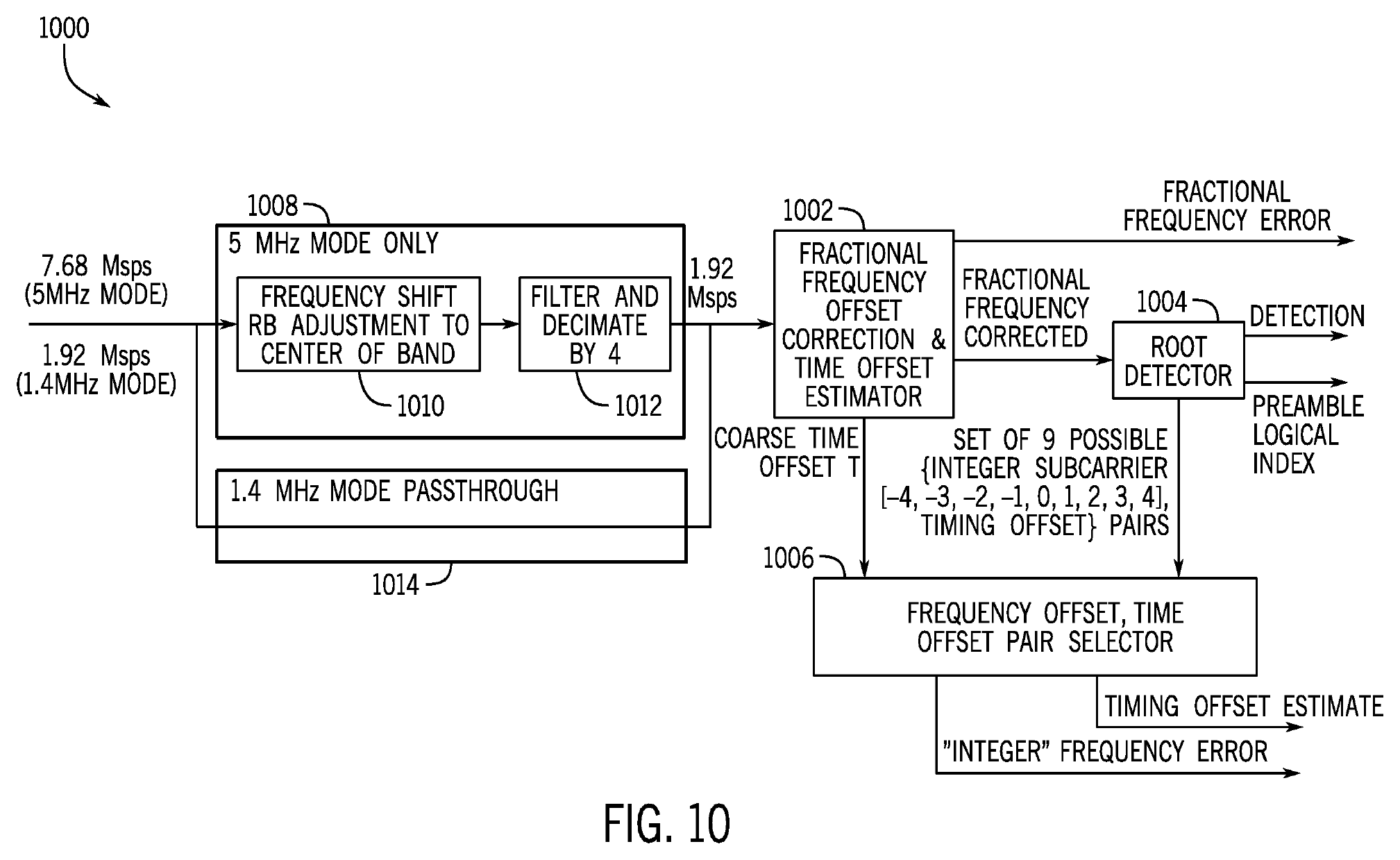
The preamble uses a mathematical sequence called a Zadoff–Chu sequence. Identifying its root lets the receiver generate candidate pairs of timing and frequency offsets. The awkward part is that more than one pair can explain what it has received. A separate, rough timing estimate helps choose the right one.1
This is the clever detail: the coarse estimate need not be accurate enough to solve the access problem by itself. It only has to distinguish the candidate pairs. Two incomplete measurements become useful together. The satellite can then send the phone a properly formatted access response; the specification describes supplying timing advance and uplink resources.1
What the access patent actually claims
Issued claim 1 ties those operations together: sample the incoming random-access signal, detect a coarse time offset, identify the sequence root, generate potential frequency/time pairs, select a pair using the coarse estimate, and return an access response. It also specifies the satellite, beam-defined cells and access-signal format in which those steps occur.1
The March 2026 allowance focuses on this processing combination, including determining offsets from the sampled access signal. The resulting July 28 grant is therefore useful evidence of a particular way to hear the knock. Reducing it to “a patent on connecting phones to satellites” would discard the machinery that makes the claim informative.141
Two phones, two different shifts
Now imagine two people under the same satellite beam. Neither is moving much, but each sees a different line of sight to the moving spacecraft. Figure 6 makes that geometry visible: phones 110-1 and 110-2 sit on different sides of reference point 520. Correcting the radio signal for that reference point leaves a different residual error at each phone.27
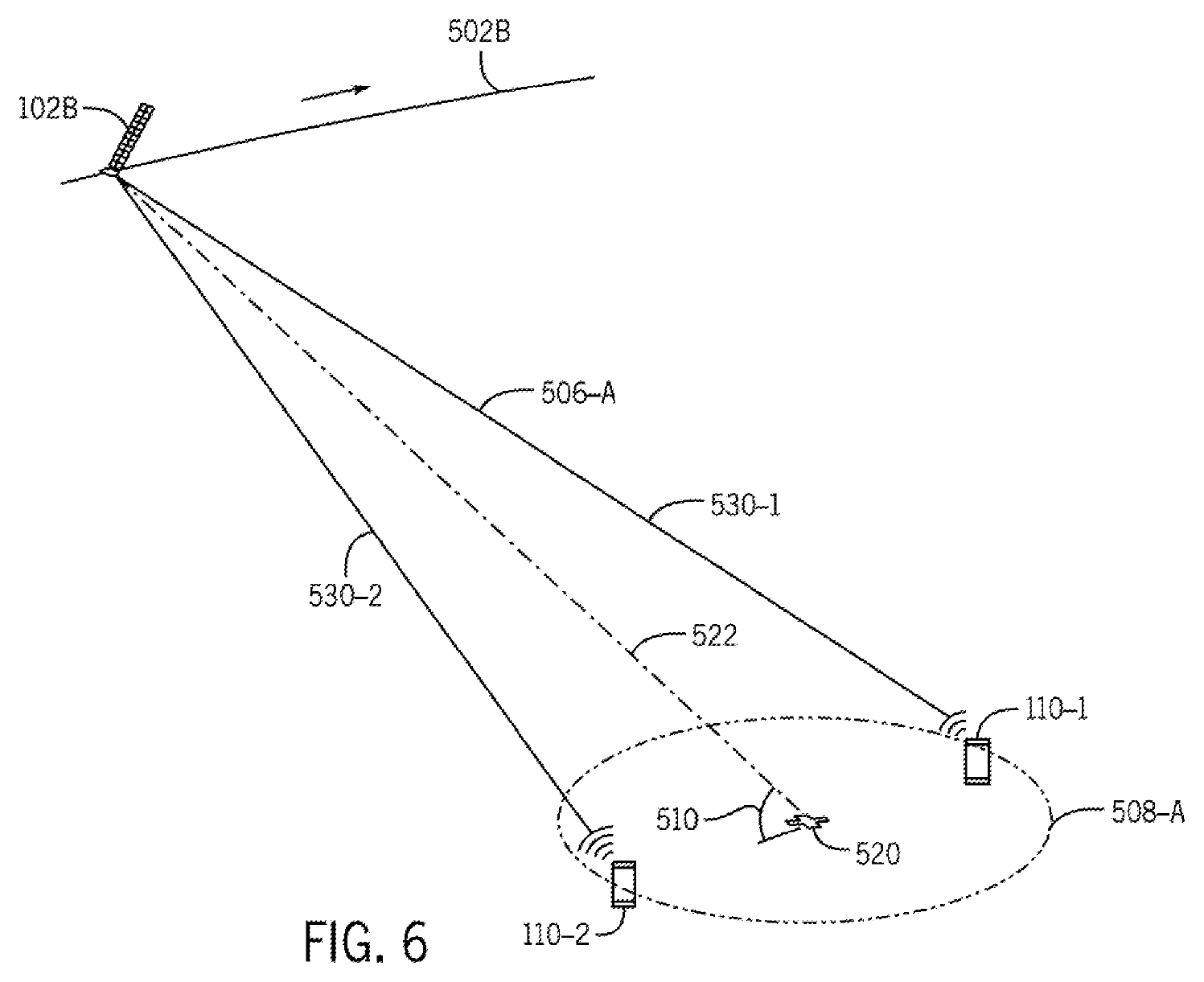
US12712597B1 starts by compensating the received beam data for the Doppler shift expected at the cell reference location, using the satellite’s trajectory. It then estimates the remaining shift associated with a particular phone in two portions, coarse and fine, and compensates for their combined effect. The reference correction handles a common baseline; the remaining work handles the phone’s difference from it.2
The specification explains why one estimator may not suffice. Comparing repeated reference signals can yield a fine estimate but also an ambiguity: a measured phase difference can wrap around. Other observations or candidate coarse offsets help resolve that ambiguity. Dependent claims describe particular tools, including reference-signal correlation, cyclic-prefix analysis and regional grouping. Those additional choices should not all be read into independent claim 1.2
The file history makes the sequence clearer
The Doppler examination turns out to be illuminating for a modest reason. In September 2025, the examiner objected that the claims did not clearly establish the compensated signal they referred to, and that “reference location” could mean the cell reference or a regional reference. SpaceX’s December response explicitly connected the received uplink signal to the reference-compensated signal and specified the cell reference location.101112
That edit helps a reader follow the invention: first compensate the beam’s received data for the chosen reference, then deal with the individual phone’s residual. The later examiner’s amendment further distinguished the first phone and first beam. This was a clarity dispute under §112(b); the cited rejection does not support a story about SpaceX retreating from someone else’s prior-art satellite system. The patent issued August 18, 2026.13210
Your address should not orbit the Earth
Receiving a message creates another problem: how does the network find you later? US12542605B1 separates the map on the ground from the radio beams passing over it. In Fig.6, the hexagons are geographic sub-areas with virtual identifiers. The ellipses are beam footprints. They are deliberately different things.38
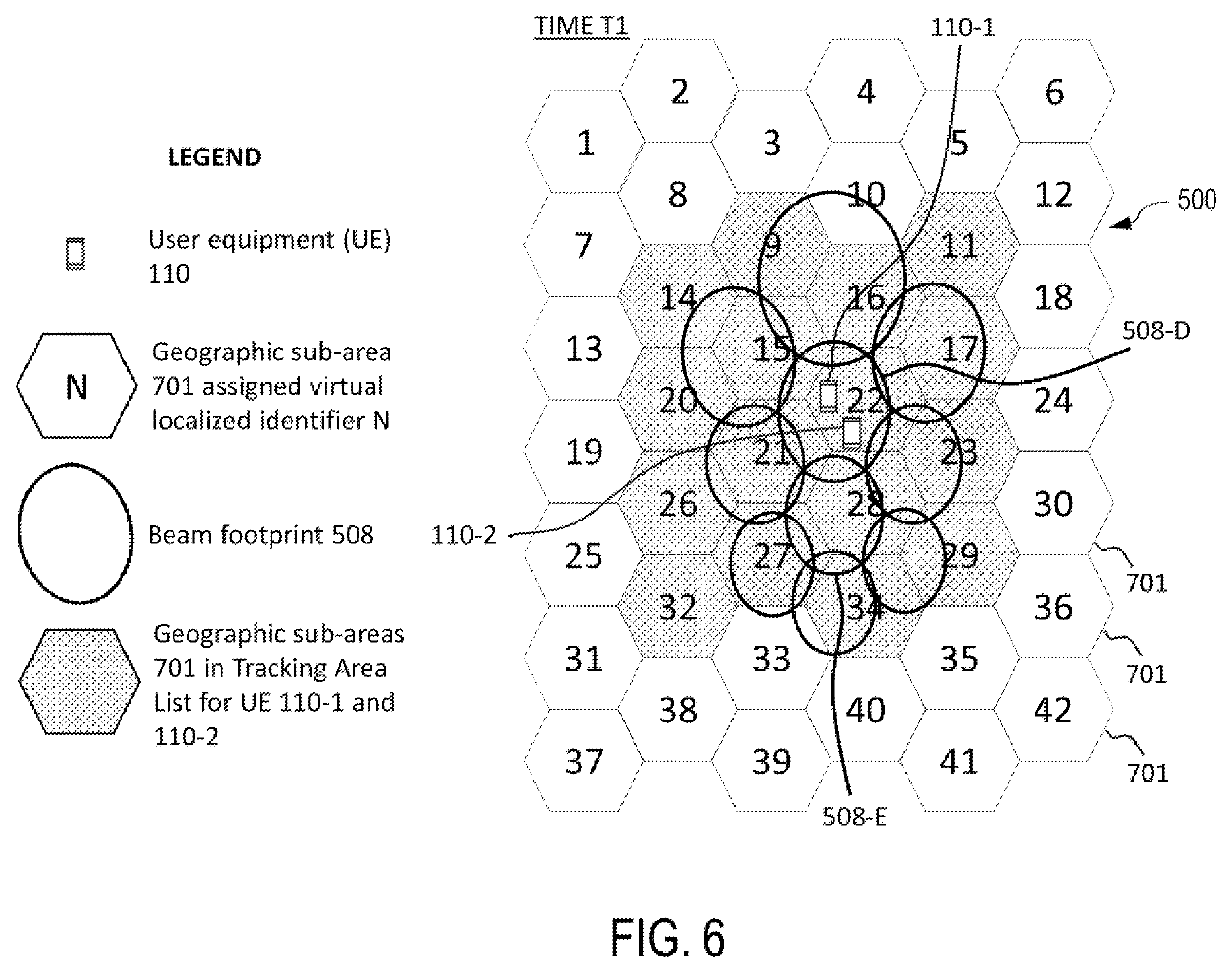
Claim 1 describes receiving connection information that includes a physical beam identifier and a connection time. A mapping covering successive time slots converts that combination into the virtual identifier for a ground sub-area. The system stores that result as location data associated with the phone. Time matters because the same moving infrastructure can serve different places later.3
This creates a stable place for the network to remember while the equipment overhead changes. When it needs to page a phone—to ask an idle device to respond—it can use the current mapping to find the beam serving the relevant ground area. A record that merely remembered yesterday’s beam would confuse a moving radio footprint with a place.3
Let the sky move without moving the subscriber
Figures 9A and 9B carry the map forward through time. One phone stays put; another moves. The disclosure uses tracking-area lists to avoid making a stationary phone report a geographic change simply because a new beam passes overhead. A phone that actually leaves its assigned set of areas can still need a location update.39
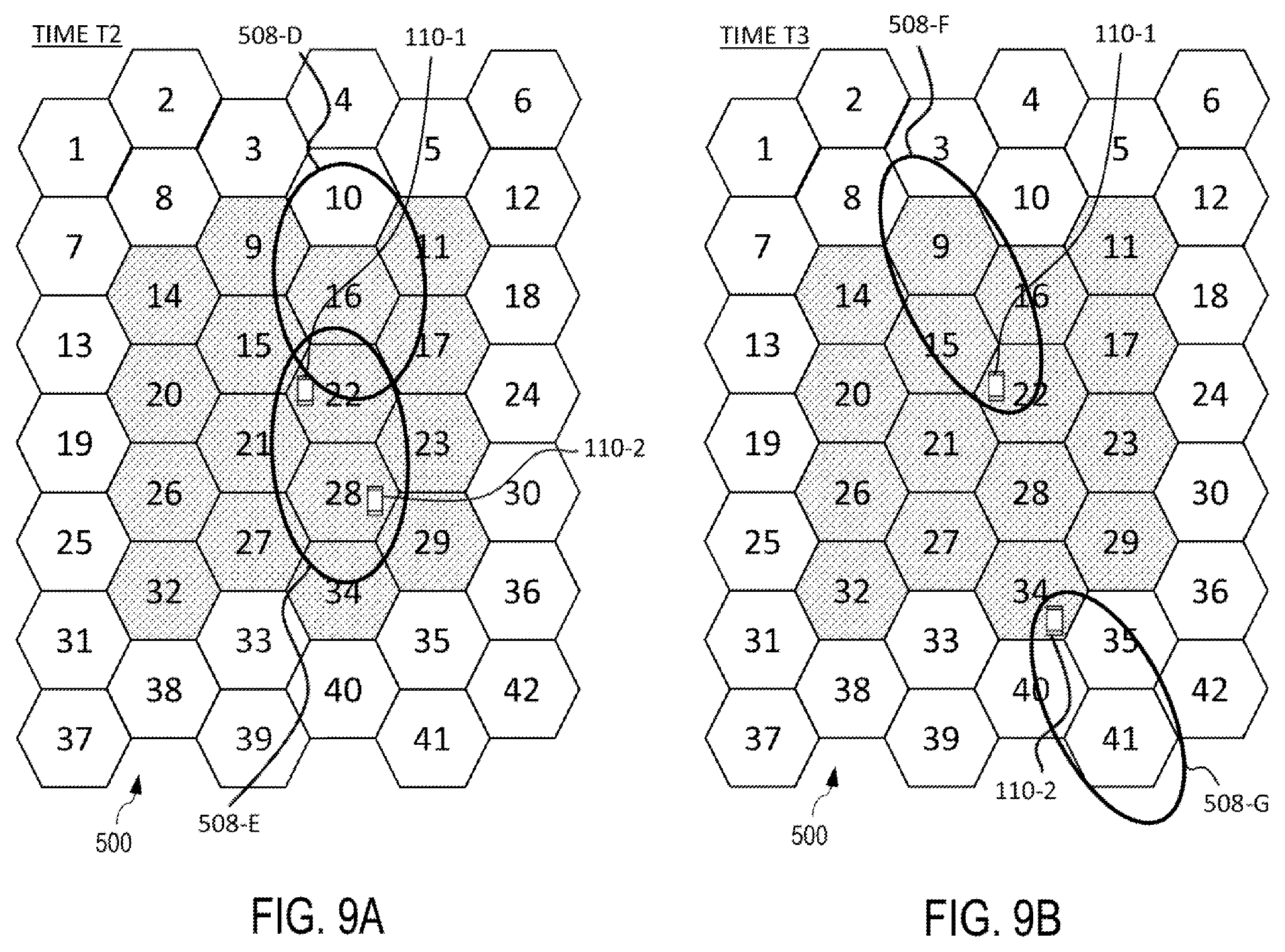
There is a tradeoff. Give a phone a large tracking area and it needs fewer updates as it travels, but the network may have more places to page when it wants the phone back. Smaller areas narrow that search and require more updates. The patent discusses choosing the areas and lists around this balance.3
The approach does not make satellites stationary or eliminate handovers. It gives a moving access network a geographic bookkeeping system. In the October 2025 allowance, the examiner singled out the time-dependent physical-to-virtual identifier mapping in explaining why the claimed combination was allowable.315
A continuation keeps the map in play
The mapping story continues in US20260135615A1, filed as application 19/441,279 on January 6, 2026. Published claim 37 approaches the mapping from the satellite side: receive identifier assignments for beams over successive time slots, direct the beams to geographic sub-areas, and broadcast the assigned identifiers as the served areas change.4
That is still a pending claim set. The September 14 record lists the case as ready for examination, and the publication shows claims 1–36 canceled with claims 37–52 remaining. Nor is the satellite-side approach entirely new to this continuation: the parent grant already contains independent claim 37 addressing that side of the system. The useful next question is how the continuation’s particular wording fares in examination.4213
What this buys the person holding the phone
T-Mobile’s service page, checked September 14, 2026, describes texts and photos, selected satellite-ready apps, and WhatsApp voice chat on compatible devices. It also describes the constraints: outdoor sky visibility, limited data speeds and possible gaps or time-outs. Compatibility and available functions depend on the device and service. A satellite connection should not be confused with unrestricted terrestrial broadband.17
The three patent stories explain different parts of getting even a small exchange across that connection. Recognize the initial request. Correct a signal distorted by motion. Keep a geographic record that survives the movement of the tower. Together, they show how much a network may have to do so that the action at the other end remains as ordinary as pressing Send.123
Evidence notes, claim details and open questions
Families and record coverage
The selected access-request record is 18/627,815, filed April 5, 2024, claiming benefit of provisional 63/461,830 filed April 25, 2023. It issued as US12695500B1 on July 28, 2026. The Doppler record is 18/762,174, filed July 2, 2024, claiming benefit of 63/531,470 filed August 8, 2023; it issued as US12712597B1 on August 18, 2026.12
The mapping parent, 18/375,319, was filed September 29, 2023 and issued as US12542605B1 on February 3, 2026. It identifies provisional 63/412,309, filed September 30, 2022, and 63/520,882, filed August 21, 2023. Its continuation 19/441,279 was published as US20260135615A1 on May 14, 2026.34
All 216 documents indexed by patent-platform across these four nonprovisionals and four provisionals were downloaded. OCR was still progressing at this review. The article draws on the publications, original drawings and selected substantive prosecution documents; downloading every document does not mean every page has received substantive review.22
These applications have recorded continuity links, but patent-platform’s family lookup and native SVG exporter returned no family for them at this snapshot. Native diagrams are therefore unavailable here. The listed US links are not presented as a complete worldwide family census, and an absent graph does not establish that no PCT application exists.22
Ownership and the limits of this reading
The recorded assignment chains identify transfers from the inventors to Space Exploration Technologies Corp.: access-request application 18/627,815 at reel/frame 68034/35 (July 19, 2024); Doppler application 18/762,174 at 68185/495 (August 5, 2024); and mapping application 18/375,319 at 66065/695 (January 9, 2024). The mapping record’s later certificate of conversion at 70366/187 is not counted as a second ownership transfer.181920
The three grants are analyzed through selected issued claims; the continuation is analyzed as a published, pending application. Specification examples are not automatically claim requirements. Examiner reasons for allowance explain the examination record, without establishing that a patent is immune to a later challenge. We have not established infringement by another provider or verified the flight software used by SpaceX.1234141315