The biggest part of your phone is somewhere else
Imagine making a call from a place with no tower in sight. You take nothing new out of your pocket. Somewhere above you, an enormous sheet of antennas does the extra work.
AST SpaceMobile describes its next-generation BlueBird array as nearly 2,400 square feet, compared with 693 square feet for its first-generation BlueBirds. The scale is striking. The patents make the more interesting question visible: how do you get a large, lightweight surface into orbit, keep it useful while it bends, and preserve a call as its coverage passes overhead?20214
Four inventions trace that chain from folded hardware to the carrier network. They are specific engineering disclosures and claims, not a complete blueprint of every BlueBird. Together, they explain why “put a bigger antenna in space” is only the beginning.2134
First, fit the antenna inside the rocket
The deployment drawing begins with a compact stack. Figure 2 looks almost like a bundle of shelves: connected antenna assemblies folded together for transport. The useful surface exists only after that stack opens.27
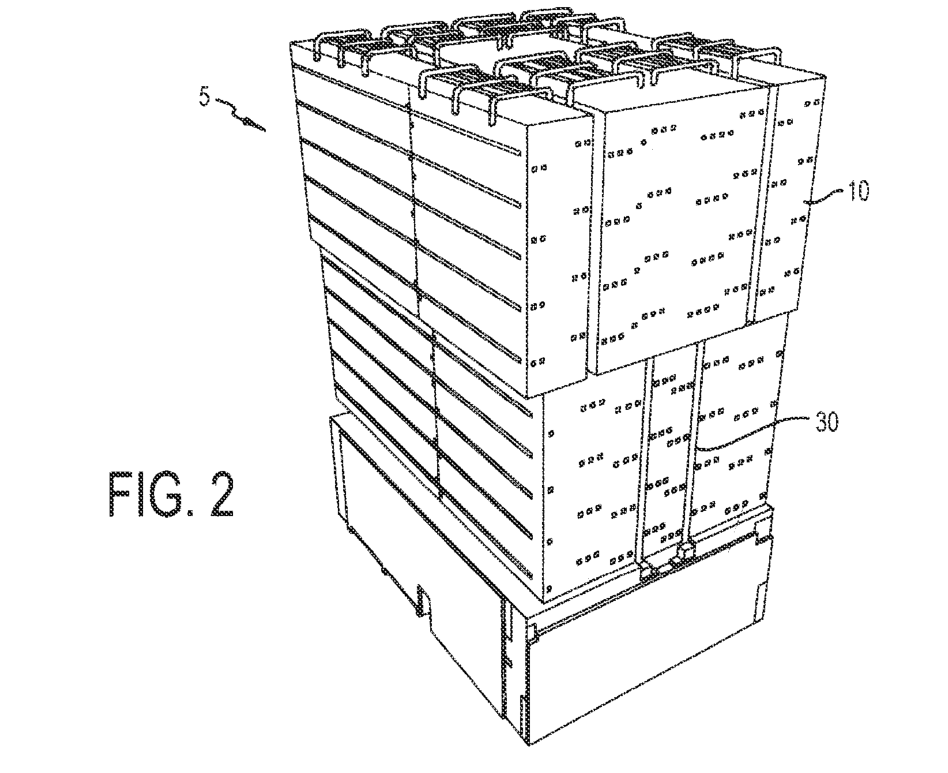
US12280894B2 describes connectors that store energy while folded and release it to move the assemblies into their deployed configuration. Tape springs are one example: the connecting part also supplies a restoring force. Other embodiments use different stored-energy arrangements; a particular tape spring is not required by every independent claim.2
The tile drawing reveals a second piece of economy. Antenna elements occupy the communications face, while the opposite face can carry solar cells. The same modular structure helps collect power and exchange radio signals. The specification also describes electrically released latches, so self-deployment does not mean the spacecraft needs no electrical control.27
The seams matter
Once open, the array must work as a surface. Figure 3(a) puts the connectors at the edge of a tile, away from its radiating face. These small details become important in the issued claims.27
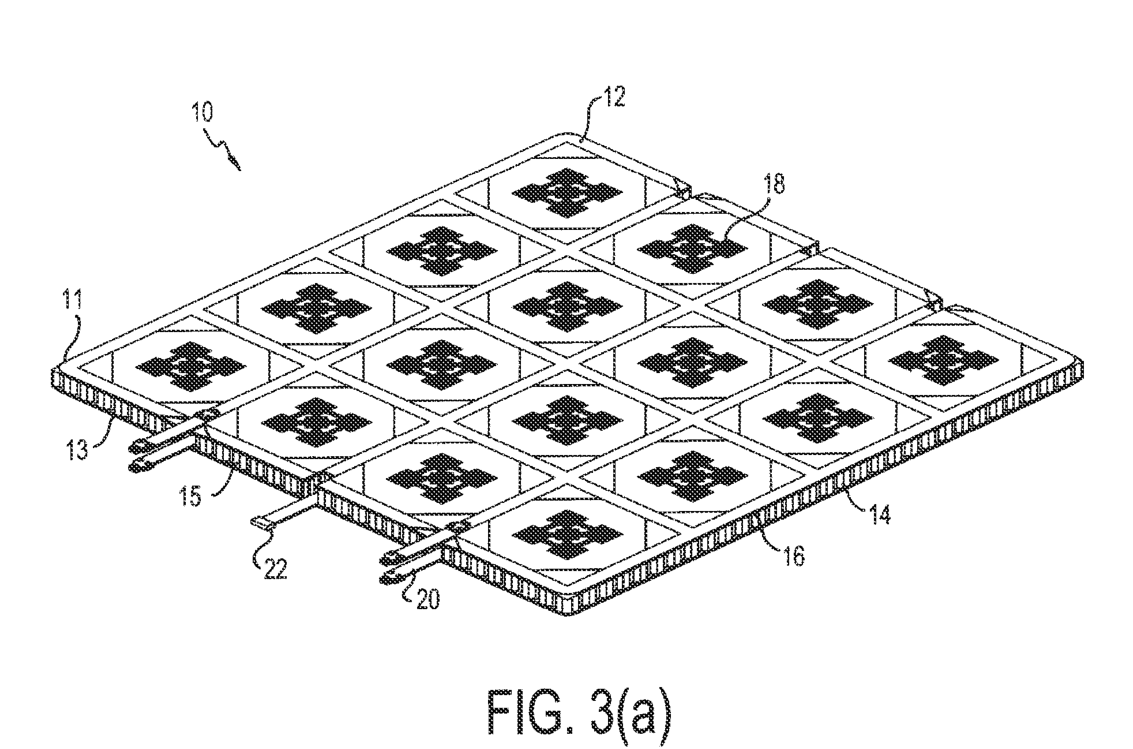
Claim 1 specifies stored-energy connectors attached to different layers of adjacent assemblies. Independent claim 10 takes another route: connectors at the side edges permit the neighboring edges to meet, producing a planar surface without gaps. These are two distinct claim combinations. Reading the patent as a general monopoly on folding antennas would erase the details it actually protects.2
The family’s prosecution also prevents an easy counting mistake. In December 2024, AST responded to an objection that its pending claims covered the same invention as its parent patent. It canceled and amended claims and added another set, including the edge-contact approach. The record describes differentiation within a family, not a second independent discovery of the whole spacecraft.15162
A giant antenna can breathe
A lightweight deployed array need not stay perfectly flat. Its individual modules may be rigid while their connecting joints flex. Across many modules, small angular changes become appreciable displacement at the edges. US12040553B1 follows that motion into the radio problem.16
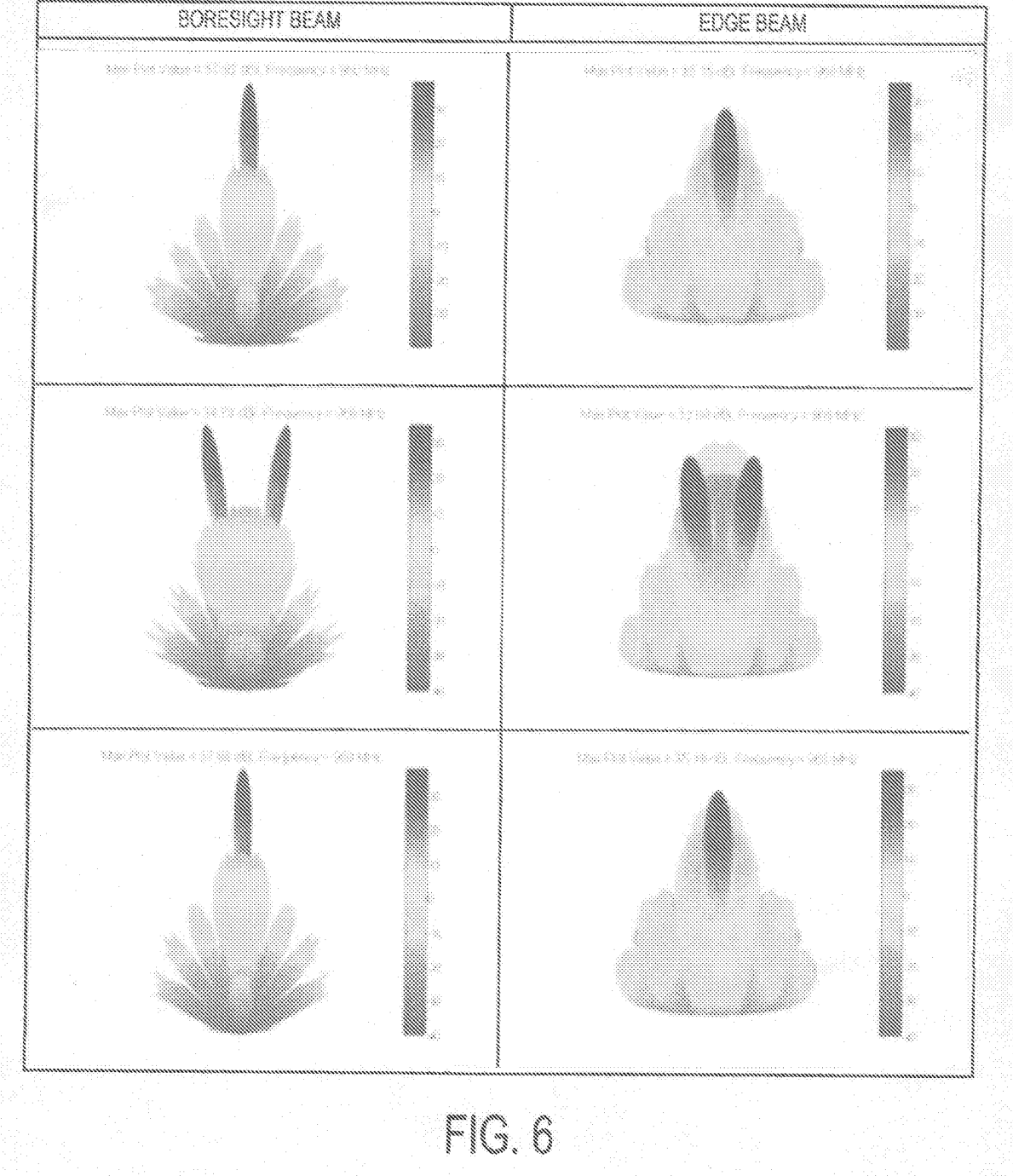
A phased array depends on the relative timing of signals at different antenna elements. Move an element and the path changes. If the beamforming calculation continues to assume the original geometry, signals no longer combine in quite the intended way. The patent’s Fig.6 compares nominal, bent and compensated cases: the bent example splits the main radiation peak; compensation brings the modeled pattern back toward its intended shape.16
Those plots are examples in a patent specification. They are not a before-and-after test of a named commercial BlueBird. Their value is explanatory: maintaining useful aperture means knowing where the elements are, not just how much surface was launched.1
Move the structure. Then correct what remains.
The patent combines two kinds of correction. A mechanical device applies force toward the deployed geometry. Sensors then detect the residual structural displacement, and the processor corrects the beam’s phase for that remaining error. The structure does not have to become mathematically perfect before the radio can work.1
The description discusses torque rods acting against Earth’s magnetic field and combining GPS-based measurements with inertial sensors. Those are implementation examples or dependent-claim details. The central requirement in issued claims 1 and 21 is the mechanical correction followed by detection and electronic compensation of the residual displacement.1
That division of labor is compelling: use physical control to tackle the larger structural departure, then use signal processing for the remaining mismatch. It makes the supposedly separate disciplines of spacecraft control and radio design part of the same problem.1
The abstract leaves out the best part
The file history explains why that sequence deserves attention. In May 2021, examiner Peter M Bythrow rejected the earlier system claim over Kempkes’s phased-array patent, US5623270A. That older grant names Riverside Research Institute as assignee; the platform’s assignment records also contain the matching 1994 Kempkes/Wiener transfer to Riverside. Correcting an antenna’s phase for movement was already in the prior-art discussion.10522
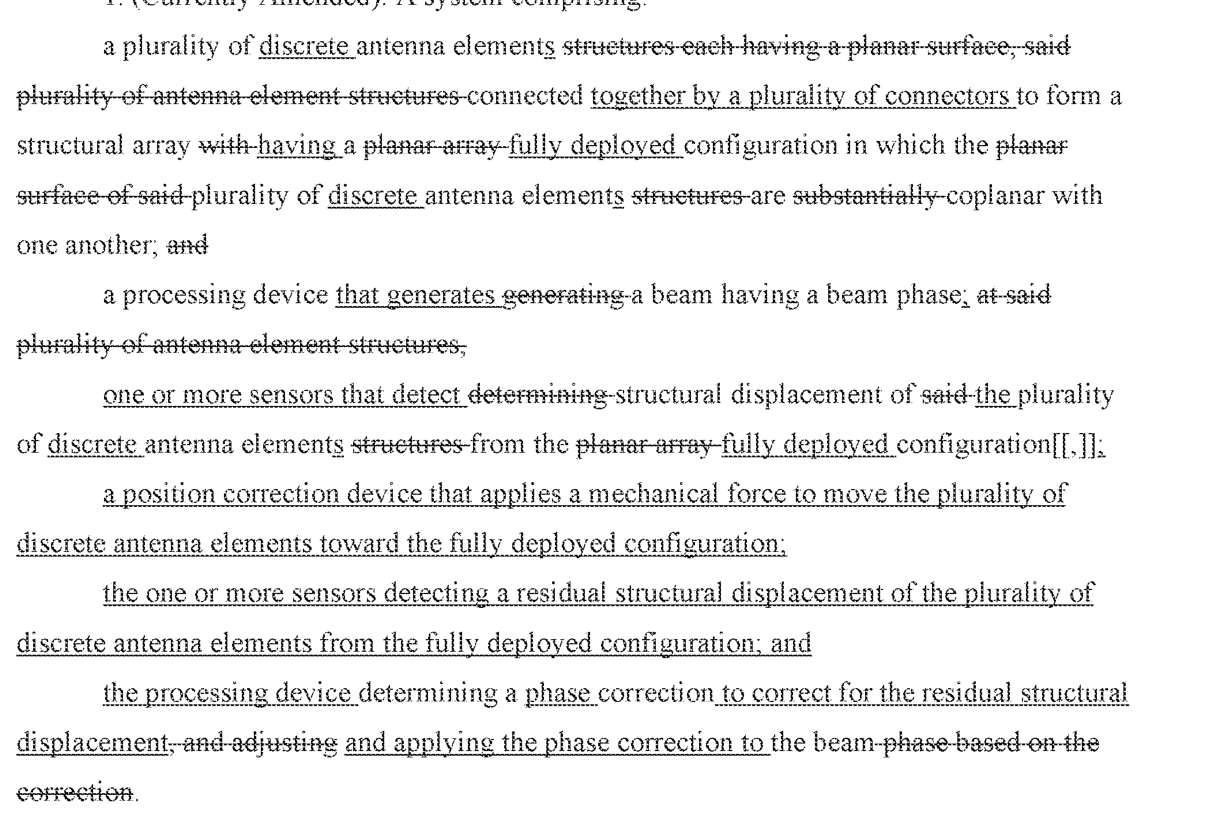
The same office action allowed method claim 21. AST’s August response, signed by Peter S. Weissman of Blank Rome, amended system claim 1 to follow that allowed method and clarified the residual-correction sequence. The marked page shows the mechanical-force and residual-displacement language entering the system claim. The later allowance expressly points back to those amendments.10111213
This is a useful reason to open the file wrapper. The abstract offers the broad idea of sensing displacement and adjusting a beam. The issued claim, and the response that shaped it, tell a more particular story about physical correction and the error left afterward.112
The enormous antenna has a ground crew
The next drawings move below the satellite. US12368504B2 shows a gateway with a bank of baseband units, a shared memory arrangement, radio links to satellites and a network control center. The ground cells remain the organizing unit while the satellites serving them change.38
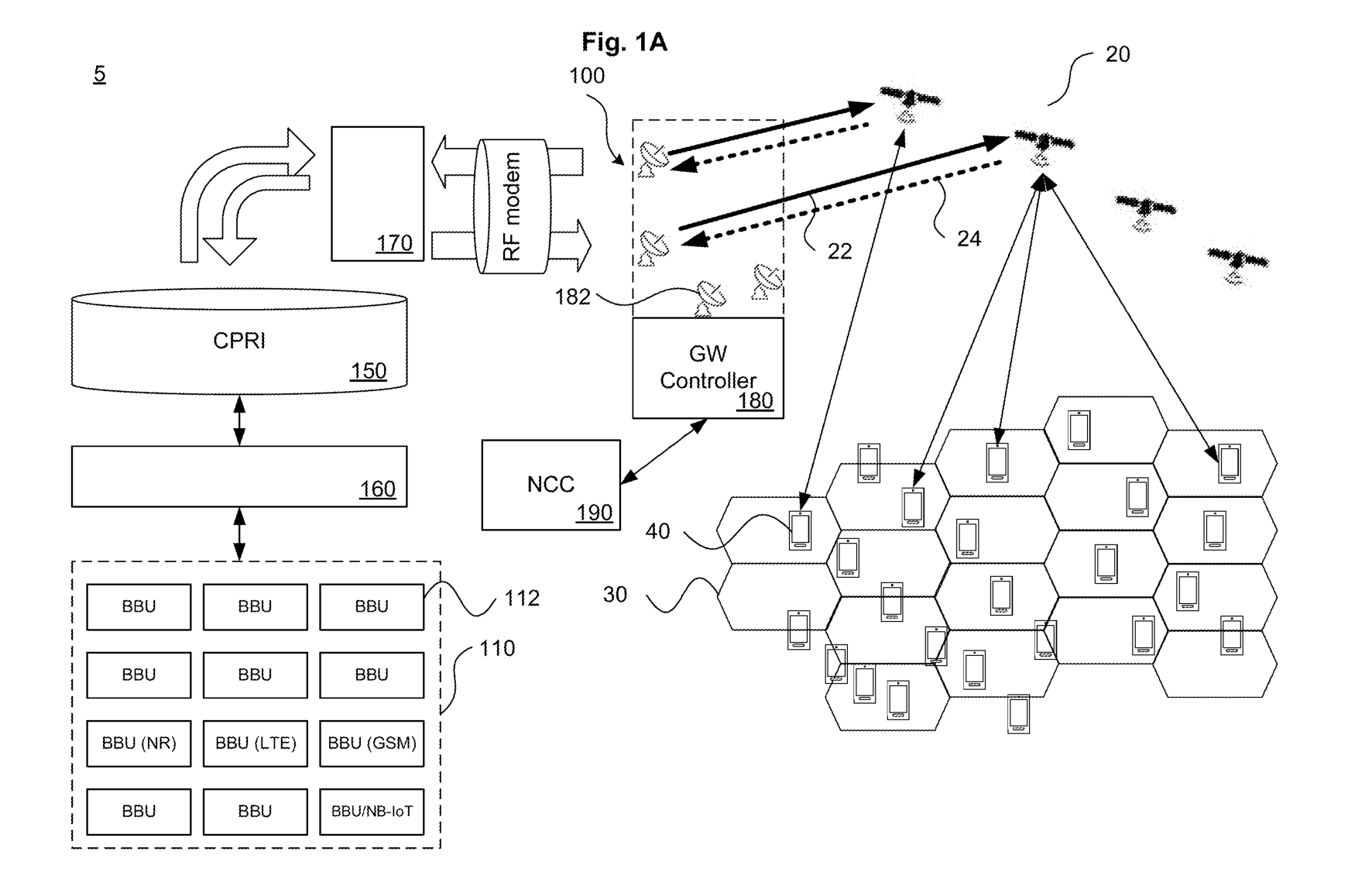
Its CPRI arrangement keeps control information, outgoing signal data and incoming signal data associated with each cell. The buffers give the baseband units and gateway controller a common place to exchange what is needed to form and use the corresponding beams. The specification describes signal samples as I and Q components—the two components used to represent the radio signal.3
Issued claim 1 ties a plurality of baseband units and cell-associated memory to a processor that causes the satellite to generate a beam using that information. Claim 8 spells out a more detailed buffering method. The examiner’s allowance focuses on those combinations, which are more specific than merely running a cellular network through space.317
The illustrated embodiment puts substantial cellular processing at the gateway. The specification also allows operations to reside at a control satellite. That matters when comparing providers: the drawing supports analysis of this architecture, not an assertion that AST never performs processing onboard.3
Change satellites without ending the conversation
A phone sitting still can outlast the satellite serving it. US12401395B2 deals with the overlap between a setting satellite and a rising one. Figure 2 gives the ground station two paths into the overlapping cell, each through a different spacecraft.49
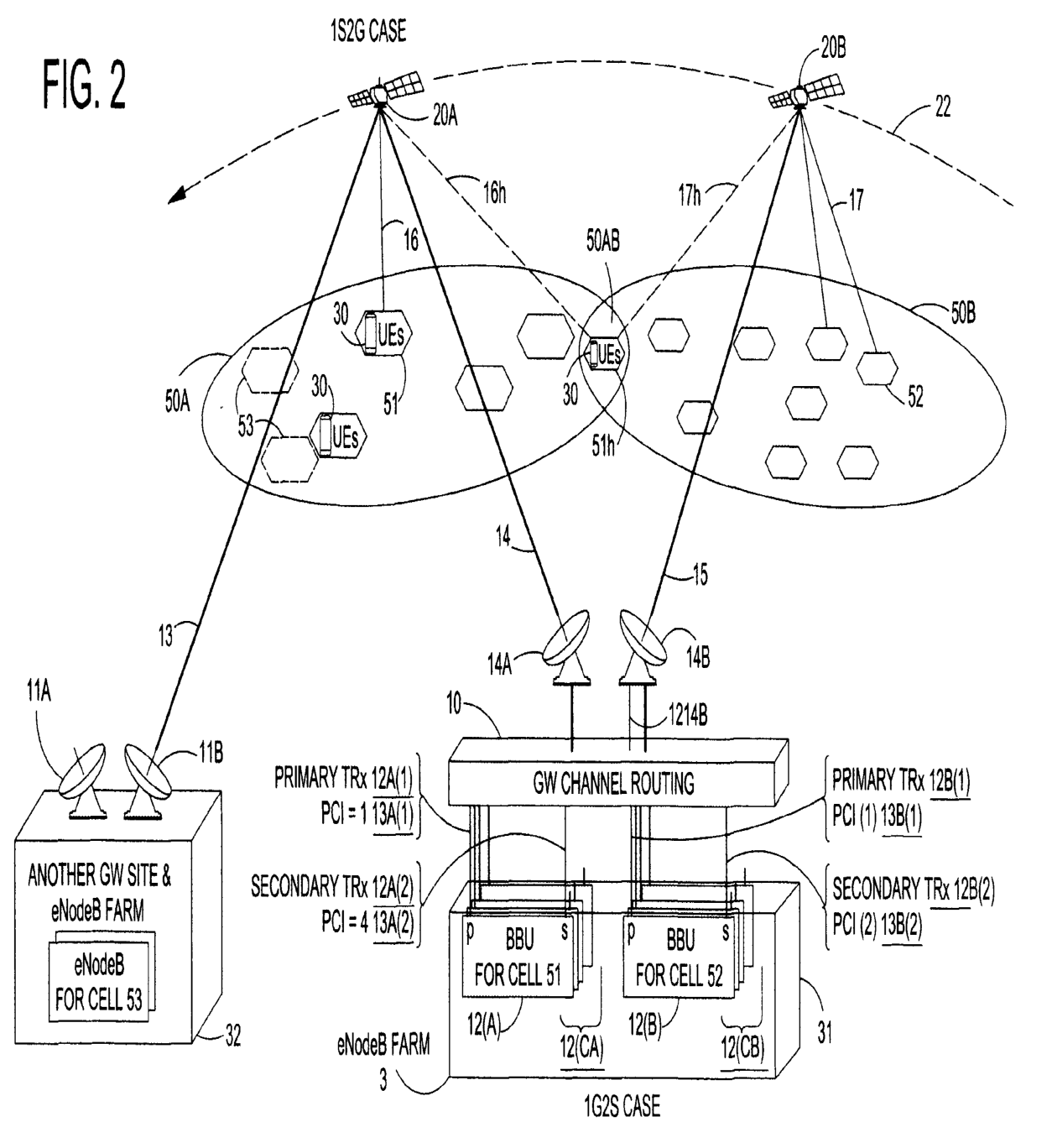
The specification describes two radio ports with different physical cell identities. During the transition, the network can make the new beam available before retiring the old one and use familiar handset handover procedures to move active users. To the phone, a change driven by orbital motion can look like a cellular handover it already understands.4
Active and idle cells are treated differently. A cell with ongoing calls needs coordinated transitions for its users; an idle cell can have its beam path switched without the same active-user procedure. The design spends complexity where someone is actually communicating.4
Delay remains part of the invention. Issued claim 1 includes gateway normalization that puts a handset at the cell center at a midpoint timing-advance value. Independent claims 17–19 protect different combinations involving transparent satellites with modified base-station processing, configurable round-trip latency, and fiber-fronthaul latency folded into delay compensation. They should be read separately rather than combined into one imaginary super-claim.4
The file history explains those separate paths. In April 2025, AST folded a previously dependent limitation into claim 1 and rewrote three other dependent claims in independent form. The subsequent allowance discusses the particular timing, processing and fronthaul combinations. Satellite handover itself was not the whole distinction.1819
The ordinary phone is the constraint
The appeal is that the user should not need to understand any of this. The radio surface unfolds and flexes; processors account for where its elements really are; gateways associate signals with cells; handover machinery moves the conversation to another satellite. The phone keeps using recognizable cellular procedures.2134
AST’s current company page advertises an AST5000-enabled target above 150 Mbps per coverage cell. That is a company target for a named generation and a shared cell, not a guaranteed speed for each subscriber. The patents explain mechanisms that could contribute to a working network; they do not establish delivered coverage, simultaneous-user capacity or real-world reliability.20
The revealing question for the next demonstration is therefore larger than “did a phone connect?” It is whether this chain keeps working as the structure changes shape, the beam moves and a call crosses between satellites. That is where a spectacular antenna has to become a dependable network.14
Evidence notes, claim details and open questions
Family coverage and what remains to read
The four focus records are 17/175,428 (oscillation), 18/409,510 (deployment), 18/196,556 (CPRI), and 17/583,992 (handover). Their recorded parent, child and provisional-benefit links expand to 22 U.S. application records, including neighboring deployment, solar/RF and thermal branches. The full available document codes were selected for acquisition: 1,464 indexed documents. The September 14 recheck found 1462 of 1,464 files held, 1394 OCR-complete and 68 skipped, with none pending, processing or failed. The missing application-data sheet was retrieved. Two search-notes records, listed as 1,575 pages combined, remain uncollected; queue completion does not resolve that acquisition gap. Close reading remains limited to the cited records.23
A fresh patent-platform reindex now supplies all four native family diagrams. Deployment includes two dated PCT records; PCT/US2020/033231 and handover PCT/US2022/013713 remain omitted because the platform lacks their filing dates. The refreshed oscillation chain also names continuations 18/739,507 and 19/789,975, whose wrappers were not accessible from USPTO. These are additional metadata leads beyond the 22-record download set. The deployment specification claims Spanish priority, so the displayed records are not a complete worldwide census.232
The oscillation grant’s June 2025 certificate of correction was checked. It changes wording in dependent claims 7, 8, 10 and 22; the independent mechanical-plus-residual sequence discussed here is unchanged. The analysis distinguishes specification examples, individual issued claims and examiner or applicant positions.141
Ownership and the people behind the records
Recorded assignments transfer the oscillation, CPRI and handover inventions to AST & Science, LLC. The later ACP Post Oak security interest and its release are financing records, not additional transfers of ownership. Patent-platform returned no assignment chain for deployment application 18/409,510; its grant identifies AST & Science as assignee, but that does not fill the missing chain.212
The cited records preserve different roles and dates: Peter S. Weissman signed the 2021 oscillation response at Blank Rome; Dustin R. Lo signed the 2024 deployment response at Shumaker & Sieffert; Andrew T. Zidel signed the 2025 handover response at Botos Churchill. The expandable people section links verified participants to their original signature pages. These are historical document affiliations, not statements about current employment.121518