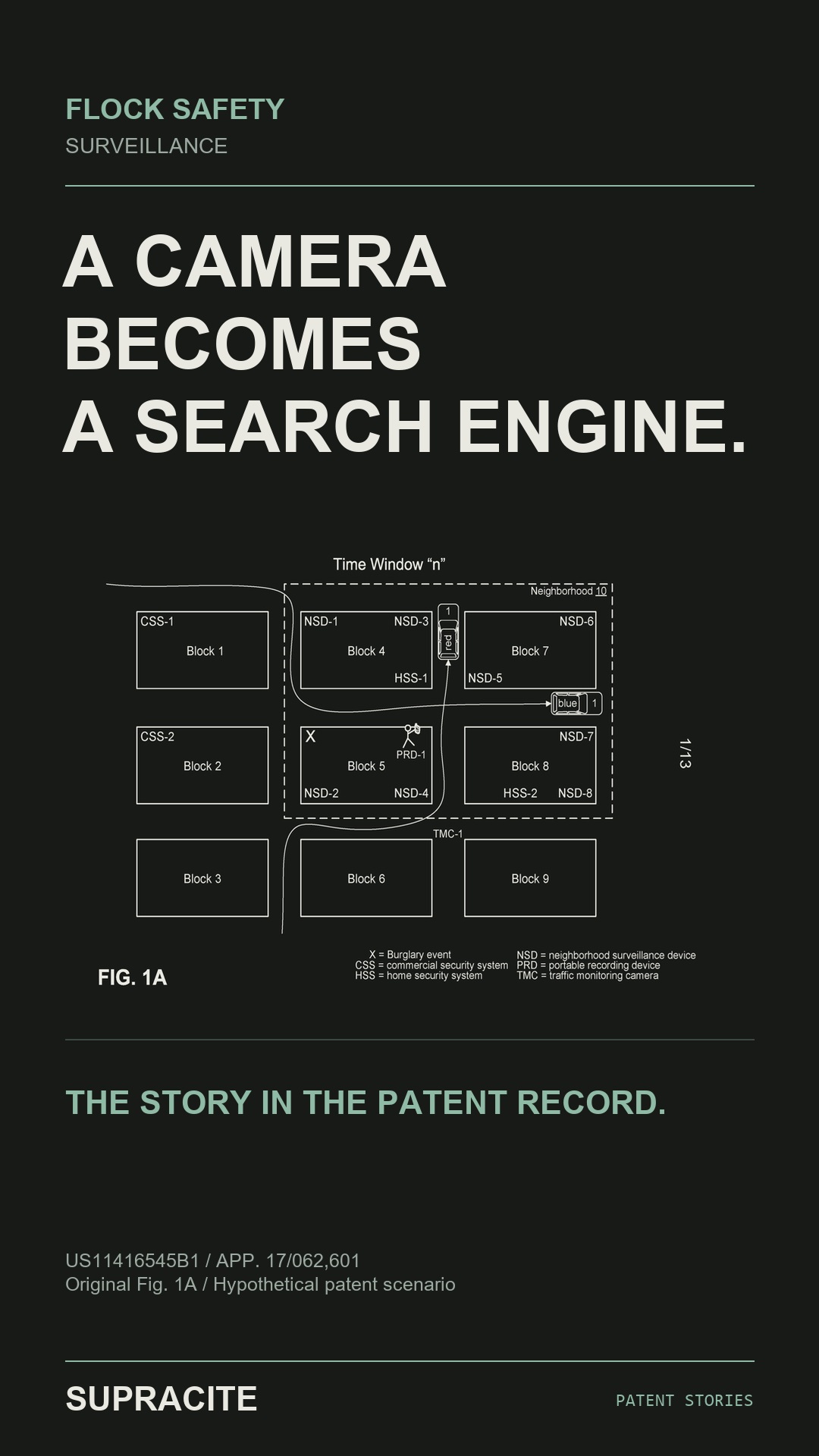
The red car stops for a candy bar
In a Flock patent, a red car passes through a neighborhood, stops for gas, and puts its driver in front of a convenience-store camera. Investigators start with the car. The proposed system helps them find the store footage, then use face-recognition data points to look for the person in other recordings. A small errand becomes a way to join otherwise separate cameras.1
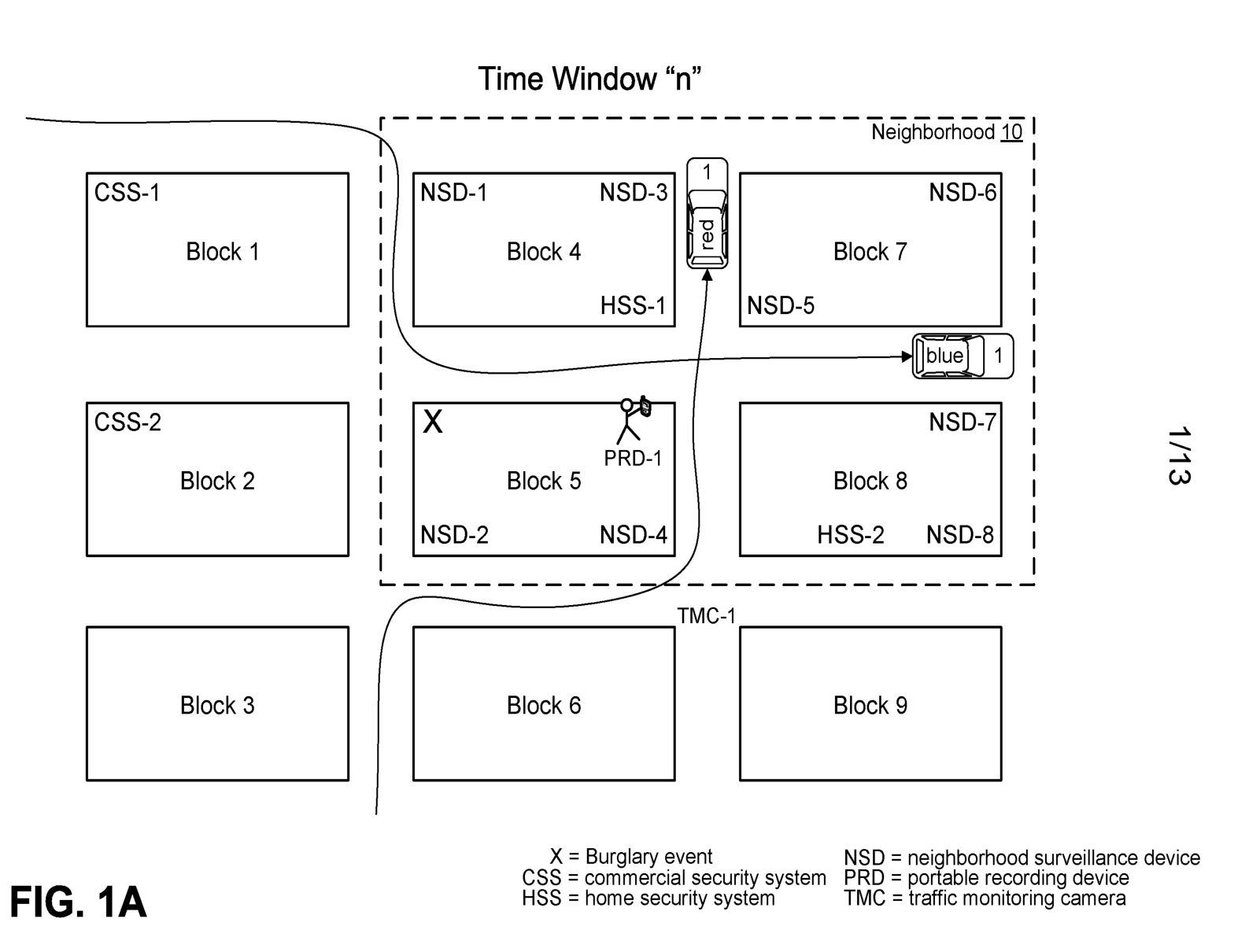
This is a hypothetical investigation in the patent, not a report of a deployed Flock feature. But it makes the engineering ambition unusually clear: turn recordings from different places into evidence that can be found by its contents. The interesting question is what must happen between a camera seeing something and an investigator being able to search for it.1
Give the footage an index
The object-query family divides the job into two questions: what kind of thing is in this frame, and what distinguishes it? A vehicle can have a make, model and color; a person can have clothing attributes. Fig.5A shows separate classification and attribute networks, with time and location attached to the image record.16
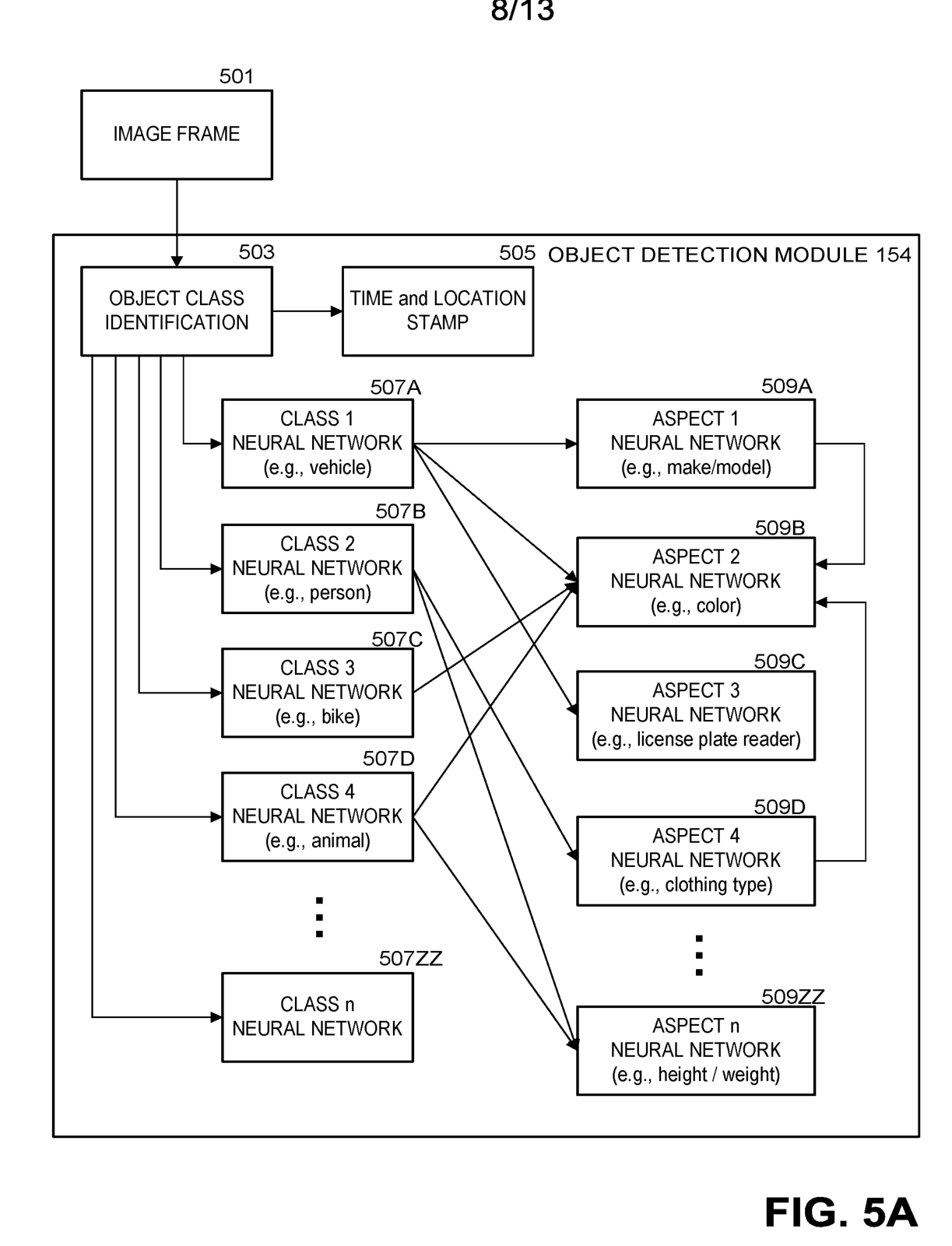
The issued claims make that searchable record concrete. Claim 1 of US11416545B1 combines captured video, time/location metadata, object classification, a search interface, database scanning and results with playable-video links. Its search condition requires at least one of time or location and at least one of object class or object aspect. That is a particular combination; “AI surveillance” is only a broad description of the field.1
The playable link mattered in prosecution
The parent application’s May 2020 response annotated its own flowchart: receive search parameters, filter the database, display matching records, and link back to playable video. Its account of an examiner interview distinguished that workflow from systems focused on reports, alerts or access decisions. The issued parent, US10795933B1, includes the search-and-playback combination.92
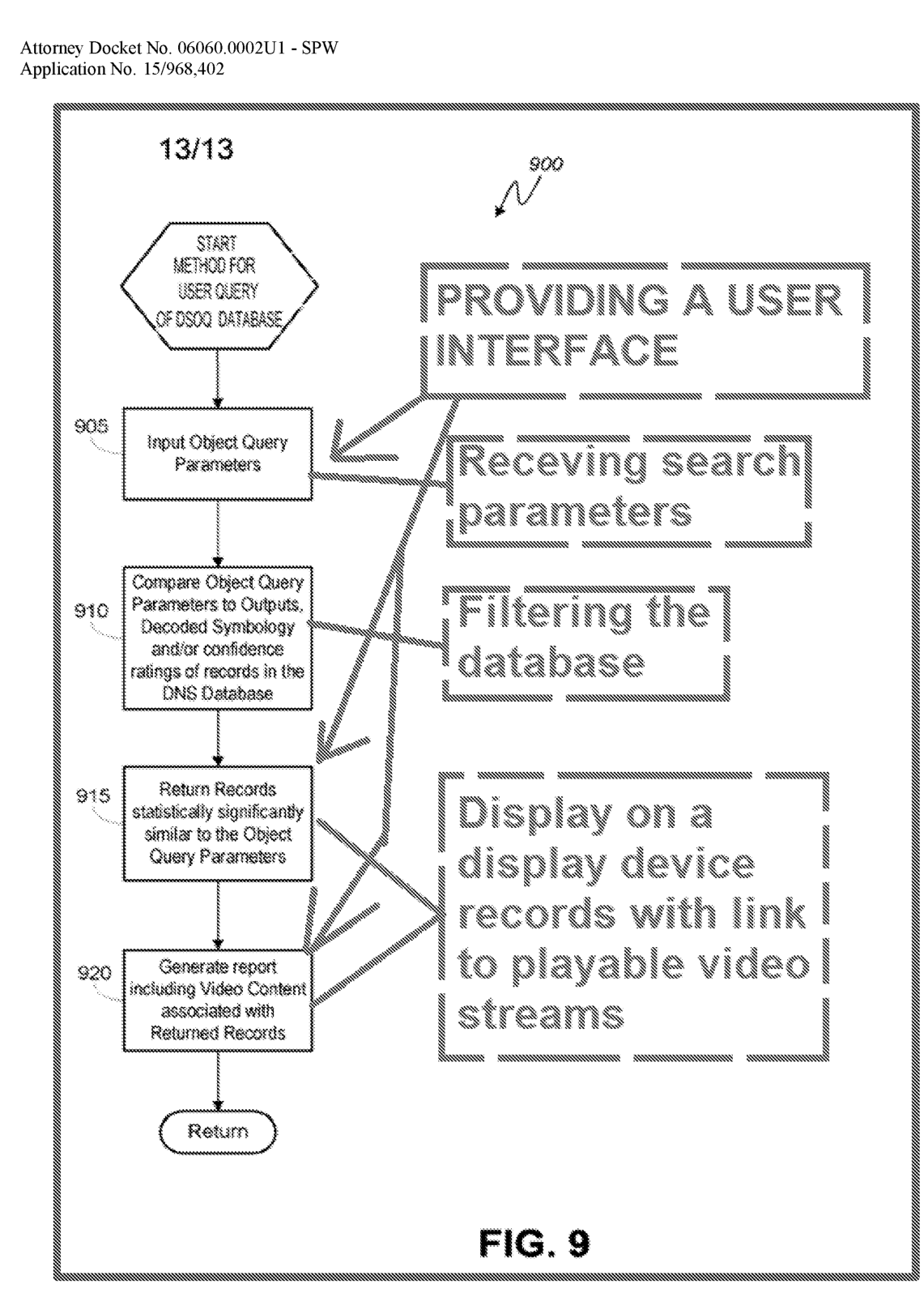
That gives the file history a useful role in the story. It shows what the applicant emphasized when seeking protection: getting from a description to footage the user can actually inspect. The later continuation’s March 2022 response instead addressed double patenting over the parent with a terminal disclaimer; that response should not be turned into a separate story about technical defeat by a competitor.910
A roadside camera has to ration its work
Before any search can succeed, useful images have to reach the database. The capture family addresses the cost of doing that on a limited energy budget. Its disclosed camera filters a batch of images, stores a reduced set, and wakes an energy-conserving processor when a time or storage condition is met. A second filter scores the remaining images before transmission.37
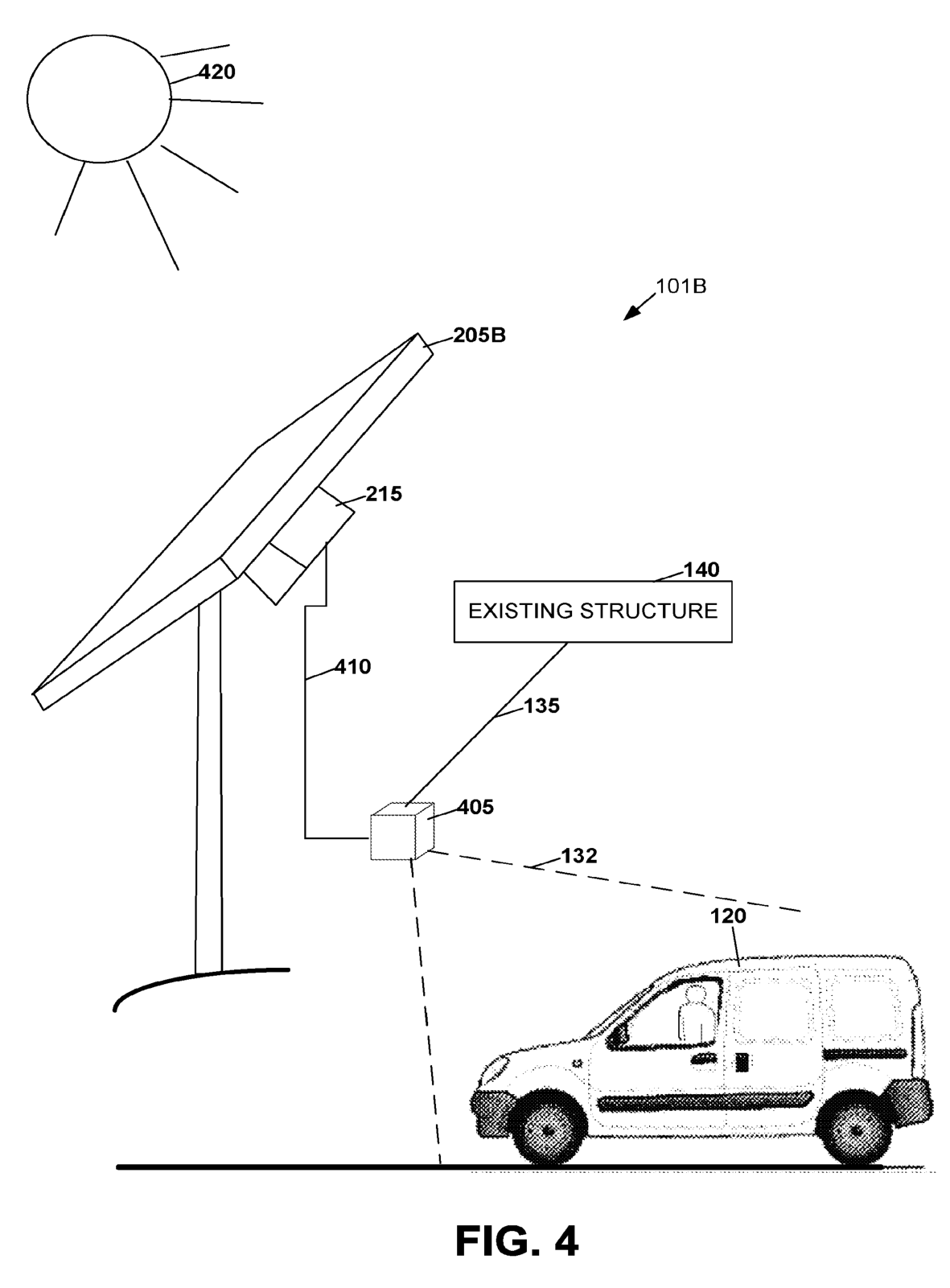
The distinction is between inexpensive work done early and more demanding work done after enough useful material has accumulated. Issued claim 1 of US11030892B1 specifies removal of duplicate images and the time/storage wake condition. The parent’s 2019 amendment argument also emphasized reduced-image storage and when the processor wakes. These details help explain how a distributed camera network might operate without continuously spending power on every frame.3411
Sometimes the plate needs different light
The newer infrared patent starts with a practical failure: some license-plate backgrounds do not give the characters enough contrast at a camera’s chosen infrared wavelength. Its examples use 850 nm and 740 nm illumination, with a readability decision determining whether another exposure is worth taking. Those numbers are examples in the disclosure and dependent claims, not universal requirements of every independent claim.58
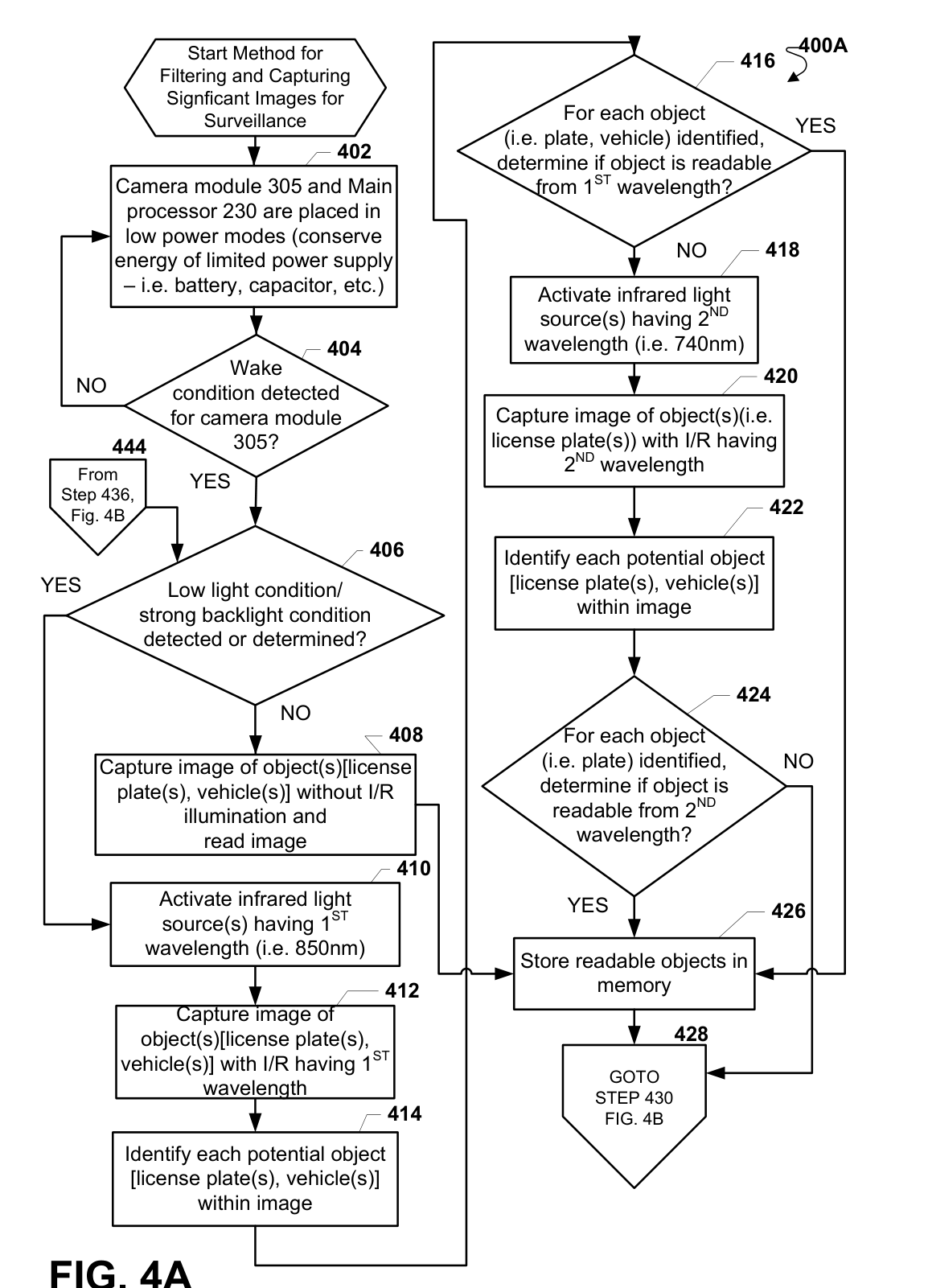
The issued combination also conserves power by leaving both lights off when low light or strong backlight is not detected. Under the specified difficult conditions it uses a first light, checks whether another image is needed, and conditionally uses the second wavelength. The decision to take another picture is part of the invention.5
Axon appears in the examiner’s reference list
One reference in the infrared examination is Alakarhu’s US20220148320A1, recorded as assigned to Axon Enterprise. This was prior art used in examination; the record reviewed here does not make Axon the party attacking Flock. In its March 2025 response, Flock emphasized the combined housing, limited power supply, lighting conditions and conditional capture sequence. The April allowance expressly credits the amended limitations together with the remaining claim elements.141213
The resulting boundary is more informative than the patent’s title. Protection is tied to an arranged sequence for getting a usable image while conserving power, rather than the mere presence of two light sources.513
Person search and face recognition are different questions
Flock’s current FreeForm page advertises natural-language searches for people’s clothing and vehicle details across enabled video feeds, with permission-based shared access and alerts. It says the product works without facial recognition. Its ALPR privacy page separately describes vehicle data and says ALPR does not collect facial-recognition data.2930
The patent’s face-matching example is broader than those descriptions. It warrants a question about which disclosed capabilities became products, but it does not establish that the company secretly deployed that example. Searching for clothing, matching a face, and identifying a named person are different operations. A useful product audit needs the enabled features, permissions, retention settings and actual search logs for a specified customer.12930
The Illinois State Police procurement record supplies a narrower, concrete example: its Flock OS purchase description includes plate lookup, vehicle-detail searches and access to other Flock devices within the jurisdiction. It establishes what that procurement sought, without proving every capability suggested in the patent.31
A camera network that can be placed by a drone
The ownership search added a family that a Flock applicant-name search missed. An April 2025 recorded assignment transferred Uniform Sierra Aerospace’s 18/677,146 and 19/034,874 to Flock Group. The first had issued as US12242288B1; the second is a continuation with a published application and later allowance records.32151618
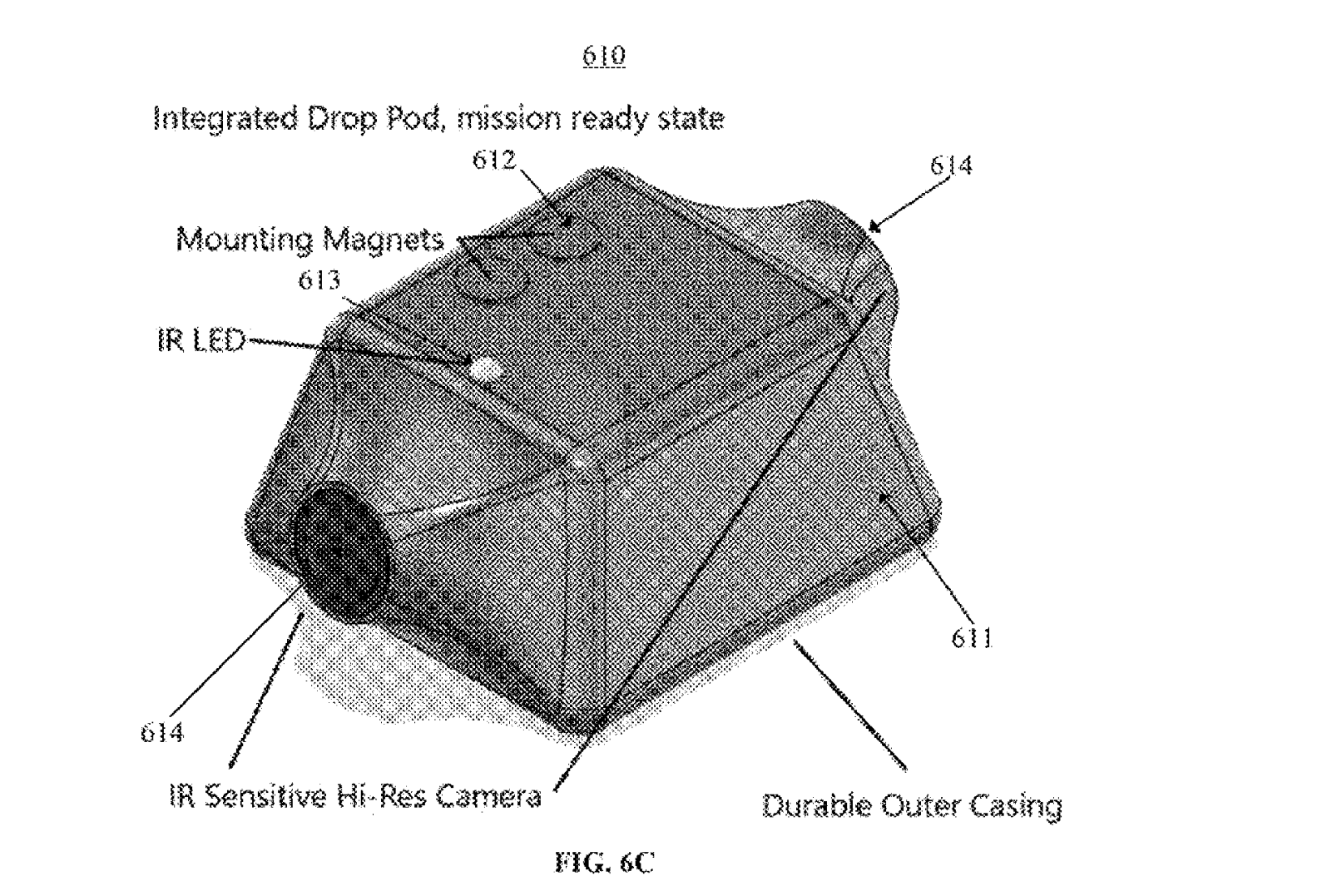
The disclosure describes an aircraft carrying sensor pods, choosing deployment points, and releasing pods that participate in a mesh network. The pods can collect information after placement. The continuation originally claimed a general aircraft connection interface. Its July 9, 2026 amendment makes the interface in claims 1 and 14 much more specific: magnetic engagement elements on the pod’s exterior, positioned at its top, couple to an electromagnet underneath the aircraft; the pod stays attached during flight while the unit is energized and releases when it is de-energized.152425
Unexpectedly, the obstacle was a grain-monitoring sensor system: Zafar’s US20190265082A1, assigned in the retrieved record to TeleSense. The April rejection used that reference against the broad independent claims. Flock’s response distinguished its exterior attachment from Zafar’s internal electromagnets, which could roll a sensor enclosure along a metal surface. The allowance then identified the more specific interface and other claimed features. This is a traceable example of narrowing in examination: where the magnets sit and what happens when power switches off became part of the requested protection. The continuation is recorded as allowed, with no grant yet identified.19231718
The same filing added independent claims 21 and 24 with a general connection interface and more specific network-control requirements. Claim 24 plans drop locations using sensor data, signal strength and deployed-pod locations; dependent claim 25 adds simulated coverage changes and retrieval/redeployment. The allowed set therefore includes a separate map-based route, not just the magnetic attachment. The companion drone investigation follows those placement and relocation decisions. 25
An outsider puts six drone patents before the examiner
An outsider was following this continuation before its first rejection. On November 5, 2025, a third party submitted six Ronald Carter patents concerning surveillance drones, docking, following subjects and operator interfaces. Alex Hobson, registration 57,173, signed the submission; the form does not identify his client. The accompanying explanation describes the submitted patents, not Flock’s products.2021
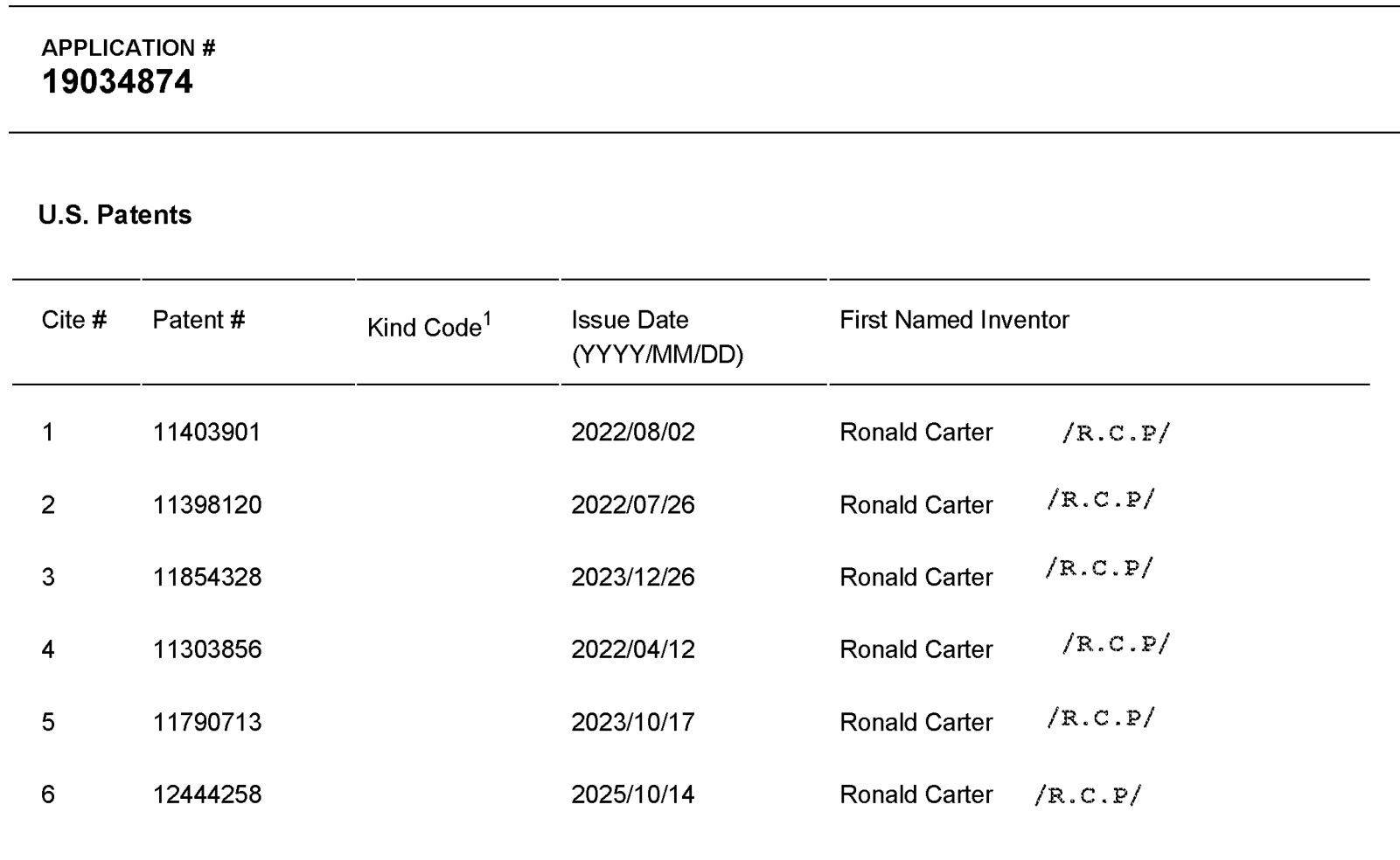
The submission reached the examiner: Rufus C. Point initialed all six references and signed the consideration field on August 10, 2026. But that is after the July 9 magnetic-interface amendment and the first allowance on July 29. The April rejection’s grounds use a different set of references. None of the six Carter patents appears in those rejection grounds.22232526
The supported conclusion is limited but useful: an outsider put its selected drone literature into the examination record, and the examiner marked it considered. The file does not establish that this submission forced the narrowing. The later interview concerned whether claim 2 was canceled, rather than a new technical concession. As the USPTO’s guidance explains, a consideration signature does not mean agreement with the submitter’s position.2728
Evidence notes, claim details and open questions
What we have, and what remains to establish
The research set now contains four patent families, seven accessible U.S. application histories, and 385 indexed documents. All 385 files have been downloaded through patent-platform. Eight U.S. family-member records are known in total: infrared continuation 19/218,489 appears in continuity data, but the USPTO document API returns HTTP 403 for its history. No PCT or provisional relationship was returned for these four families by the refreshed source records.
The linked publications, selected original drawing sheets, amendment arguments and allowance pages support this first draft. At the September 14, 2026 recheck (9:57 p.m. Arizona time), all 385 accessible documents were held: 359 OCR-complete and 26 skipped, with none pending, processing or failed. The substantive passages above were checked using publication text and the cited original PDF pages. Downloaded does not mean that every page has been read.
The third-party review covers the original submission, all April rejection grounds, the July amendment and initial allowance, the signed consideration form and the August interview/corrected allowance. It establishes consideration without showing a rejection based on the six submitted patents. Recorded assignments for three of the six identify 1AHEAD Technologies; the retrieved chains for the remaining three are empty. That incomplete ownership picture does not identify the client behind the filing.3334
Original PDFs of all six submitted publications are also archived: US11403901B2, US11398120B2, US11854328B2, US11303856B1, US11790713B2 and US12444258B2. The recorded transfers to 1AHEAD Technologies cover the first three; ownership of the last three remains unresolved in the retrieved assignment data. Their appearance on the list is established, while their full technical relevance remains a separate research question.3536373839403334
The completed-text pass through the capture continuation and later drone allowance records did not establish another competitor-driven narrowing. The capture continuation’s response addresses formal issues and double patenting.41 The drone record retains the distinction between considered third-party references and the different references used in rejection.2318
Next research questions: extend the close reading across the remaining family records; finish the third-party reference ownership chains; reconcile any newly issued continuation claims; and seek product-specific evidence for implementation. Searches for additional acquired-company portfolios did not establish further Flock-linked patents in this dataset, so this is not represented as a complete worldwide portfolio census.