The drone leaves something behind
A drone slips through a doorway. The radio link weakens. It leaves a relay near the entrance and keeps going. In the next room, it finds a useful view, puts down a camera, and heads farther into the building. That is the mission drawn in a patent family now assigned to Flock Group.12
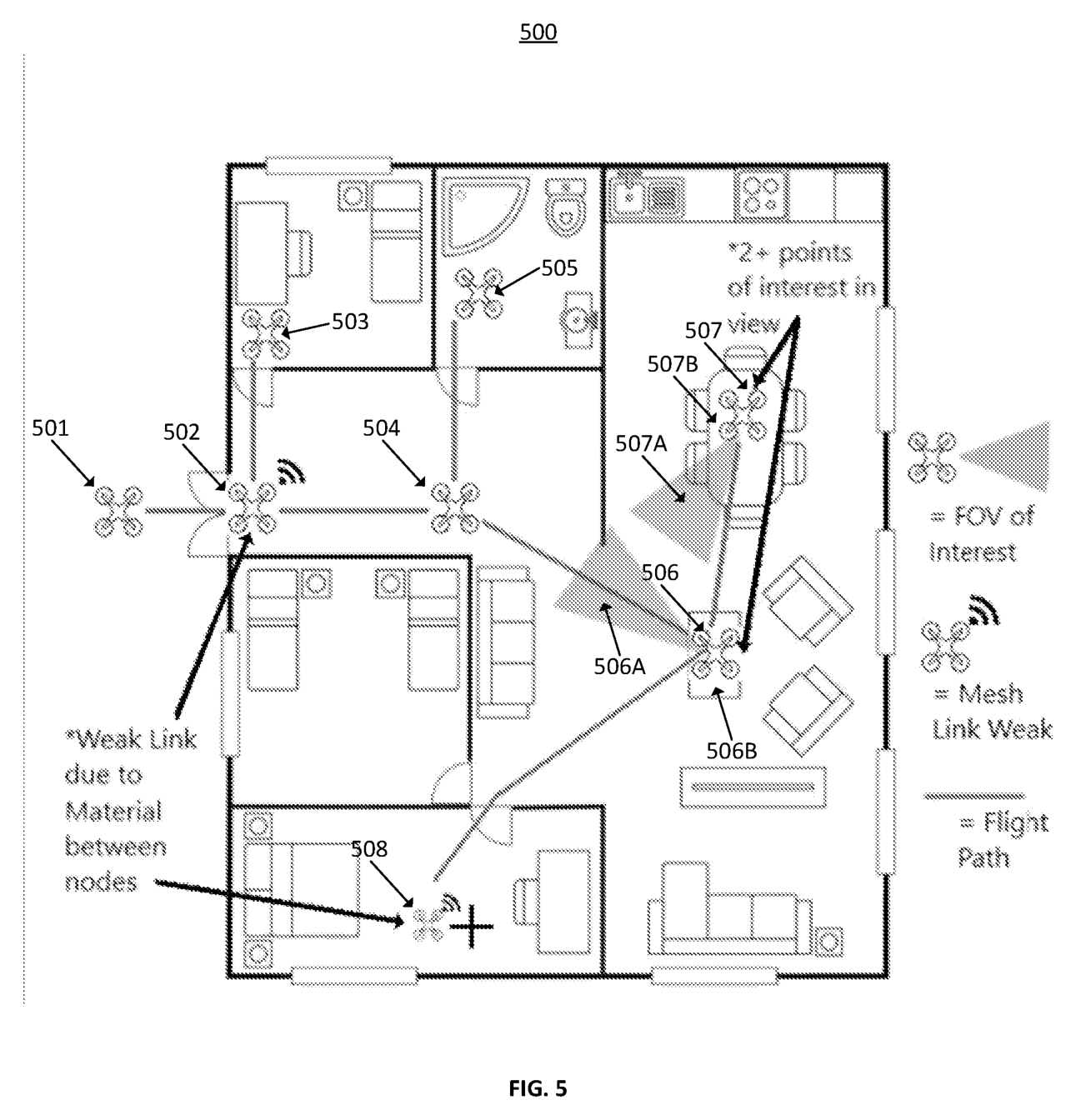
The aircraft is installing a temporary sensor network as it explores. A camera it leaves behind can keep contributing a view while the drone moves elsewhere, provided the pod has power and a working route through the mesh. In this design, flight changes where the network exists.3
The family began at Uniform Sierra Aerospace. Its first U.S. application, 18/677,146, became US12242288B1 in March 2025. A continuation, 19/034,874, published as US20250370477A1, has since reached allowance. Together, they describe a progression from choosing a useful place to leave a sensor to deciding when that sensor should move again.456
First, keep the radio path open
The doorway matters before the camera does. At waypoint 502, the example system detects a weak mesh-radio connection and calls for another radio pod. It repeats that decision deeper inside at waypoint 508. The proposed response to a weak link is physical: leave another node where it can extend coverage.1
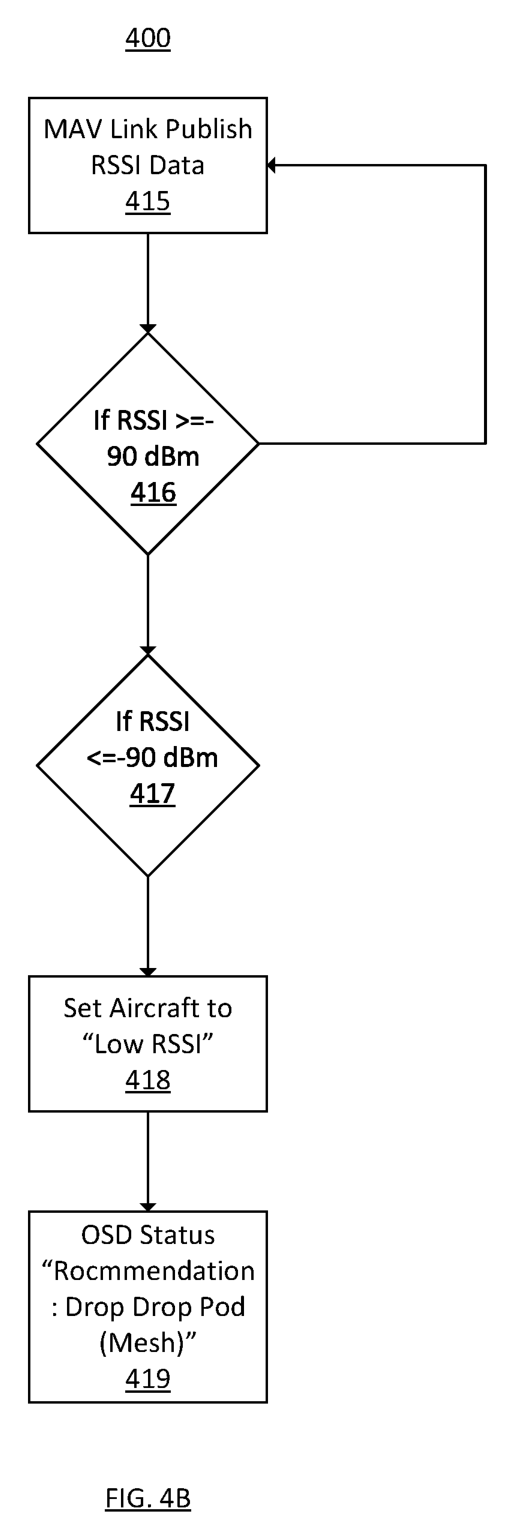
Fig.4B makes the decision legible. The aircraft reports received signal strength, the system compares it with a threshold, and the operator’s display recommends dropping a mesh pod. The example threshold does not establish a universal indoor-radio setting or guarantee that a particular building will be covered.3
The aircraft itself can relay sensor data between the pods and control station. Leaving a camera behind therefore does not, by itself, establish that its feed survives when the aircraft flies out of range.3
A useful camera needs a useful view
A relay belongs where it helps the radio path. A camera belongs where it can see something. The patent treats those as different placement decisions, using pod type and point-of-interest type to choose what to deploy.4
In the building example, the drone identifies doors along its route, finds a table or other flat surface, and chooses an orientation for the camera. At locations 506B and 507B, the shaded viewing angles matter as much as the dots on the floor plan. Putting a sensor in the right room with its camera pointed into a wall would satisfy the delivery problem while failing the observation problem.1
The simpler decision chart counts doors and stairways as camera-placement cues. Other embodiments use computer vision and trained models to identify objects or revise the route. The file describes both operator-generated plans and autonomous changes. “Autonomous” in the title should not erase the operator recommendations shown in the drawings.31
What stays behind has its own power and radio
The cutaway makes the pod a small working device: camera interface boards, a microcontroller, a mesh modem, antennas and a battery. The illustrated enclosure has cameras on opposing sides; other disclosed sensor options include microphones, gas sensors and temperature sensors.13
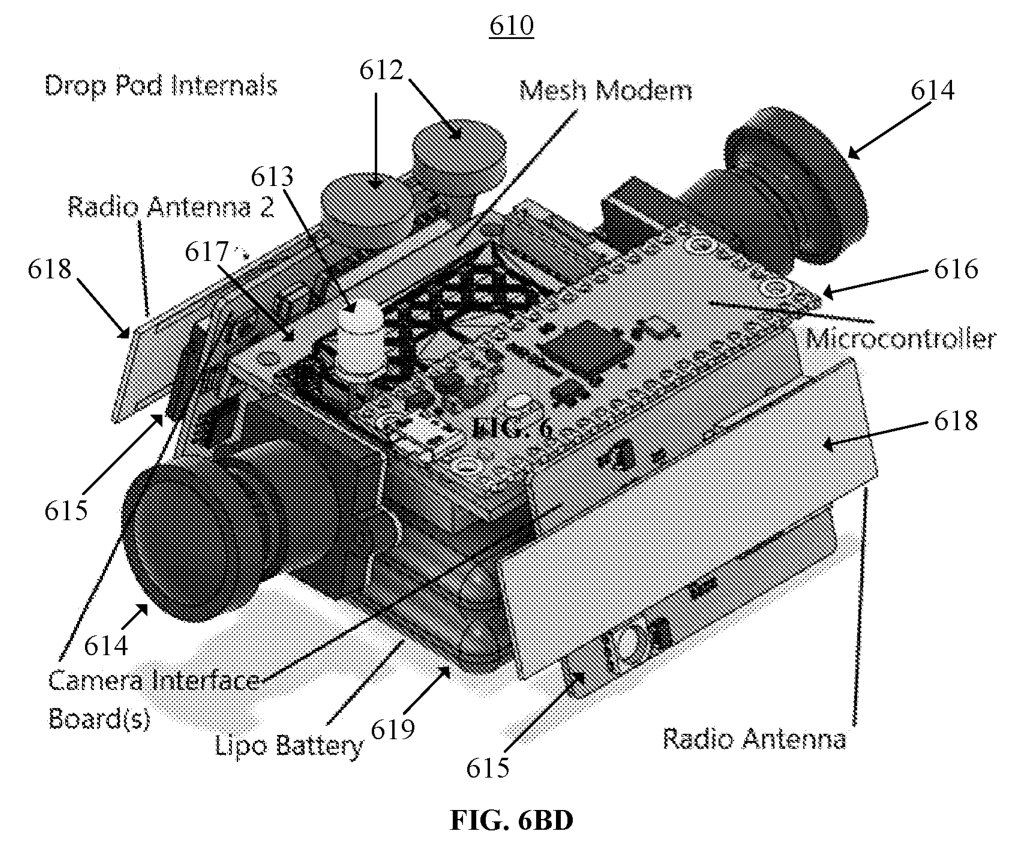
A sensor can remain useful without its carrier hovering over it, but still needs energy and a route for its data. The patent gives an architecture. It does not supply a measured endurance or throughput result for this building mission. How many simultaneous video feeds remain usable through several relays is a practical question the drawing leaves open.
The first grant protects a placement sequence
Issued claim 1 recites a mesh system with a control station, aircraft and sensor pods. Within that combination, the system uses environmental data and pod type to identify points of interest, selects a suitable pod, and chooses its drop location and orientation based on point-of-interest type. Claim 9 follows the method route.4
That last step earned attention from examiner Hongmin Fan. In the September 2024 action, Fan identified location and orientation based on point-of-interest type as a limitation missing from the closest reference discussed for the allowed method claims. The camera’s direction was part of the examination outcome.7
The same action’s rejection of claims 1–8 concerned the antecedent for “the mission plan.” The November response changed it to “a mission plan.” That is a wording repair, not evidence that an outside challenger forced the first grant into this technical shape. The placement sequence was already there.87
A grain sensor puts the attachment under pressure
The continuation encountered a different problem. In April 2026, the examiner applied Zafar’s US20190265082A1, a grain-monitoring reference with sensor deployment and retrieval. The platform’s assignment record links that reference to TeleSense, Inc. A drone placing sensors was already present in an apparently distant application.910
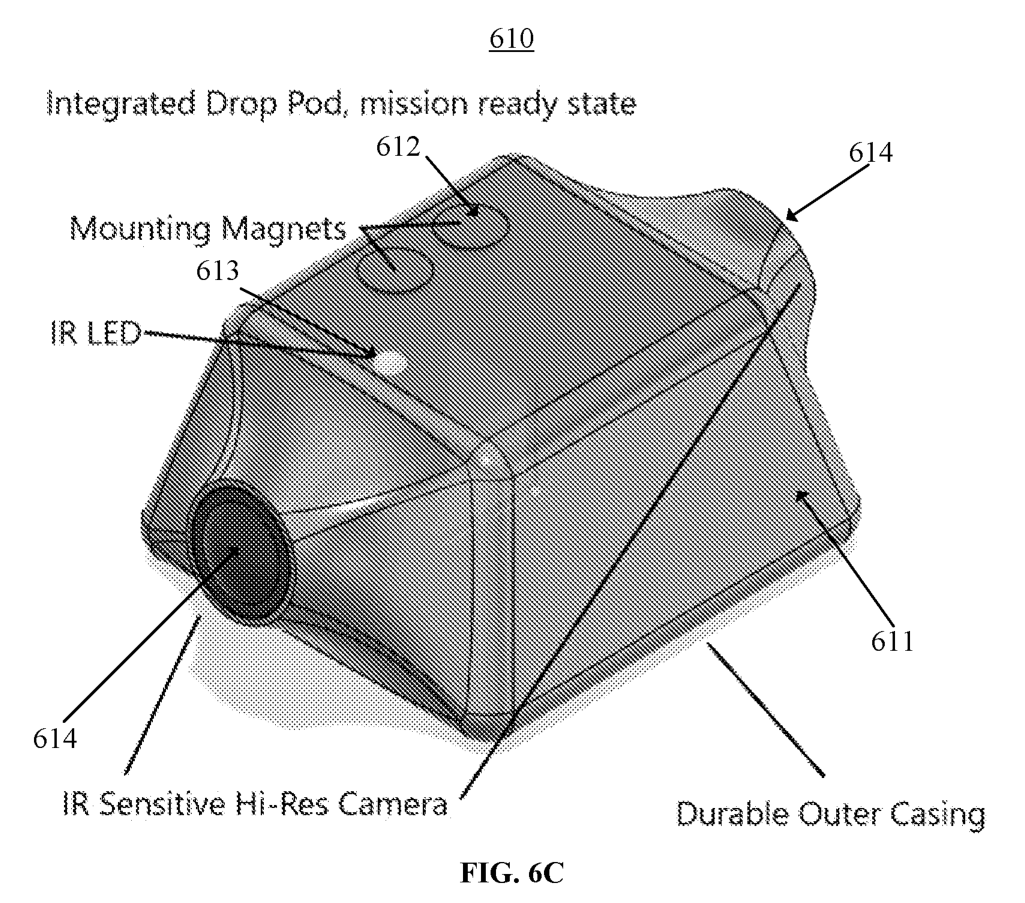
The July response made the connection in claim 1 more specific: engagement elements on the pod’s exterior top side couple to an electromagnet underneath the aircraft. Power on retains the pod in flight; power off releases it. Method claim 14 received corresponding detail. The applicant distinguished this arrangement from the grain system’s attachment and retrieval mechanisms.1112
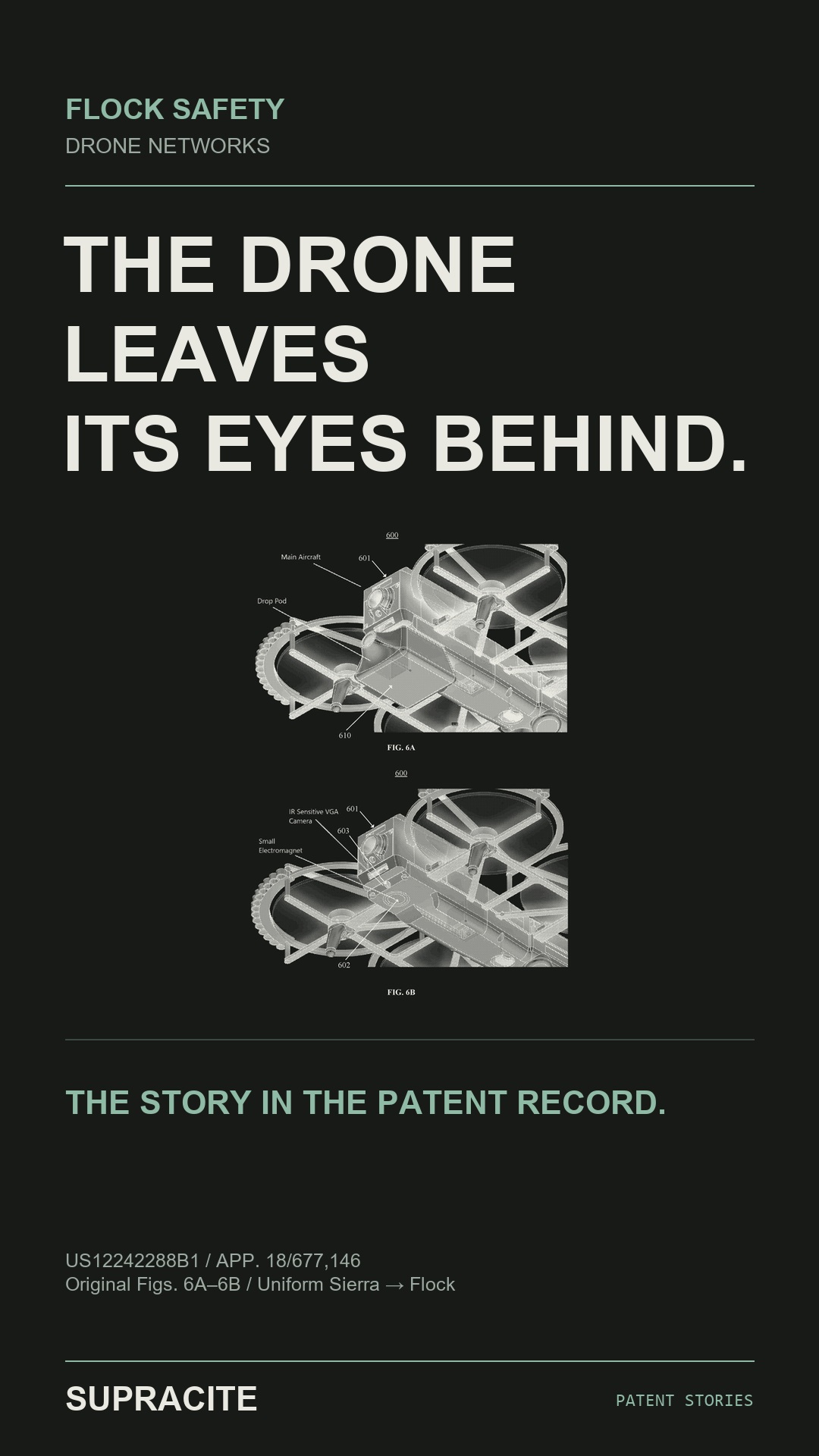
The drawings make the argument tangible: mounting elements sit on top of the pod, where it meets the carrier. Examiner Rufus C. Point’s corrected allowance reasons identify the electromagnetic interface among the features missing from the cited art. Here prosecution explains a concrete attachment limitation added to particular claims.136
The other claim route is the map
It would be a mistake to stop at the magnets. The July filing also added independent claims 21 and 24. They recite a general aircraft connection interface rather than importing claim 1’s specific electromagnetic arrangement. They pursue a different combination: the deployed pods, radio links, and control station’s placement decisions.14
Claim 21 combines image analysis, pod type and received signal strength to select a drop point, then displays incoming feeds to an operator. Claim 24 goes further into planning. Its mission map holds sensor data, signal strength and deployed-pod locations. Projected drop locations depend on their distribution and an estimated signal-strength map.14
This family therefore seeks protection for both a particular way to carry and release a pod and particular ways to decide where the network should go. A different attachment would not, on that fact alone, answer the separate map-based claims. Each claim still requires its complete recited combination.14
When coverage changes, move the network
Dependent claim 25 supplies the most interesting next step. The control station identifies weak regions of the mesh, simulates the effect of relocating deployed pods, selects pods based on that simulation, and tells an aircraft to retrieve and redeploy them. It adds that sequence to the system of claim 24.15
Imagine a room beyond the original route becomes important. The system could assess whether a node already in use would help more somewhere else, then send an aircraft to move it. That illustrates the claimed logic; it is not a documented Flock deployment. Retrieval becomes a way to reshape coverage during the mission.
The corrected August notice lists claims 21–25 as allowed alongside the amended attachment claims. Its reasons also discuss the mission map’s sensor data, signal strength and pod locations. The retrieved record shows allowance; it does not yet show a grant for this continuation.6
An outsider entered the file, but causation needs evidence
On November 5, 2025, Alex Hobson, registration 57,173, submitted six Ronald Carter patents with an explanation pointing to drone surveillance, docking, tracking and operator interfaces. The form does not identify the client behind the filing.1617
Point’s returned list records consideration of all six on August 10, 2026. But none supplied a rejection ground in the April action, and the magnetic amendments were filed on July 9. The record supports outside scrutiny followed by consideration; it does not establish that this submission caused the narrowing described above.18911
The stronger documented connection is between the examiner’s grain-monitoring art, the applicant’s attachment amendment, and the reasons for allowance.126
How this fits Flock’s actual drone business
Flock’s Alpha announcement describes a first-responder aircraft with cellular connectivity, a battery-swapping and charging dock, and integration with its DFR software and FlockOS. That is a concrete company product description. The acquired patent family describes another capability: installing and rearranging sensors and relays on the ground.19111
The ownership link is documented: Uniform Sierra Aerospace’s assignment to Flock Group was recorded on April 17, 2025. That is the patent recordation date, not necessarily the acquisition closing date. Ownership connects the family to Flock; it does not demonstrate that Alpha implements every disclosed feature.2
The demonstration worth watching for is a complete cycle: place a sensor where it has a useful view, keep its feed connected, identify a coverage gap, retrieve the right pod, and improve the network by putting it somewhere else. The patent record gives us that sequence to investigate. The compelling technical question is how well it survives a real building.
Evidence notes, claim details and open questions
Evidence coverage and the people behind the file
This review covers both indexed members of family 67018: 18/677,146 and 19/034,874. Refreshed platform indexes list 125 documents, all with files held: 64 in the parent and 61 in the continuation. Of those, 117 are OCR-complete and eight skipped. The parent’s September action had an empty text field, so its original PDF was rendered and read locally. Archive completeness is distinct from reading every administrative page.
The review checks original drawings, issued claims, deployment disclosure, parent examination and response, continuation rejection and July amendments, corrected allowance, and the third-party submission and returned list. The platform currently returns these two U.S. family members; no PCT or provisional was returned. This is a targeted family review, not a claim to have found every patent Flock owns.
Hongmin Fan signed the parent examination. Schiller Hill (78,886) signed its November response. Edward Steakley (47,964) signed the continuation’s July argument; Rufus C. Point signed its corrected allowance; Alex Hobson (57,173) signed the third-party submission. These are document-specific roles, not an assertion that any person represents every party discussed.7812616