SUPRACITE

Meta / Smart Glasses Draft

Before Meta Connect: when should smart glasses get out of the way?

New Meta filings explore a screen that disappears, cameras that pass object codes, hardware-enforced muting and quieter conversation. The original provisionals reveal the engineering questions worth watching at Connect.

Public draft · Research through 2026-09-16 · Updated 2026-09-16. This article is in review; findings and wording may change.

Watch an overview 1:32Narrated patent drawings · Captions included

A short summary of this article, with synthetic narration. The full analysis and sources follow below. Download video.

Read the video transcript

When should glasses get out of the way?
A computer on your face has to know when to disappear. Meta's recent patent filings make that a useful question before Connect.

The screen clears. The task continues.
One proposal clears the display when the wearer starts driving, while keeping audio responses available. The original January provisional already shows this transition.

Pass on context. Limit the pixels.
Another design recognizes objects on the image sensor and sends encrypted object codes onward. That can reduce raw-image exposure for that task. It does not make every camera mode private.

What actually enforces off?
A separate filing puts sensor muting under hardware control. The question becomes what enforces off, and whether the privacy indicator matches the sensor.

Two routes to a clearer conversation.
For conversation, one approach uses head motion to infer which sound zone matters. Another sends the glasses wearer's voice directly to somebody else's listening device.

A reply you need not say aloud?
Silent-input research senses physical activity associated with forming speech. It does not read arbitrary thoughts. Accuracy and accidental activation remain crucial questions.

The battery helps carry the frame.
A structural battery could help support the glasses arm and occupy curved space. That is a proposed design, without measured gains established here.

Watch the handoffs. And the mistakes.
These are engineering proposals, not confirmed launches. At Connect, watch the handoffs between modes, and what happens when the glasses get you wrong.

Explore the Meta patent families
People in this article · 4

Verified participation in the records cited here. Open a name for the full profile, or a PDF link for the original evidence page.

The most useful screen might be the one that disappears

A message arrives in your glasses. A moment later, you get behind the wheel. The message vanishes from your field of view; the assistant can still answer through audio. In Meta’s patent drawings, the impressive trick is the empty space where the interface used to be.2014

That is a useful way to read the company’s recent glasses filings before Connect. Meta said it would have more to share about its glasses lineup at the September 23 event. The records examined here point to a deeper question than whether another display or camera will fit into a Ray-Ban frame: can a computer on your face become useful without making every moment a computer interaction?19

The applications describe ways to clear the display, limit what a camera passes onward, make conversation easier to hear and accept speech-related input without an ordinary spoken command. They are separate engineering proposals, not a confirmed feature list for the next Ray-Ban product. Their value is in the decisions they make visible—and the questions they give us to ask of a live demonstration.

First, know when to get out of the way

US20260229154A1, published August 6, treats a display as something the glasses can switch out of, while continuing to respond through speakers. Its examples include automatically suppressing the display during driving and asking a cyclist to turn it off. When the relevant condition clears, the interface can return automatically or after a prompt. The broader mechanism also lets the wearer wake the display again.1
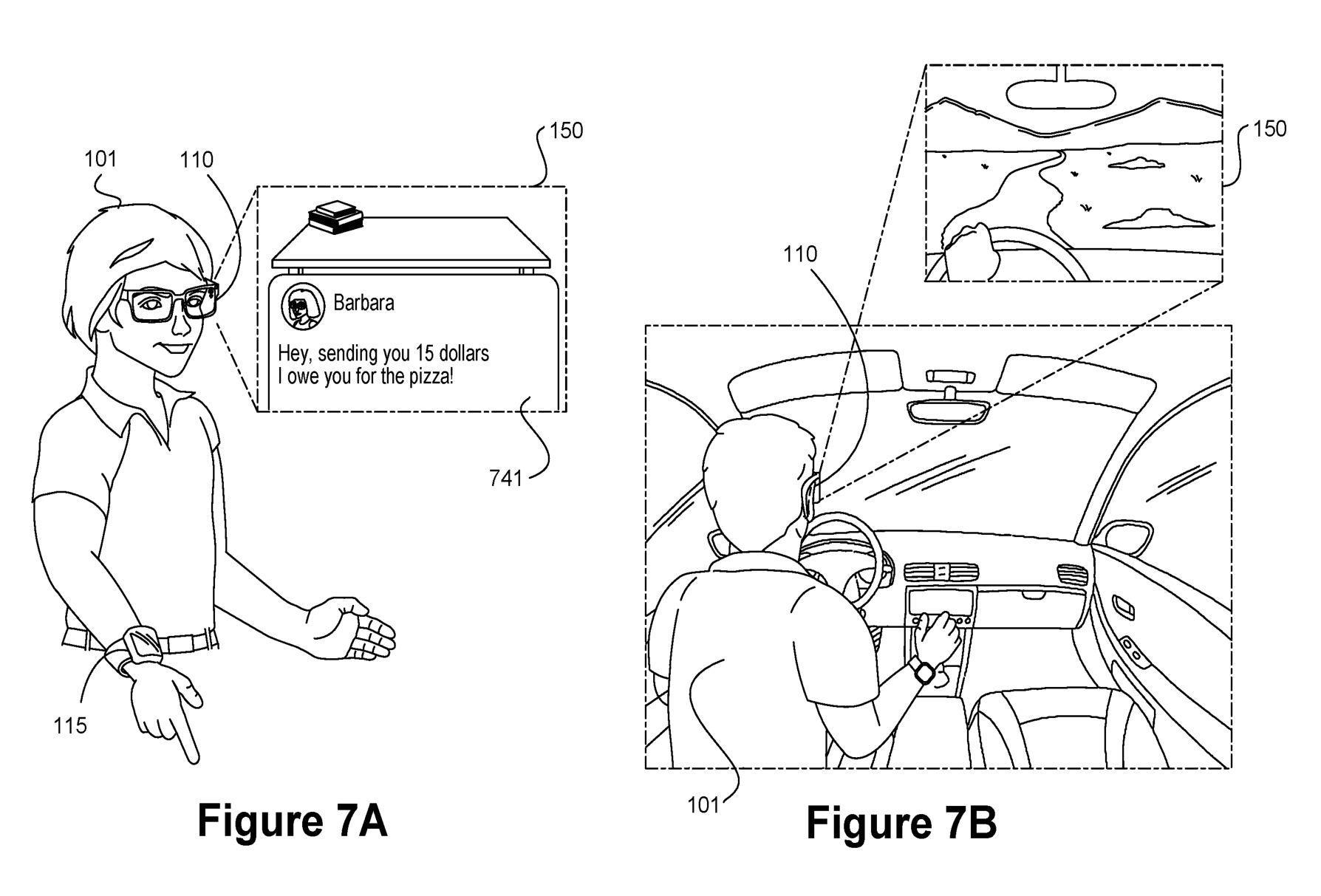
Original Figures 7A and 7B: a message in the glasses display, followed by a driving view with no displayed message.
63/752,499 — Figures 7A–7B from the January 31, 2025 provisional, later claimed by US20260229154A1. The displayed message disappears in the driving scene. Original drawing sheet 7, rotated upright and cropped at the margins. Application 63/752,499 Inspect original PDF

This is more interesting than a generic “do not disturb” toggle. The assistant can keep doing work while changing how the wearer receives the result. A visual confirmation can be useful at one moment and a distraction at the next. A display-equipped pair of glasses can temporarily behave like audio glasses.

The original filings let us check how early that idea existed. The January 31, 2025 provisional, 63/752,499, already contains the driving and bicycle sequences. In the corresponding passage of the July 8 provisional, 63/840,575, Meta elaborates the driver-versus-passenger problem: a forward camera could identify a steering wheel, and the determination could draw on camera, audio, location, motion or other sensor data. These are specific additions in the passages compared here; they are not a conclusion that every feature in the later application has a particular priority date.1415

The demonstration worth watching is the transition. Does a useful answer survive the change of mode? Does the display return at the right time? And when the glasses misread the situation, can the wearer correct them immediately? The filing supplies a design for that problem, not evidence that driving with an audio assistant is safe.

A camera that passes along meaning

The privacy question starts before a photograph reaches an app. US20260252168A1, published August 27, puts object detection on the image sensor. The sensor recognizes objects, generates codes describing them and encrypts those codes for an off-sensor processor. In the original Figure 1, a scene containing a car and a dog becomes object codes, then encrypted object codes.212
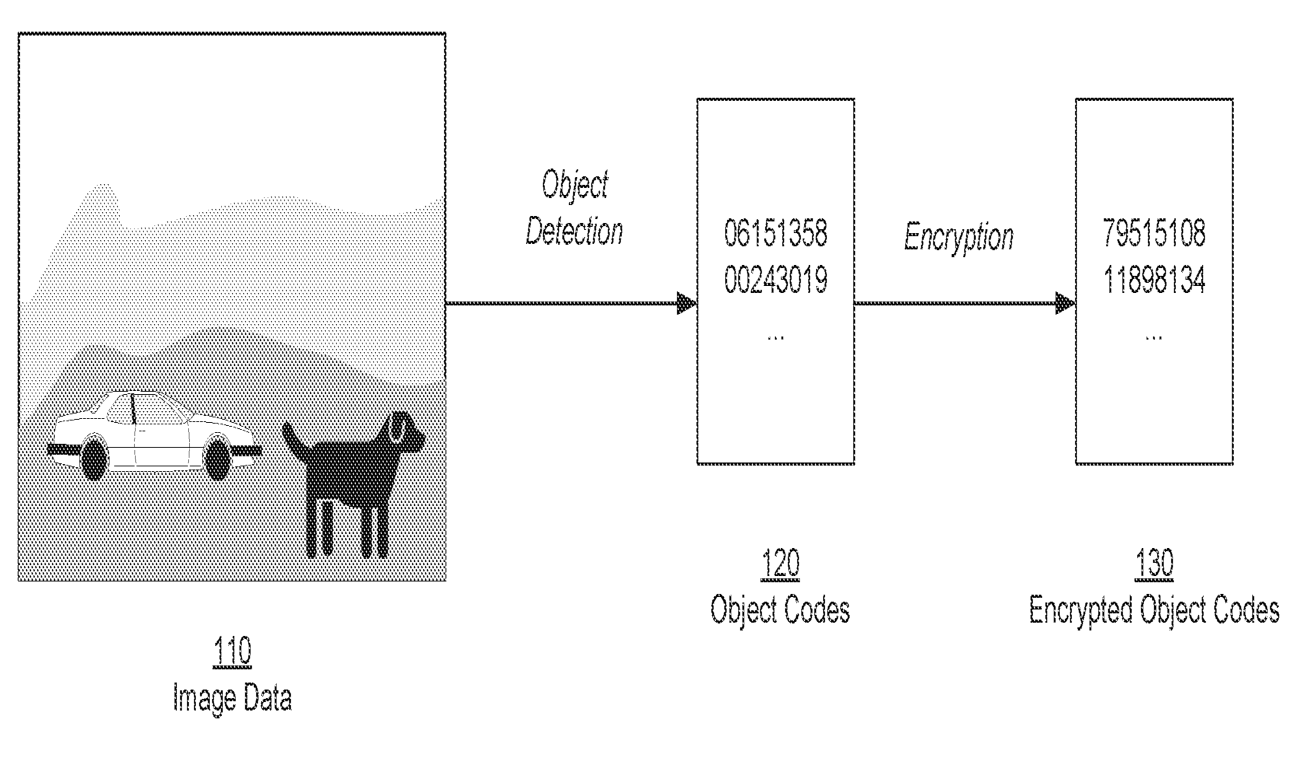
Original sensor diagram showing image data converted into object codes and then encrypted object codes.
63/764,049 — detail of original Figure 1, filed February 27, 2025; publication US20260252168A1. Left to right: image data, object codes, encrypted object codes. Cropped from IFW drawing document 239789, PDF p.1; no mechanism has been redrawn. Application 63/764,049 Inspect original PDF

That changes what the next stage of the system needs to receive. An assistant that needs object context might not need the original pixels for that task. The February 27, 2025 provisional, 63/764,049, already describes onboard detection and an encryption circuit; this is not an architecture inferred from a later marketing description.11

There is still a meaningful tradeoff. Object codes carry information about a scene, and their usefulness depends on the sensor identifying the right objects. This proposal does not show that all camera modes avoid transmitting images, that an entire product is private, or that every assistant task can be reduced to object labels. It gives us a concrete reporting question: for this feature, what exactly leaves the sensor?

And a mute control that software cannot casually undo

A separate family asks what “off” should mean. US20260244794A1, published August 20, describes a hardware-controlled sensor mute state. Its original February 18 provisional, 63/760,047, describes applying the mute state as a single hardware operation, enforcement settings that software cannot subsequently alter except through a hardware reset, and separate secure and non-secure sensor-processing paths.313

The distinction from the object-code design matters. One limits the information passed along while a sensing function operates. The other governs whether sensors may operate and how their processing paths are isolated. The latter disclosure also addresses coordination between privacy indicators and actual sensor operation: a light that says “off” is only useful if it tracks what the hardware is doing.13

Read together, the two families suggest a more demanding way to assess a camera assistant. Ask both what it shares while it is working and what enforces its state when you turn it off. They remain separate proposals; the records do not establish that a current or forthcoming pair of Meta glasses combines them.

Two ways to hear the person across the table

Now move from the road to a noisy table. There are two different places to improve the conversation: at the listener, where competing sounds arrive, or at the talker, before their voice has to cross the room.

The listener-side proposal is US20260255124A1, published August 27 and claiming January 17 and February 24, 2025 provisionals. It uses motion data to infer an auditory zone of interest and selectively enhance sound from that zone. The specification describes a focus anchored to the surrounding world, rather than assuming the desired speaker is always directly in front of the wearer’s face. That matters when you briefly turn your head while continuing to listen to the same person.7

US20260270630A1, published September 10 and claiming provisional 63/767,613 of March 6, takes the talker-side route. The glasses capture their own wearer’s voice and send it to another person’s wearable audio device. This is a direct link from the person speaking to the person listening, distinct from enhancing the listener’s surrounding sound field.8

The comparison produces different tests. For the first, watch whether the system follows the conversation the wearer intends to hear when their head moves. For the second, ask how people establish the link and what happens when the conversation changes participants. A quiet stage demonstration would tell us little about either problem.

The reply you would rather not say aloud

Listening discreetly is only half the social problem. There are plenty of places where speaking an instruction to your glasses is awkward. US20260253591A1, published August 27, explores detecting speech-related activity through sensors in contact with the head or face. Its February 25, 2025 provisional, 63/762,845, discusses electrical muscle signals, contact microphones and motion or vibration sensing.918
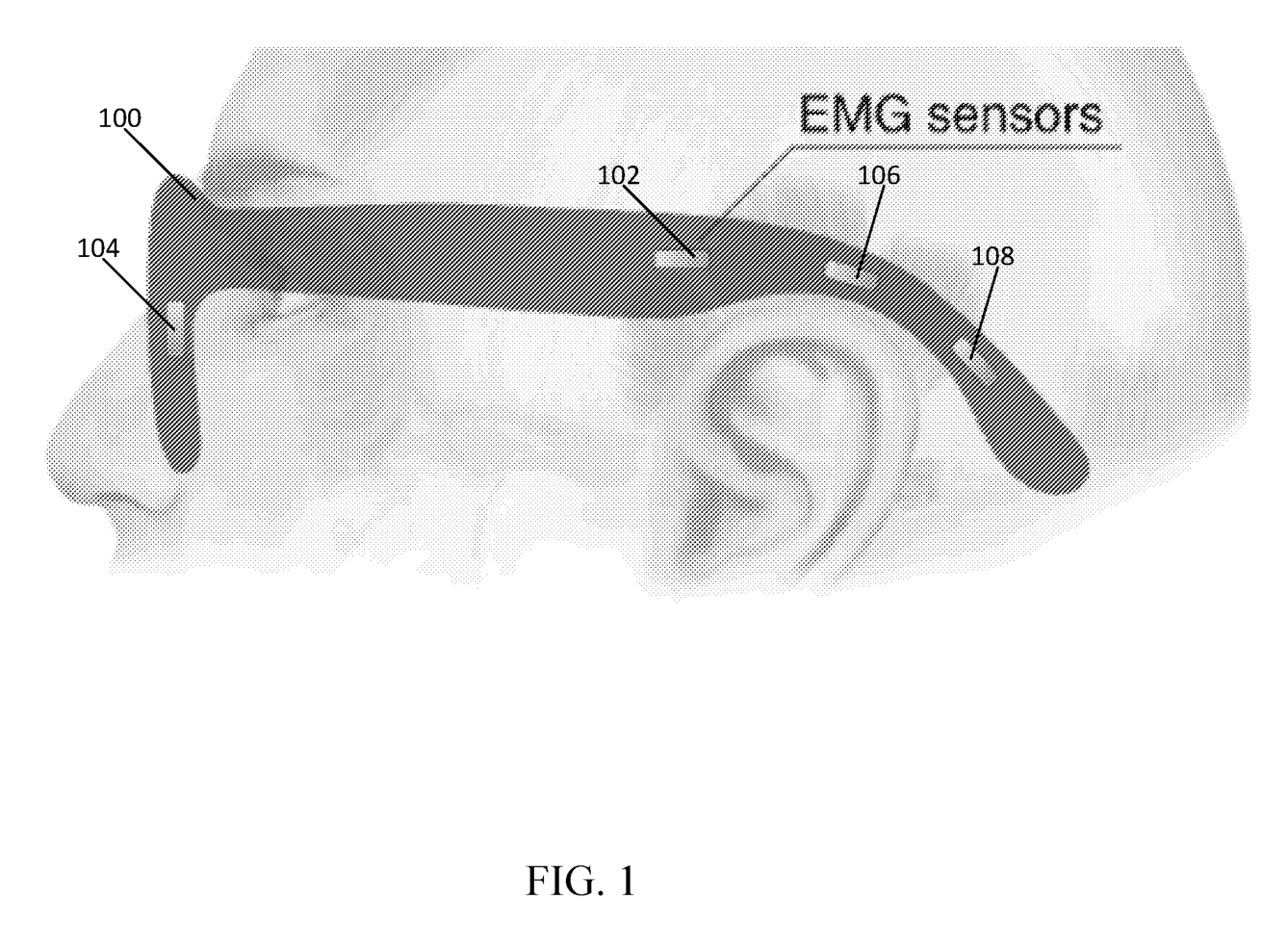
Original Meta silent-speech provisional drawing with sensing locations on a glasses frame.
63/762,845 — original Figure 1, filed February 25, 2025; publication US20260253591A1. Contact with the head or face provides access to physical speech-related signals. The drawing is not evidence of unrestricted thought decoding. Application 63/762,845 Inspect original PDF

The appealing scenario is a private instruction without an ordinary voiced command. The mechanism still depends on physical activity associated with forming speech. It does not read arbitrary thoughts. Mouthing words, whispering and producing detectable activity without audible speech also impose different technical demands; a demonstration should say which one it is doing.

This is the frontier portion of the story. A convincing demo would need to show the permitted vocabulary, calibration, sensitivity to frame fit and the rate of unintended activations. A successful command on stage would not by itself establish an everyday replacement for speech or touch.21

The frame has to carry all of this

Every additional sensing or display function still has to fit into something a person will wear. The most tangible hardware idea in this group appears in US20260237727A1, published August 13: a polymer-electrolyte battery integrated into a temple arm, with a bonded hermetic coating. A dependent claim expressly adds mechanical support of the temple arm.4
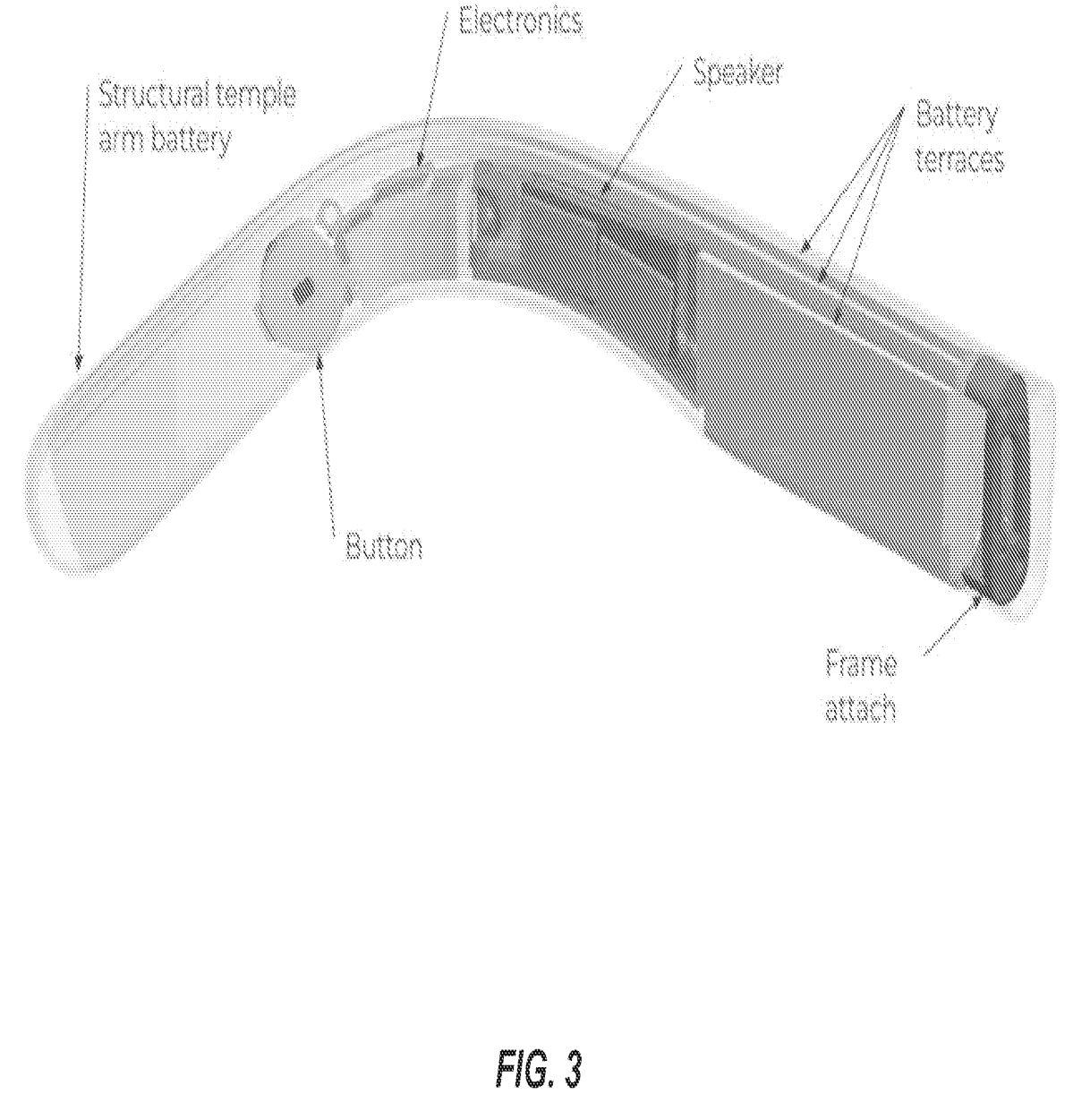
Original provisional Figure 3 labels the structural temple-arm battery, electronics, speaker and battery terraces.
63/756,718 — original Figure 3, filed February 10, 2025; publication US20260237727A1. Battery geometry and frame structure are designed together. Cropped from original drawing document 239936, PDF p.3. Application 63/756,718 Inspect original PDF

The original February 10, 2025 provisional, 63/756,718, makes the proposal easy to see. Its Figure 3 labels a structural temple-arm battery, a speaker, electronics and terraced battery sections. The specification describes tuning the battery’s stiffness, reducing the surrounding packaging burden and shaping cells to occupy curved parts of the frame.1617

The ambition is for the battery to contribute to the structure that holds it, while recovering space otherwise lost to packaging and awkward geometry. The unresolved questions are equally physical: repeated bending, moisture protection, manufacturing tolerances and long-term capacity. The reviewed record does not establish measured gains in battery life, weight, yield or cycle life. It is a strong direction to follow, with much weaker grounds for predicting a product announcement next week.

Two more problems beyond the next demo

The rest of the shortlist broadens the engineering picture. US20260244025A1, published August 20, uses body-coupled communication in eyewear: one electrode contacts skin, while another arrangement can use a transparent lens conductor as a floating ground. Its claimed provisional is 63/760,324, filed February 19, 2025. The June 18 publication US20260172123A1 addresses a related but separate wearable-network problem—adapting communication as body impedance and contact conditions change—and claims five provisionals from December 2024 through July 2025. These are communications proposals, not evidence of thought sensing or of Bluetooth disappearing from a named product.56

US20260177838A1, published June 25 and claiming 63/736,435 of December 19, 2024, tackles prescription display optics. Light from the real world and light making the virtual image take different paths; its holographic optical element incorporates correction for the virtual image. Ordinary prescription support is not the novelty being claimed here. The interest lies in making the display’s optical path work for the wearer as well as the view through the lens.10

These subjects deserve their own treatment. For this preview, they explain why adding a feature to glasses can also create a connection, fit, power or optical problem elsewhere in the system.

At Connect, watch the handoffs

The records give us a more useful checklist than an invented product specification. Watch a visual answer become an audio answer without losing the task. Watch what happens when the glasses infer the wrong context. Ask what the camera passes onward, what actually enforces a mute, and whose voice a listening feature is designed to improve.

If silent input appears, ask what physical action makes it work and how often it fires when it should not. If lighter frames or longer endurance are announced, look for measured results before connecting them to a structural-battery proposal.

The common question is whether the interface leaves you in control of your attention. A computer that is always available has to be unusually good at knowing when to disappear.

Evidence notes, claim details and open questions

What these records establish

Research through September 16, 2026. This pass screened 133 Meta Platforms U.S. application publications returned for June 1–September 16; the latest imported publication week was September 10. A parallel Facebook-name search added no results. Fifty opening priority statements identified a continuation or divisional. Those were not treated as new underlying research simply because their publication date was recent.

The ten publications discussed here claim 16 provisionals, with no earlier U.S. publication found in the retrieved application and continuity records. We treat them as first-U.S.-publication candidates. International publication coverage was insufficient to establish the first worldwide disclosure, so “newly visible” here does not mean proved secret until the U.S. publication date. Provisionals are not independently published application publications; their underlying files can become accessible through related public records. Nor does a priority claim prove that a provisional supports every later feature.

As of 2026-09-16 18:18 UTC, all 479 indexed documents across the 26 selected U.S. files were downloaded. 455 had text; OCR reported 454 completed and 25 skipped, with none pending. Acquisition is not substantive review. This article relies on the specific publication passages, original provisional passages and drawings identified in its source pinpoints. It does not claim a complete review of every appendix, all prosecution events or international file histories.

The family maps below are native patent-platform exports. The map for US20260255124A1 is withheld because the returned graph incorrectly includes an unrelated medical branch. Its publication and two expressly claimed provisionals remain identified above; we have not substituted a reconstructed family tree.

The people panel links the on-sensor application’s signed data sheet and inventor declarations to their original pages. It identifies documented participation; it is not a complete contributor list for all ten families.2223

Sources and original records

  1. US20260229154A1 — TECHNIQUES FOR SWITCHING BETWEEN A DISPLAY MODE AND A DISPLAYLESS MODE AT A HEAD-WEARABLE DEVICE, AND DEVICES AND METHODS OF USE THEREOF

    Application 19/458,549 · Publication US20260229154A1

    Publication August 6, 2026; paragraph 0001 (two provisionals), paragraphs 0073–0080 (driving/cycling), 0104 (display/audio mode switching), claim 1.

    Original record supports the specific disclosed mechanism and document identity. This is selected technical review, not a claim-support opinion, complete prosecution review, product identification, or confirmed announcement.

    Retrieved 2026-09-16

    Original-file fingerprint88890e0b1cb74452d976c0588869d31efd153288ac49bd5546b2b3157a6e9e20
  2. US20260252168A1 — ON-SENSOR OBJECT DETECTION FOR PRIVACY

    Application 19/536,269 · Publication US20260252168A1

    Publication August 27, 2026; paragraph 0001 (63/764,049), paragraphs 0026–0034 and claim 1 (on-sensor object detection and encrypted object codes).

    Original record supports the specific disclosed mechanism and document identity. This is selected technical review, not a claim-support opinion, complete prosecution review, product identification, or confirmed announcement.

    Retrieved 2026-09-16

    Original-file fingerprint5b57006c2225db620bb9049e7f2b5de57c0c3ef7c8263f75394a972b5d2dc00c
  3. US20260244794A1 — Secure Hardware-Enforced Sensor Privacy Systems And Methods for Performing Thereon

    Application 19/533,026 · Publication US20260244794A1

    Publication August 20, 2026; paragraph 0001 (63/760,047), paragraphs 0003–0008 and claim 1 (hardware-controlled mute state).

    Original record supports the specific disclosed mechanism and document identity. This is selected technical review, not a claim-support opinion, complete prosecution review, product identification, or confirmed announcement.

    Retrieved 2026-09-16

    Original-file fingerprint646dc8df99e4a851a845bfa33b8eb82b5acff4b3e73ad16e5612c5539488f1c2
  4. US20260237727A1 — HERMETICALLY SEALED POLYMERIZED STRUCTURAL BATTERIES FOR WEARABLE DEVICES

    Application 19/534,665 · Publication US20260237727A1

    Publication August 13, 2026; paragraph 0001 (63/756,718), paragraphs 0004–0008, claims 1–2 (hermetic coating, polymer electrolyte and structural support).

    Original record supports the specific disclosed mechanism and document identity. This is selected technical review, not a claim-support opinion, complete prosecution review, product identification, or confirmed announcement.

    Retrieved 2026-09-16

    Original-file fingerprint3bc5d0e335f66cbdbde0e9961a1828a7f0521711c288cdba75ecba0837908f90
  5. US20260244025A1 — HUMAN BODY COMMUNICATION VIA ELECTRONIC EYEWEAR DEVICES

    Application 19/467,605 · Publication US20260244025A1

    Publication August 20, 2026; paragraph 0001 (63/760,324), paragraphs 0036–0041, claims 1–3 (skin contact and transparent lens electrode).

    Original record supports the specific disclosed mechanism and document identity. This is selected technical review, not a claim-support opinion, complete prosecution review, product identification, or confirmed announcement.

    Retrieved 2026-09-16

    Original-file fingerprintc40020a9fc5d4601dc27f6239e12af5b3b88c08b821c88c5a96caa0f50901f84
  6. US20260172123A1 — DEVICE, SYSTEMS, AND METHODS FOR BODY AREA NETWORK COMMUNICATIONS

    Application 19/425,877 · Publication US20260172123A1

    Publication June 18, 2026; paragraph 0001 (five provisionals through July 10, 2025), paragraphs 0007–0010 and claim 1 (adaptive body-area communication).

    Original record supports the specific disclosed mechanism and document identity. This is selected technical review, not a claim-support opinion, complete prosecution review, product identification, or confirmed announcement.

    Retrieved 2026-09-16

    Original-file fingerprintc8917c470461c1e33b1b8a38f8e222efd994dade5682df864e8cf54746bacc8e
  7. US20260255124A1 — SELECTIVE ENHANCEMENT OF AUDIO SIGNALS FROM ZONES OF INTEREST

    Application 19/446,140 · Publication US20260255124A1

    Publication August 27, 2026; paragraph 0001 (January 17 and February 24, 2025 provisionals), paragraphs 0031–0032 and claim 1 (motion-derived auditory zones). Family graph has an unrelated medical branch and is not relied on.

    Original record supports the specific disclosed mechanism and document identity. This is selected technical review, not a claim-support opinion, complete prosecution review, product identification, or confirmed announcement.

    Retrieved 2026-09-16

    Original-file fingerprintd0711cbfb2f1442d590360ce332af18c68455889dc4c18e2cf3af873d8f9a66e
  8. US20260270630A1 — SMART GLASSES SYSTEMS FOR HEARABLE CONVERSATIONS

    Application 19/554,369 · Publication US20260270630A1

    Publication September 10, 2026; paragraph 0001 (63/767,613), paragraphs 0027–0029 and claim 1 (transmission of a talker’s voice to a listener’s wearable audio device).

    Original record supports the specific disclosed mechanism and document identity. This is selected technical review, not a claim-support opinion, complete prosecution review, product identification, or confirmed announcement.

    Retrieved 2026-09-16

    Original-file fingerprint2c88be0b3063b3bc753a1e85e7e502b9660da016e410275a3cce4f70edecc929
  9. US20260253591A1 — Methods And Systems For Detecting Sub-Vocal Speech Using Wearable Devices

    Application 19/550,171 · Publication US20260253591A1

    Publication August 27, 2026; paragraph 0001 (63/762,845), opening technical discussion and claim 1 (head/face contact sensors detect speech-related articulatory activity).

    Original record supports the specific disclosed mechanism and document identity. This is selected technical review, not a claim-support opinion, complete prosecution review, product identification, or confirmed announcement.

    Retrieved 2026-09-16

    Original-file fingerprintc8b512d4b6a612c9f78aa3c2578957ead31e1ab50d5f5a9c4c564659f4b2f12a
  10. US20260177838A1 — HOLOGRAPHIC DISPLAY FOR PRESCRIPTION LENSES

    Application 19/385,352 · Publication US20260177838A1

    Publication June 25, 2026; paragraph 0001 (63/736,435), paragraphs 0024–0032 and claim 1 (holographic element with prescription correction).

    Original record supports the specific disclosed mechanism and document identity. This is selected technical review, not a claim-support opinion, complete prosecution review, product identification, or confirmed announcement.

    Retrieved 2026-09-16

    Original-file fingerprint4ad639b22de5b84ce4494ae69f2268747cd4edecb7a95448d7b0f92a0eafb6aa
  11. 63/764,049 — Original on-sensor object-identification provisional

    Application 63/764,049

    Original specification PDF p.4, paragraphs 0020–0021 visually reviewed: on-sensor object detection, object codes, encryption and ASIC implementation. Remaining pages not fully reviewed.

    Original record supports the specific disclosed mechanism and document identity. This is selected technical review, not a claim-support opinion, complete prosecution review, product identification, or confirmed announcement.

    Retrieved 2026-09-16

    Original-file fingerprint299573d9a0b9cdd86149a9b86b8b802d99c554b4a52960d14e5e97f7c948957b
  12. 63/764,049 — Original provisional Figure 1

    Application 63/764,049

    PDF p.1 / drawing 1 of 12. Image data becomes object codes and then encrypted object codes. Original page rendered inline.

    Original record supports the specific disclosed mechanism and document identity. This is selected technical review, not a claim-support opinion, complete prosecution review, product identification, or confirmed announcement.

    Retrieved 2026-09-16

    Original-file fingerprint9d153be86c0a0970d769e5da51ee004427f7966711ba108129264769cbac82de
  13. 63/760,047 — Original hardware sensor-privacy provisional

    Application 63/760,047

    Original specification PDF pp.1–3, paragraphs 0001–0011; OCR opening passages reviewed. Hardware mute enforcement and secure/non-secure sensor paths already described.

    Original record supports the specific disclosed mechanism and document identity. This is selected technical review, not a claim-support opinion, complete prosecution review, product identification, or confirmed announcement.

    Retrieved 2026-09-16

    Original-file fingerprint5acce5f8e9b72908462a131fd87810699e4847561c984826093e6cfdbbb96a1a
  14. 63/752,499 — January display/displayless provisional

    Application 63/752,499

    Original specification PDF p.1 paragraph 0002; pp.24–27 paragraphs 0071–0078: automatic display suppression in the driver seat, continued audio, bicycle prompt and restoration. Selected original passages compared with the July version.

    Original record supports the specific disclosed mechanism and document identity. This is selected technical review, not a claim-support opinion, complete prosecution review, product identification, or confirmed announcement.

    Retrieved 2026-09-16

    Original-file fingerprint65a0149ff9d1b4badb4308f364f8edd4185aab6a346b42eefaed58662679d4a7
  15. 63/840,575 — July display/displayless provisional

    Application 63/840,575

    Original specification PDF pp.24–28, paragraphs 0071–0079. Paragraph 0072 elaborates driver-versus-passenger identification, steering-wheel camera example and possible sensor inputs; paragraphs 0071, 0074 and 0077 add timing examples. Compared with the corresponding January passages, not a complete priority-support analysis.

    Original record supports the specific disclosed mechanism and document identity. This is selected technical review, not a claim-support opinion, complete prosecution review, product identification, or confirmed announcement.

    Retrieved 2026-09-16

    Original-file fingerprint354ce5e1b94b2b634676118f8671198994eb2219a127e1ca75151b4422651053
  16. 63/756,718 — Original structural-battery provisional

    Application 63/756,718

    Original specification PDF pp.3–5 / printed pp.2–4, paragraphs 0007–0014, visually reviewed. Flexible structural battery, tunable polymer electrolyte stiffness, thin hermetic coatings, shaped cells, temple-arm support. Appendix review outstanding.

    Original record supports the specific disclosed mechanism and document identity. This is selected technical review, not a claim-support opinion, complete prosecution review, product identification, or confirmed announcement.

    Retrieved 2026-09-16

    Original-file fingerprint31d8ee87bfae430e4bf27ca14e62858e2f5ca0f66cd6513d3d839a9bc44ec2c1
  17. 63/756,718 — Original provisional Figure 3

    Application 63/756,718

    PDF p.3 / drawing 3 of 3. Structural temple-arm battery, battery terraces, electronics and speaker. Original page rendered inline.

    Original record supports the specific disclosed mechanism and document identity. This is selected technical review, not a claim-support opinion, complete prosecution review, product identification, or confirmed announcement.

    Retrieved 2026-09-16

    Original-file fingerprintd96f4ca611ef2d31e5d237ca69f6916f240d7137e8f639d281a83edfc5db6266
  18. 63/762,845 — Original silent-speech provisional

    Application 63/762,845

    Prior September 15 review: PDF pp.2–4, paragraphs 0008–0016; reluctance to speak in public, frame-mounted EMG/contact microphones/motion sensing and vocabulary alternatives.

    Original record supports the specific disclosed mechanism and document identity. This is selected technical review, not a claim-support opinion, complete prosecution review, product identification, or confirmed announcement.

    Retrieved 2026-09-16

    Original-file fingerprint3bec46a7504e264dbcd018f3b14643f116abab5174f9a025f5811c7ef977a881
  19. Meta Q2 2026 earnings call — glasses at Connect

    PDF p.4: management says it will have more to share on the glasses lineup at Connect on September 23. This does not identify any of these patent features.

    Direct company statement supports a glasses-focused Connect research angle.

    Retrieved 2026-09-16

  20. 63/752,499 — Original display-mode Figures 7A–7B

    Application 63/752,499

    PDF p.7. Displayed message gives way to an unobstructed driving view. Rotated 90 degrees clockwise and cropped at the page margins; original figure labels retained.

    Original drawing or specification supports the cited disclosed mechanism; it does not identify a shipping product.

    Retrieved 2026-09-16

    Original-file fingerprintdbd3c5b62a06e40fa417aca79332e50523ed102445546fa228b70d576ea9e7d5
  21. 63/762,845 — Original silent-speech Figure 1

    Application 63/762,845

    PDF p.1 / original Figure 1; head-contact sensing locations in the glasses frame.

    Original drawing or specification supports the cited disclosed mechanism; it does not identify a shipping product.

    Retrieved 2026-09-16

    Original-file fingerprintfb8cb4dde3bd0e16de372124076beb28772a3959c718e3acfe022b4e4ffd6bbc
  22. 19/536,269 — Application data sheet — Aaron J. Visbeek, registration 68,372

    Application 19/536,269 · Publication US20260252168A1

    Original PDF p.7: signatures visually checked; application identity matched to US20260252168A1.

    Document participation, not technical authorship of every feature or an inference about current employment.

    Retrieved 2026-09-16

    People in this record

    Original-file fingerprint64197a54bab5ee4dd944a4948cf7f196dd49f6851ad34f730de0832b6d759d6d
  23. 19/536,269 — Inventor declarations — Sarwar, Liu and De Salvo

    Application 19/536,269 · Publication US20260252168A1

    Original PDF p.3: signatures visually checked; application identity matched to US20260252168A1.

    Document participation, not technical authorship of every feature or an inference about current employment.

    Retrieved 2026-09-16

    Original-file fingerprint73a761b3263df71f67ef90e184fa450d1e5da9d66b9e6160c09dc347c67c56e9