Your hands already have a job
Imagine wearing a computer that mistakes reaching for your coffee for a click. Then imagine it making that mistake while you cook, button a shirt or talk with your hands. A wristband that can recognize tiny movements has a second, less glamorous job: deciding which movements to leave alone.
That is the problem running through Meta’s gesture patents. Their starting point is ordinary hand activity accidentally triggering an interface. The proposed answer is to give an interaction a beginning, a period in which commands count, and a definite end. 1
Meta Neural Band has already brought wrist-based muscle sensing to Ray-Ban Display glasses. Reading the patent record reveals the decisions behind this kind of interface: when to listen closely, how to move through a menu, and when to go quiet again. The filings describe several possible systems; they do not establish the internal design of the band you can buy. 14
The signal is muscle activity
Surface electromyography, or sEMG, measures electrical activity from muscles through electrodes on the skin. In Meta’s research system, patterns recorded at the wrist become inputs for models that recognize finger gestures, wrist movement and handwriting. A thought alone is not the signal being measured. 15
That gives the interface an appealing physical scale. You need not raise a hand into a camera’s view or reach for the glasses. Meta describes the consumer band as translating subtle hand movements into commands. But detecting a movement and deciding that it was meant for a computer remain separate problems. 14
The distinction matters because your hand spends most of its day doing things for you, with no computer involved. Sensitivity is useful only if the interface gives you a reliable way to take control of it.
First, make the gesture mean something
In Figure 1B, a pinky-to-thumb pinch changes what the wearer can do. The radial menu acquires prompts for further actions. Keep the pinch, rotate the wrist to another option, then use a control gesture to act on it. The specification explores several variations, including tapping another finger and increasing pinch force. 16
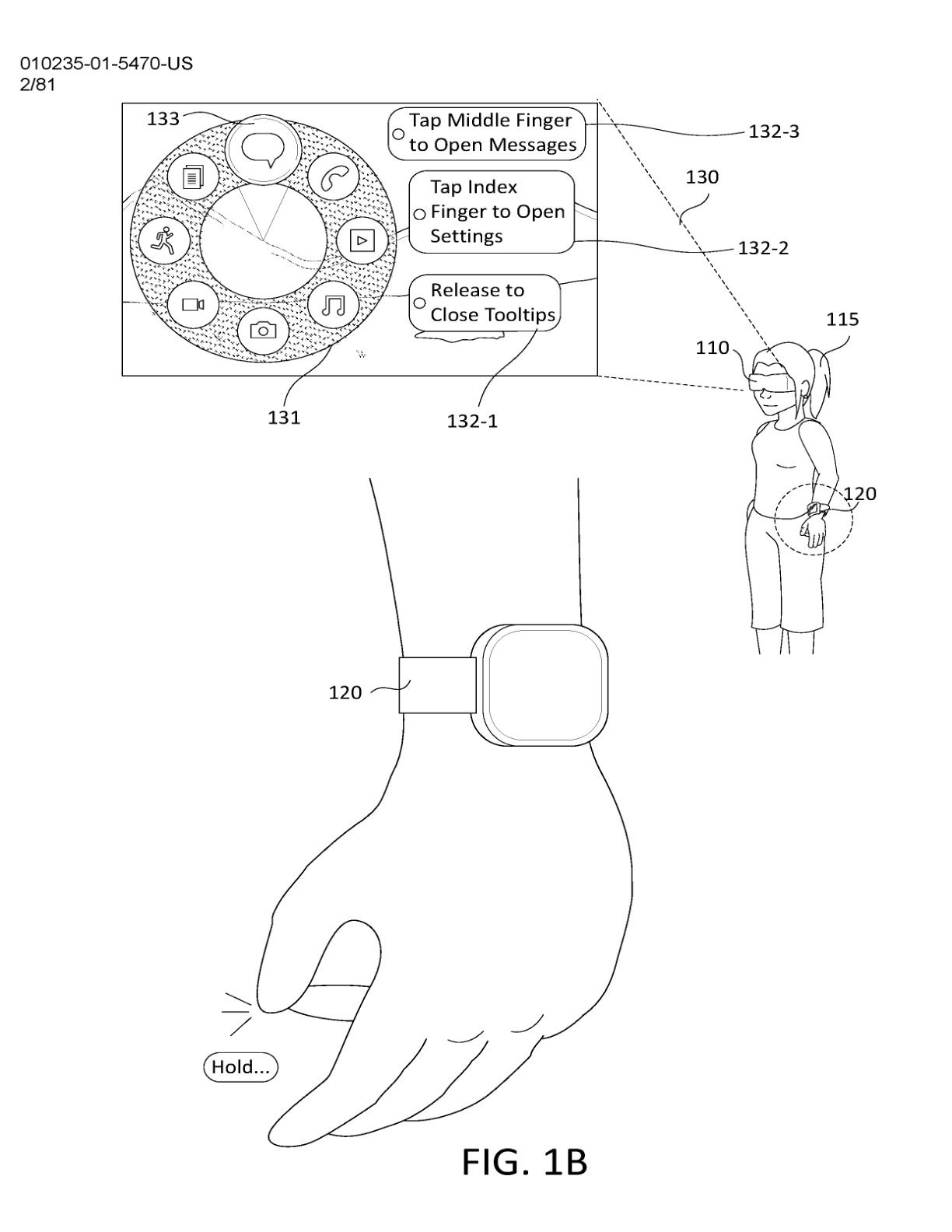
Think of the first gesture as opening a short conversation with the interface. Subsequent movement has a context: you are choosing something in a menu. The patent also describes releasing a held gesture to dismiss a display, and other embodiments in which release commits a selection. Those are different interaction designs, not one universal meaning for letting go. 1
The useful idea is that recognizing a pinch need not immediately perform the consequential action. The system can first expose the available choices, let you steer, and wait for confirmation.
The part of the claim that changes the story
The issued claim in US12436620B2 is more specific than that menu example. A priming gesture activates the interface and additional wrist sensors. A control gesture must arrive within a defined time and must be detected using at least those additional sensors. After execution, the interface and extra sensors deactivate. The claim then includes another activation cycle in which no timely control gesture arrives, and they deactivate again. 1
This is where the file history earns its place. In April 2025, Meta’s response emphasized activating additional sensors and the repeated shutdown-and-restart sequence. The examiner’s reasons for allowance described that combination the following month. Reading only the title would miss the connection between avoiding accidental commands and deciding when more sensing hardware should be awake. 910
It also changes the question to ask of the technology. A convincing demonstration shows a command working. A convincing everyday interface also shows what happens when you start an interaction, change your mind, or never finish it.
“Send” deserves a second step
One of the clearest drawings begins with an unsent message. The interface invites a ring-finger pinch to start sending; the next screen asks for a wrist rotation to confirm. The hand gesture and visible prompt work together, giving the wearer a chance to distinguish preparing an action from completing it. 16
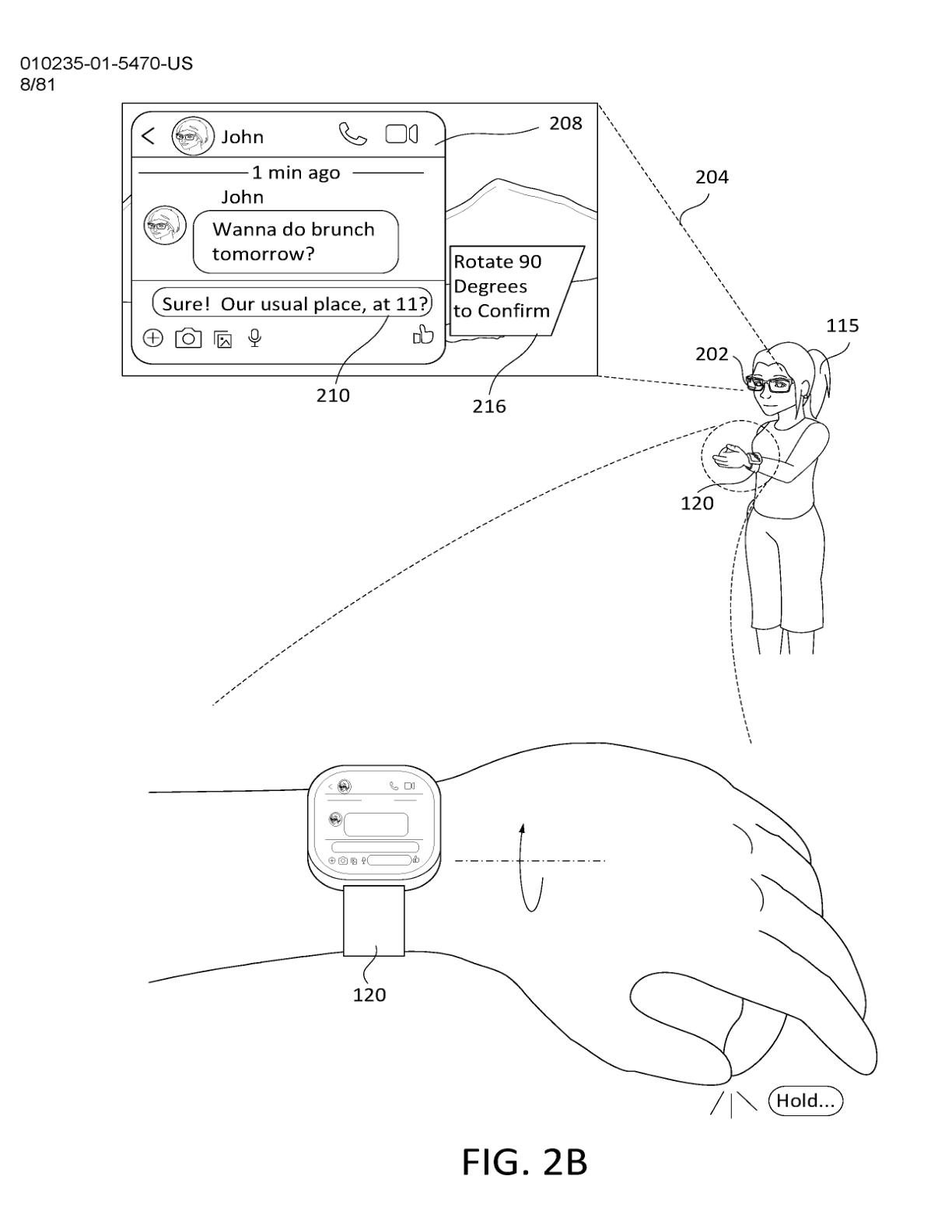
That example makes the design problem tangible. An accidental menu opening is annoying. An accidental message can be harder to undo. A staged interaction can spend a little more effort where a mistake matters, provided the extra step remains easy to understand.
The drawing illustrates that possibility. It does not prove a measured reduction in accidental messages, and it should not be read as a description of the current messaging app.
A cursor needs somewhere to land
Once you have the interface’s attention, a new difficulty appears: landing on the right control without a mouse or touchscreen. Meta’s navigation patent, US12360608B2, describes two conditional navigation behaviors. A finger-based gesture snaps the point of focus between selectable elements. A wrist- or forearm-based gesture moves it directionally to a position distinct from those controls. A further execution gesture acts on the selected element. 2
The two behaviors offer the predictability of stepping through a list and the freedom of moving a pointer. The dependent claims also explore proximity-based snapping and a separate threshold for moving away again. In practical terms, the interface can help a selection settle onto a target without making it equally easy to drift off it. 2
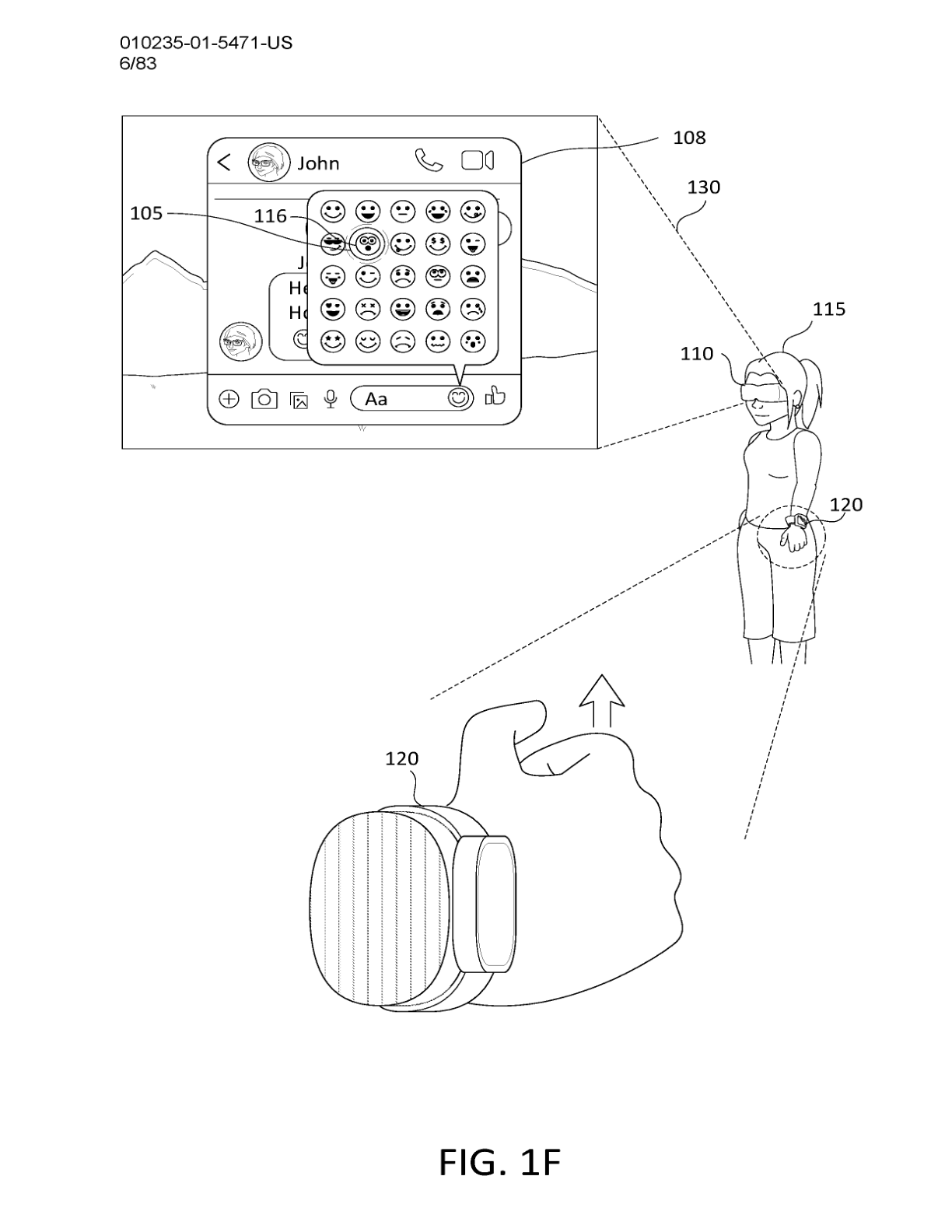
The drawings make this less abstract: a wearer moves through an emoji menu with wrist movements and then taps to insert the chosen emoji. The important distinction is between moving the selection and executing it. A system that recognizes both motions still needs to preserve that distinction for the user. 27
The full recognizer need not stay awake
The power-processing patent, US12724491B2, gives the band two levels of gesture recognition. A lower-power detector can flag signals that need a more capable detector. The higher-power detector recognizes a larger set of gestures. Crucially, some gestures can be recognized and acted on by the lower-power detector alone. 3
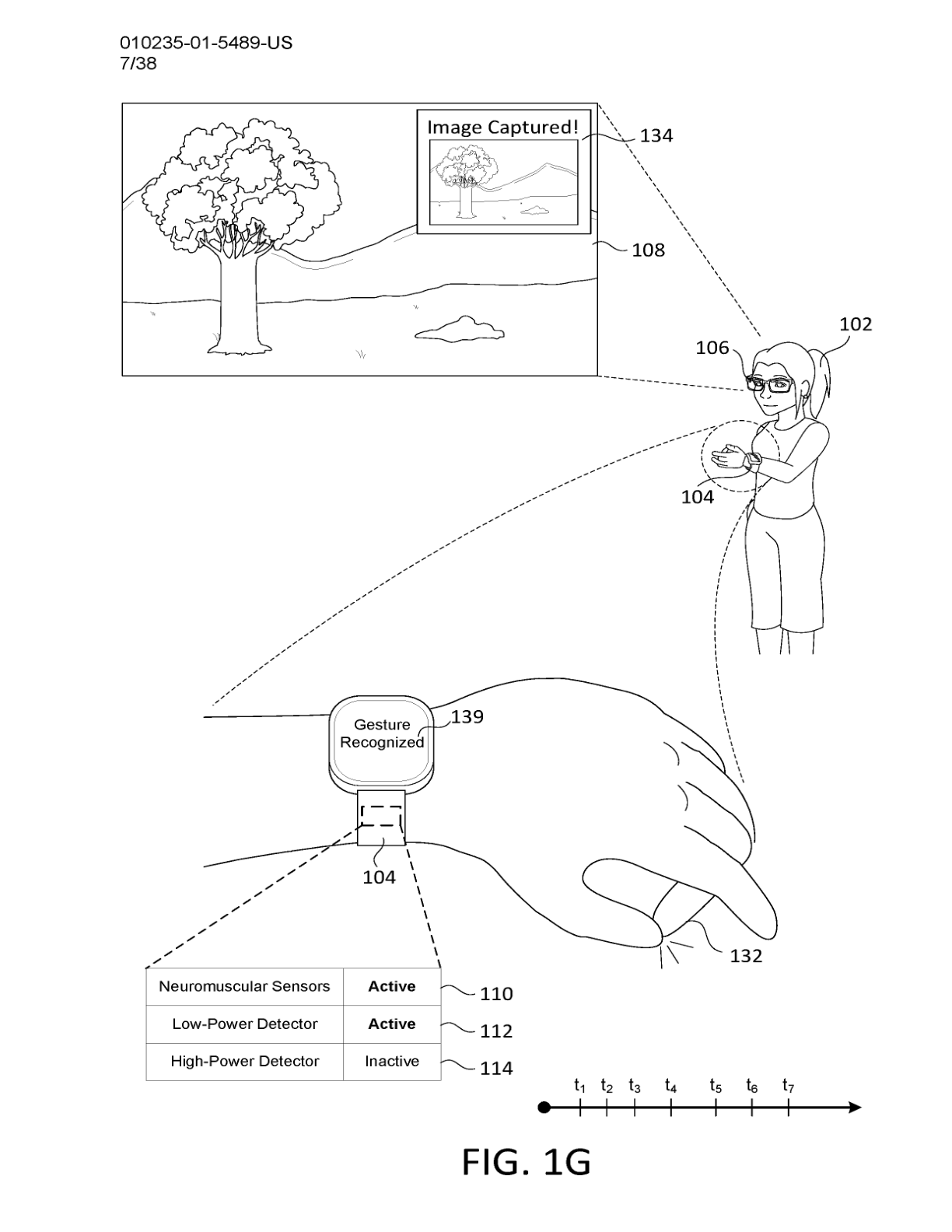
Figure 1G is a useful place to pause. The wearer captures an image, while the status box explicitly shows the high-power detector inactive. Earlier figures use the higher-power detector to open the camera application; this later action can be handled with less processing. The point is to spend power according to what the interaction requires. 38
That low-power-only path was central to the prosecution. Meta emphasized it in the January 2026 response, and the examiner highlighted it in the March allowance. The patent issued on September 1, 2026. This is a concrete architectural distinction, rather than a general promise that the wristband saves energy. 11123
The record gives us a reason the architecture could reduce unnecessary processing. It does not supply a measured battery-life gain for the retail Neural Band.
An invisible volume knob
The newer volume-control application gives the story a familiar gesture. In published claim 1 of US20260194986A1, you hold a thumb-and-index pinch, rotate your wrist to raise the glasses’ speaker volume, then use a shorter pinch for another application operation while retaining that volume. Dependent claims describe turning the other way to lower it, and using related movement to zoom a camera. 4
Meta’s product announcement separately describes pinch-and-rotate volume control. That is a meaningful connection between the product and the kind of interaction explored in the filings. It is not enough to establish that the product performs every step of the published claim. 144
Duration, direction and what the application is currently doing become part of the control vocabulary. The same few fingers can do more than produce a series of identical clicks. The challenge is making those distinctions feel obvious without asking the wearer to memorize a manual.
The test is everything between commands
The story is now larger than a laboratory gesture demo. In May 2026, Meta opened a developer preview for display-glasses experiences, including gesture input through Neural Band. That gives more software a chance to explore what this input can do. 16
But the questions worth testing are still ordinary ones. How often does the interface wake during unrelated activity? How easily can you abandon an action? Does a selection stay put while you perform the confirmation gesture? What happens to response time and power use over a day of intermittent commands?
The reviewed patents offer specific answers in architecture and interaction design. They do not answer those product-testing questions for us. My reading of the record is that the band’s most valuable skill may be restraint: understanding the brief moments when your hands are addressing the computer, and letting the rest of your life pass without a click. 123
Evidence notes, claim details and open questions
What was reviewed, and what remains open
This draft concentrates on three issued US patents: US12436620B2, US12360608B2 and US12724491B2; the volume-control application US20260194986A1; and the status of continuation US20250370549A1. Current claim texts, selected specification passages, amendments, reasons for allowance and illustrated drawing pages were checked. The volume application remained awaiting examination in the September 13 record. Application 19/239,748 had an August 13 allowance; an allowance is not a grant. 1234513
The earlier acquisition covered ten US applications, including five provisionals: 423 held documents, 397 marked OCR-complete and 26 skipped. Download coverage is broader than the close reading supporting this article. It does not mean every page was reviewed, every OCR transcription is correct, or every foreign/PCT history was acquired.
The original platform exports cover two indexed families. The gesture export omits the newer volume-control application 19/559,871; it is linked separately in the article, and no substitute node has been drawn. These are the families selected for this story, not an inventory of all Meta EMG patents. 17
Several embodiments use a smartwatch-style display or a headset. They should not be visually identified as the retail Neural Band. The specification’s example false-positive percentages are not a verified consumer performance result. Open editorial checks: independent daily-use testing, product-to-claim mapping, and detailed review of the latest allowed continuation claims against the original amended sheets.