SUPRACITE

Meta / Headsets & Spatial Computing Draft

Meta’s next headset has a heat problem—and an eye problem

Companion compute, gaze-aware passthrough and moving optics reveal several routes beyond today’s headset. The patent families show how old those routes are, and why the research prototypes should not be combined into one imaginary Quest.

Public draft · Research through 2026-09-14 · Updated 2026-09-15. This article is in review; findings and wording may change.

Watch an overview 1:17Narrated patent drawings · Captions included

A short summary of this article, with synthetic narration. The full analysis and sources follow below. Download video.

Read the video transcript

Your face is a bad place for a radiator.
A better headset cannot just be a faster computer strapped to your face. Meta's filings attack two constraints: where the heat goes, and what your eyes actually see.

Move some work off your head.
One design moves processing to a handheld companion when the headset's thermal state calls for it. Its allowed combination also includes a wrist input device.

Split the pipeline. Check the link.
Another patent splits camera processing into stages. Later work can stay local or move to the companion, depending on battery, application and communication conditions. Sending data also costs something.

The camera is not where your eye is.
Passthrough cameras sit away from your eyes, creating a viewpoint mismatch. Meta uses the depth of what you're looking at to adjust each eye's image. That does not fix every depth at once.

Change the optics. Not just the pixels.
In another family, moving a reflector inside folded optics changes optical power. That is a physical adjustment of the light path, rather than simply blurring the displayed image.

Put the light where the eye is.
A holographic design goes further, shaping an optical field and redirecting it toward the eye box. These filings show engineering directions. They do not add up to a confirmed next headset.

Explore the Meta headsets patent families
People in this article · 0

No people have been verified against this article’s cited records yet.

A better headset has to do more with less on your face

A headset can show a sharper world and still feel like a computer strapped to your head. Meta’s filings keep returning to the things a resolution specification leaves out: where the work happens, where the heat goes, how the cameras represent nearby objects and whether the optics put the image where your eyes need it.1653

The useful “what’s next” story is several connected engineering problems. The records do not establish that their solutions will appear together in a named next-generation Quest. Quest 3 supplies a familiar pancake-optics baseline; newer publications and research prototypes show possible directions beyond it.1314

Move the work, not just the battery

US20260169761A1 places graphics processing in a handheld intermediary device and presents the result through a separate head-wearable device. The companion is part of the computing arrangement. Its disclosed role goes beyond supplying power: it processes shared information and helps produce the artificial-reality experience.17
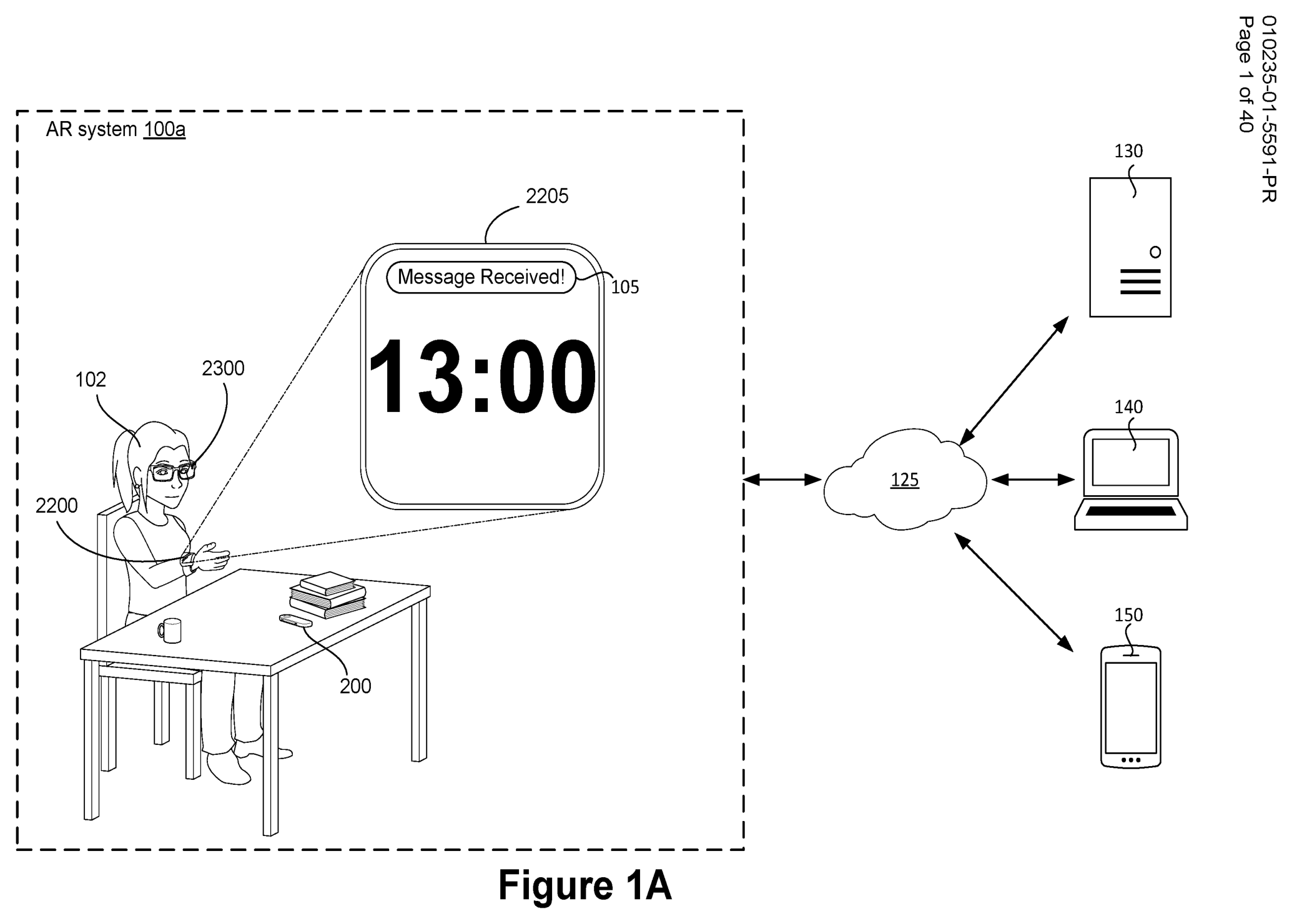
The broader AR system in Meta provisional 63/519,544. Original Fig.1A, drawing PDF p.1; rotated 90° clockwise. Intermediary device 200 appears on the table.
The broader AR system in Meta provisional 63/519,544. Original Fig.1A, drawing PDF p.1; rotated 90° clockwise. Intermediary device 200 appears on the table. Application 63/519,544 Inspect original PDF

The August 14, 2023 provisional already describes an intermediary generating an AR representation and instructing the head-worn display. Its first dependent claim even permits a companion without a screen. The June 18, 2026 publication is therefore a continuation of an older direction, not evidence that Meta first conceived of companion processing this summer.178

The file history now gives that companion a more specific job. The September 1, 2026 allowance includes a three-device arrangement: a handheld processor, a distinct wrist device and a headset sharing image data. When the headset’s thermal level calls for moving back-end tasks, the handheld takes them on. The headset presents the image and receives control through commands from the wrist device. The allowed claim combines those roles; it is not a claim to any headset with an external processor.15

That distinction mattered in Meta’s July response. The applicant argued that offloading because of the headset’s thermal state was different from merely observing that offloading could reduce heat. It also insisted that the wrist input device and handheld processor were separate devices. This is a concrete direction to watch: the display, the work and the input can live in three different places.1615

Which camera jobs belong on the companion?

The more specific processing split appears in US12368967B2. Camera data starts with Bayer processing on the head-mounted device. A controller decides whether later YUV processing should remain there or run on a companion, considering battery power or application state and checking the communications channel before transfer.2

This is a useful way to judge an offloading proposal: identify the exact job, what data crosses the link and the conditions under which moving it makes sense. A remote processor may reduce work on the face, but the transfer still has costs. The patent supplies a partitioning strategy; it does not supply a verified retail-headset battery-life gain. The application was filed March 8, 2023 and granted July 22, 2025, with a continuation in the retrieved family.2

The continuation, 19/249,847, shows why “move processing off the headset” is still too general. Its August 26, 2026 final action rejects claims 1–6 while allowing other combinations. One sends both raw camera data and locally generated statistics to the companion when battery power falls below a threshold. Another ties transfer of partially processed images to an application capturing video—a condition added to independent claim 15 in June. These are two different choices about what crosses the link and when. The examiner accepted those combinations while continuing to reject the battery-triggered processed-image route in claims 1–6. The application has allowed subject matter, not an issued continuation patent.1817

An accessory can become another way out for heat

US20260239588A1 describes selecting a heat path when the device detects thermal contact with an accessory. Its published claim combines conductors, contact detection and switching between paths. The accessory is part of heat management, rather than necessarily another source of electrical power.6

The July 11, 2022 provisional frames overheating as a limit on sustained operation: processing may have to slow or stop. The current continuation was filed December 29, 2025 and published August 13, 2026. My inference is that this family belongs beside companion computing because both address the thermal burden of wearing the device. The record does not prove that they are one integrated product design.612

Make the nearby object look right where you are looking

A passthrough camera is not located at the eye. Reprojecting its image to the eye’s viewpoint requires an estimate of scene depth, and errors can make nearby objects look misplaced. US12423916B1 uses gaze and vergence to identify the object the wearer is attending to and derives a separate distance from each eye to that object.5

The system then builds a constant-depth mesh for each eye and warps the corresponding camera image. The engineering tradeoff is selective: improve the geometry for the attended depth, rather than claim perfect reconstruction of every surface in the room. This application was filed March 21, 2024 and granted September 23, 2025. The refreshed source record returned no related applications, which the family section states explicitly.5

Move a reflector inside the folded optical path

Pancake optics make an optical path fit into a thinner package by folding light between elements. Meta’s US12517343B2 asks what happens if one of the reflectors can move. Changing its axial position changes the optical power and focal setting of the arrangement.3910
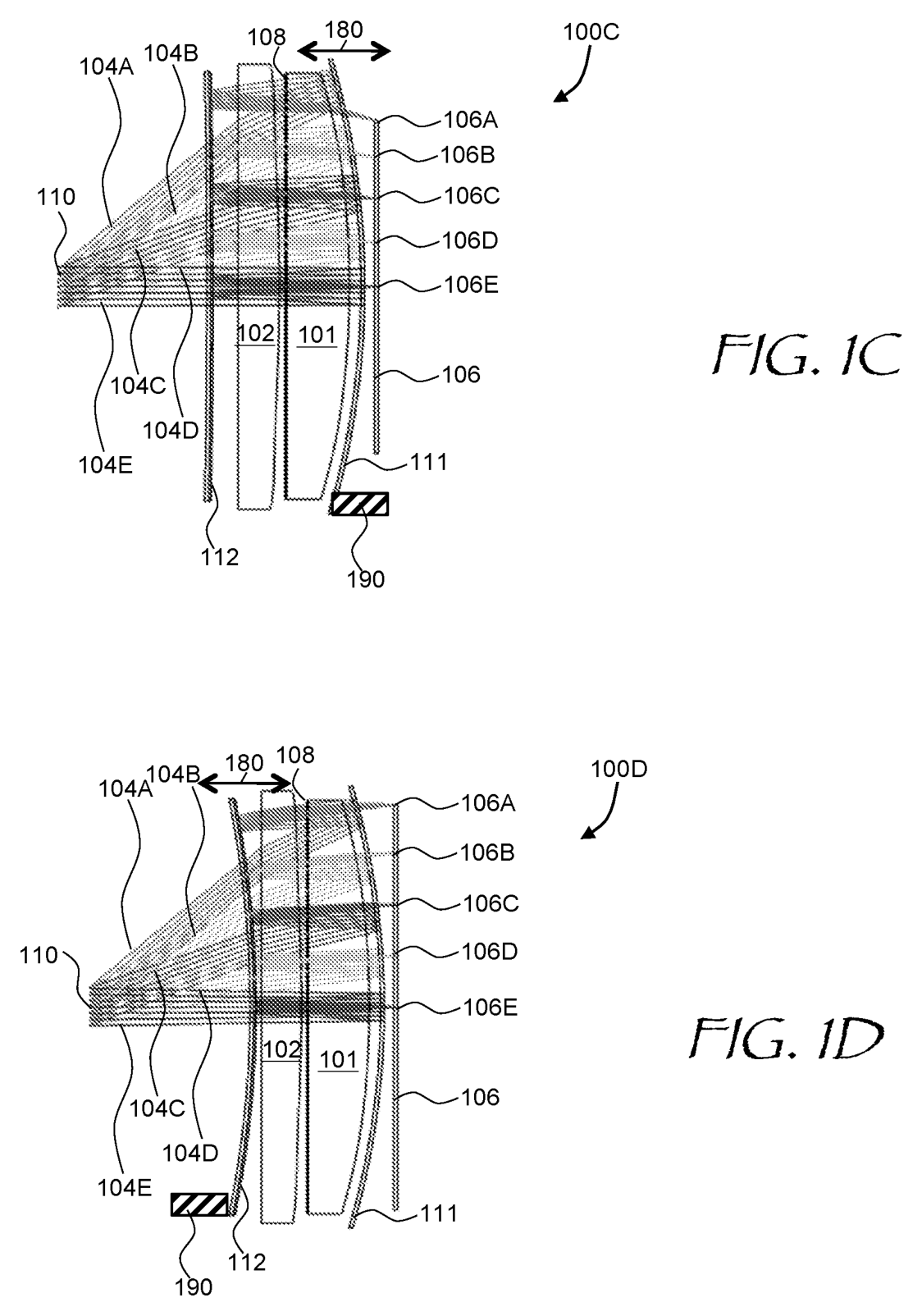
Two ways to tune the folded optical path. Meta provisional 63/414,260, original Figs.1C–1D, drawing PDF p.2.
Two ways to tune the folded optical path. Meta provisional 63/414,260, original Figs.1C–1D, drawing PDF p.2. Application 63/414,260 Inspect original PDF

The original October 7, 2022 provisional shows alternatives: translate the partial reflector or translate the reflective polarizer. The drawing makes the proposal easier to understand than the title does. This is physical optical adjustment; a change in rendered sharpness alone would not be the same mechanism. The nonprovisional was filed December 12, 2022 and the patent issued January 6, 2026.39

A holographic image still has to reach a moving pupil

US12607855B2 goes further into display architecture. A spatial light modulator changes a light wave so that the resulting optical field forms the image. That is a different proposition from using a passive holographic element merely to redirect light. The hard practical question is where the wearer can put an eye and still see the image.4

The family addresses pupil positioning and replication. The issued claim includes beam redirection toward successive locations in the eyebox and a spatial filter that controls unwanted diffraction orders. The November 17, 2022 provisional already discusses replicated light, spatial modulation and following the pupil. That establishes a research lineage; the precise issued combination should still be distinguished from the earlier disclosure.411

This is the more ambitious frontier in the set. It should not be presented as a confirmed optical engine for the next consumer headset. Publication and grant tell us what entered the public patent record, not whether a display has met the cost, brightness, efficiency and manufacturing requirements of a product.4

Do not build an imaginary headset from two prototypes

Meta’s own 2025 research presentation makes the tradeoffs unusually visible. Tiramisu emphasizes high angular resolution and brightness but has a narrow field of view. Boba 3 explores a much wider field of view with different display and optical compromises. The company presents them as research prototypes.14

Taking Tiramisu’s sharpness, Boba 3’s width, a companion processor from one patent and a moving lens from another would create a compelling specification sheet. It would also describe a machine these sources do not establish. The more useful synthesis is a set of research directions: move computation, manage heat, improve attended-depth passthrough and explore better control of light reaching the eye.1416534

Evidence notes, claim details and open questions

Research coverage and what comes next

This selection covers six focus publications and 15 retrieved U.S. application records, including four provisionals. Eleven native family diagrams were retrieved across the combined Meta and Apple research; Meta accounts for five diagrams and one application with no related records returned. The search is targeted, not a complete worldwide portfolio census.

All indexed document codes were requested for each member. The original focus publications and accessible provisional specifications, claim sheets and drawings are archived locally. A local OCR pass made selected provisional pages readable while platform OCR continued. The long intermediary-device provisional was read selectively: its opening specification pages and claim sheets, not all 105 specification pages.

The article is a technical research draft. This pass reconciles the companion-device allowance with its amended claim 1 and reviews the ISP continuation’s June claims and mixed August action. Other selected responses were read for context; every amendment across all families has not been reconciled. Product evidence connecting these mechanisms to an announced device remains a separate question.

Acquisition checkpoint, September 14, 2026 at 9:57 PM Arizona time: 642 of 642 indexed documents downloaded across 15 applications; 604 OCR-complete and 38 skipped, with none pending, processing or failed. The skips comprise 23 specification/abstract records routed to publication text, six actions routed to another text archive, and nine records without a stated skip reason. The August ISP action’s archive fallback did not return text, so its original PDF was checked directly and locally OCRed. Queue completion does not mean every page has been read.

International coverage gap: the refreshed platform records identify PCT/US2024/042241 and PCT/US2023/079961, but their filing dates are missing upstream, so the native SVG omits those nodes. The manifests flag this limitation. Those PCT histories are not included in the U.S. download totals and remain to be acquired and reviewed.

Sources and original records

  1. US20260169761A1 — INTERMEDIARY DEVICE FOR OFFLOADING PROCESSING OPERATIONS FOR AN ARTIFICIAL-REALITY SYSTEM AND FOR ENABLING INTERACTIONS AND INPUT PARADIGMS, AND SYSTEMS AND METHODS OF USE THEREOF

    Application 19/358,328 · Publication US20260169761A1

    Published specification and claim 1: graphics work performed by a handheld intermediary device for a head-wearable device. Continuity to August 14, 2023 provisional; publication text used with original provisional claims.

    Supports the identified mechanism and dated document. A disclosed embodiment is not proof of a shipping product; a cited provisional relationship is not a claim-by-claim priority determination.

    Retrieved 2026-09-14

    Original-file fingerprint16c70ba254b7fc8e41539a16349698c3bf3476fbdb63e2316e62078e9f7319e8
  2. US12368967B2 — DISTRIBUTED IMAGE SIGNAL PROCESSOR (ISP) SYSTEM FOR A HEAD-MOUNTED DEVICE

    Application 18/118,991 · Publication US12368967B2

    Issued claim 1 and specification: head-mounted Bayer processing, conditional partition of YUV work, battery/application state and communications-channel check.

    Supports the identified mechanism and dated document. A disclosed embodiment is not proof of a shipping product; a cited provisional relationship is not a claim-by-claim priority determination.

    Retrieved 2026-09-14

    Original-file fingerprint6deee5e9a305b4feedff3519df96c98ab1aef39f97ff120adf69cb3c13a01525
  3. US12517343B2 — TUNABLE LENS WITH TRANSLATABLE REFLECTOR

    Application 18/079,427 · Publication US12517343B2

    Issued claim 1, Figs.1A–1D and specification: folded optical path and controllable translation of a reflector to tune optical power. Original first-page identity checked.

    Supports the identified mechanism and dated document. A disclosed embodiment is not proof of a shipping product; a cited provisional relationship is not a claim-by-claim priority determination.

    Retrieved 2026-09-14

    Original-file fingerprintdfc2dc01692cd2e94daca84d8d5071c0eae1e951a42bbd287adf0772442c160e
  4. US12607855B2 — HOLOGRAPHIC VR DISPLAY

    Application 18/105,225 · Publication US12607855B2

    Issued claim 1 and specification: spatial light modulation, beam redirection, sequential eyebox locations and low-pass spatial filter. Distinguish holographic image formation from a passive holographic optical component.

    Supports the identified mechanism and dated document. A disclosed embodiment is not proof of a shipping product; a cited provisional relationship is not a claim-by-claim priority determination.

    Retrieved 2026-09-14

    Original-file fingerprintb66150c1e0e114960abf68db2878cab7b56d0ec697de581f75b9cdebaddd1419
  5. US12423916B1 — EYE-TRACKING ASSISTED PASSTHROUGH RENDERING

    Application 18/612,041 · Publication US12423916B1

    Issued claim 1 and specification: gaze/vergence identifies an attended object, separate eye-to-object distances and per-eye constant-depth meshes for passthrough reprojection. Refreshed continuity search returned no related applications.

    Supports the identified mechanism and dated document. A disclosed embodiment is not proof of a shipping product; a cited provisional relationship is not a claim-by-claim priority determination.

    Retrieved 2026-09-14

    Original-file fingerprint058dc3cb5089a7eab818223b1988b3ae055a5f1eae55b946506cf8faaa44f945
  6. US20260239588A1 — ARTIFICIAL REALITY DEVICE ACCESSORIES TO INCREASE THERMAL BUDGET

    Application 19/435,424 · Publication US20260239588A1

    Published claim 1: heat conductor contact with an accessory, detection of contact and selection between heat paths. Current continuation relates to July 11, 2022 provisional.

    Supports the identified mechanism and dated document. A disclosed embodiment is not proof of a shipping product; a cited provisional relationship is not a claim-by-claim priority determination.

    Retrieved 2026-09-14

    Original-file fingerprintb986d9f0096cdbe62c4d797dd10efed451b1ff2b4d147dc3bea0025d8fe1f040
  7. 63/519,544 — Original provisional claim text

    Application 63/519,544

    August 14, 2023 provisional claim text, PDF p.1: handheld intermediary generates an AR representation and sends display instructions; dependent claim 2 permits no screen. This is provisional text, not granted scope.

    Supports the identified mechanism and dated document. A disclosed embodiment is not proof of a shipping product; a cited provisional relationship is not a claim-by-claim priority determination.

    Retrieved 2026-09-14

    Original-file fingerprint3675c388bf50bb874081ba36f5a60aafd72780cafa99dc58ba79c1d104a32de6
  8. 63/519,544 — Original provisional drawings

    Application 63/519,544

    Original provisional Fig.1A, drawing PDF p.1. Rotated clockwise for reading; depicts the head-worn system, wrist interface and intermediary device 200.

    Supports the identified mechanism and dated document. A disclosed embodiment is not proof of a shipping product; a cited provisional relationship is not a claim-by-claim priority determination.

    Retrieved 2026-09-14

    Original-file fingerprint8659351ded0b5297930953a7f983e7cbf1b2a43f402b899f48f69784b62f3ea7
  9. 63/414,260 — Original provisional specification

    Application 63/414,260

    October 7, 2022 provisional specification, PDF pp.7–8, ¶¶25–28: pancake optical path, reflector translation and focal-power tuning.

    Supports the identified mechanism and dated document. A disclosed embodiment is not proof of a shipping product; a cited provisional relationship is not a claim-by-claim priority determination.

    Retrieved 2026-09-14

    Original-file fingerprint36c0f05865965ee47ba8a6593b642737bae1708fab4d8a6304e285d06b583df3
  10. 63/414,260 — Original provisional drawings

    Application 63/414,260

    Original provisional Figs.1C and 1D, drawing PDF p.2: alternatives translating the partial reflector or reflective polarizer.

    Supports the identified mechanism and dated document. A disclosed embodiment is not proof of a shipping product; a cited provisional relationship is not a claim-by-claim priority determination.

    Retrieved 2026-09-14

    Original-file fingerprint2cd6aa783e6915c4690326bf905cd610a90c8da78928cf0350cae7f368250e6d
  11. 63/426,338 — Original provisional specification

    Application 63/426,338

    November 17, 2022 provisional specification, PDF pp.4–6, ¶¶20–23: pupil replication, spatial light modulation and eye-tracked exit-pupil positioning. Supports this underlying direction, not an assertion that all issued limitations are identical.

    Supports the identified mechanism and dated document. A disclosed embodiment is not proof of a shipping product; a cited provisional relationship is not a claim-by-claim priority determination.

    Retrieved 2026-09-14

    Original-file fingerprint49c8c024684249e5c33e455b12d56f880ce6b0a5d4a54fb4d14daf0382f9b97f
  12. 63/388,103 — Original provisional specification

    Application 63/388,103

    July 11, 2022 provisional specification, PDF pp.1–4: device heating, reduced functionality and accessories that extend thermal capacity.

    Supports the identified mechanism and dated document. A disclosed embodiment is not proof of a shipping product; a cited provisional relationship is not a claim-by-claim priority determination.

    Retrieved 2026-09-14

    Original-file fingerprintfb05227f69683d909e8bee1b1c5220ee0bd118df7b4017f0f6c25fda655b9bd4
  13. Meta — Quest 3 launch

    Company description of the Quest 3 architecture and pancake optics; reference baseline, not a current price comparison.

    Official company account. Product specifications and research prototype results are attributed to the company, not independently measured here.

    Retrieved 2026-09-14

  14. Meta Reality Labs — Tiramisu and Boba 3

    Official research-prototype account. Tiramisu emphasizes angular resolution/brightness with narrow field of view; Boba 3 emphasizes very wide field of view. Neither is a commercial product specification.

    Official company account. Product specifications and research prototype results are attributed to the company, not independently measured here.

    Retrieved 2026-09-14

  15. 19/358,328 — September 2026 allowance and examiner’s amendment

    Application 19/358,328

    PDF p.7: amended claim 1, visually checked for strikeouts and additions; pp.20–22: allowed claims and reasons. The final amendment uses back-end/front-end tasks associated with shared image data; deleted image-data-processing/presenting wording is not retained as an extra limitation.

    Original filed record supports the stated claim language or examiner/applicant position. Selected passages reviewed; allowance is distinct from grant and from product implementation.

    Retrieved 2026-09-14

    Original-file fingerprinte2eee0bbc7ca02c7e2665e8a1e8749b785b79b8a8d5d90f7f5f2be340b2b3657
  16. 19/358,328 — July 2026 companion-device response

    Application 19/358,328

    PDF pp.2–3: applicant distinguishes a thermal-state trigger from a generic heat-reduction benefit, and separates the handheld processor from wrist input. Read with the later examiner’s amendment.

    Original filed record supports the stated claim language or examiner/applicant position. Selected passages reviewed; allowance is distinct from grant and from product implementation.

    Retrieved 2026-09-14

    Original-file fingerprint5a2e79766b7df77f8cc2c79a6fe60f3360e94366c7134db98482b738daac7ffc
  17. 19/249,847 — August 2026 final action with allowed subject matter

    Application 19/249,847

    PDF p.2: claims 1–6 rejected; 7–15, 19–20 and 22 allowed; 21 objected to but allowable if rewritten with inherited limitations. PDF pp.8–9: video-capture trigger and raw-data-plus-statistics combinations. Original pages visually checked; the MCP text endpoint returned an archive-path error, so this original PDF was locally OCRed.

    Original filed record supports the stated claim language or examiner/applicant position. Selected passages reviewed; allowance is distinct from grant and from product implementation.

    Retrieved 2026-09-14

    Original-file fingerprint8653708ce3db408e2d52db2da51d3a25c267d38176305053eb8e05a52509ff4a
  18. 19/249,847 — June 2026 ISP claim amendments and response

    Application 19/249,847

    PDF pp.3–4: claim 7 sends raw image data and its statistics; p.5: claim 15 adds the video-capture condition; pp.7–9: applicant’s explanation and interview account. The video limitation is underlined in the original claim sheet.

    Original filed record supports the stated claim language or examiner/applicant position. Selected passages reviewed; allowance is distinct from grant and from product implementation.

    Retrieved 2026-09-14

    Original-file fingerprint7f99ac01a0d5914a067ad0ab055e0b694bbbf7bac101573e545bdb57da9685b1