The difficult part is opening it again
Close a book and the pages shift. Close a phone and the thing shifting is also a display: a stack that must keep making an image while its shape changes. Open it again and the middle has to become a surface you want to read, touch and look across.
Apple announced iPhone Duo on September 9, with a 7.6-inch inner display and a 5.4-inch outer screen. Availability begins October 23. At this draft’s September 13 cutoff, the phone has been announced but has not reached that launch date.1
The patent record makes the engineering more interesting than the familiar question of whether glass can bend. It describes a display that slides, a hinge whose friction is deliberately tuned, and glass that is treated differently exactly where it folds. Those are useful ways to understand the problem. They do not, by themselves, establish which mechanisms Apple put into Duo.235
Start with the construction Apple actually describes
Apple describes Duo’s inner surface as a coated, nano-textured polymer cover, with glass above and below the folding display panel. Adhesives let the layers move relative to one another. The hinge supports the center when open; the texture is said to reduce glare and crease visibility.1
That account contains several different jobs: managing movement, supporting the open display and changing what the eye notices. A less visible crease does not tell us how much the underlying stack bends or how its shape changes with use. To explore those questions, we can turn to the mechanisms in Apple’s filings, keeping the announced construction separate from the portfolio of proposals.24
Give the screen somewhere to go
Imagine fastening a ribbon across a hinge. If the hinge and ribbon follow different paths through the bend, fastening everything rigidly is a problem. In US20260122799A1, Apple gives the display room to slide relative to the housing. The description connects that movement to an offset between the display’s bending axis and the hinge’s, as well as manufacturing variation and changes caused by a drop.2
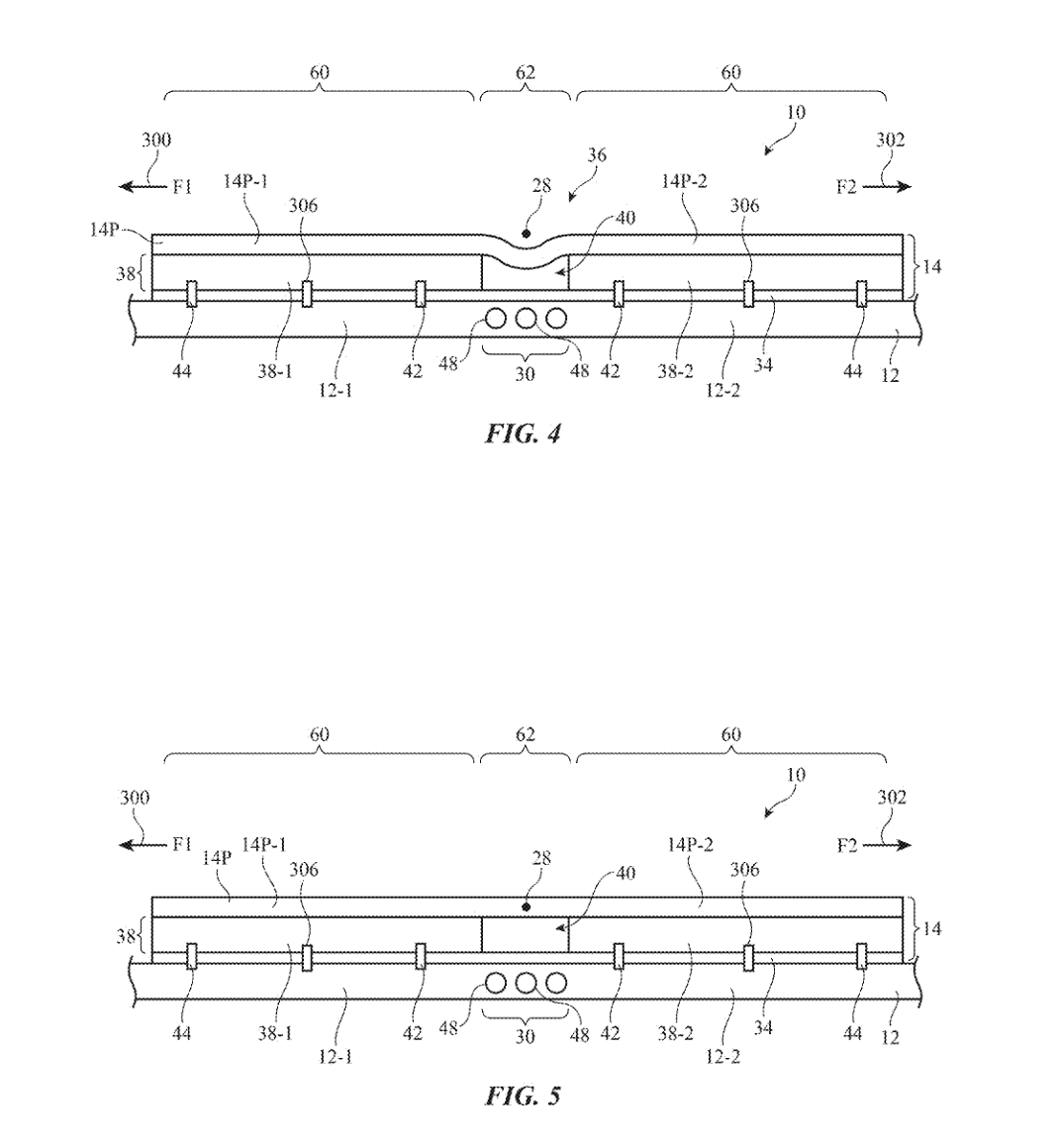
The striking part is what happens when the device opens. A tension assembly pulls the display toward a flatter state. Figures 4 and 5 draw the idea almost like a before-and-after: a dip at the center, then a flattened surface. These drawings illustrate the proposed action; they are not a measured demonstration of Duo’s crease disappearing.2
The engineering bet is that a flat display can be something the mechanism actively maintains. Instead of asking a flexible stack to return to exactly the right geometry unaided, the housing can help put it there. That is my reading of the disclosed arrangement, not evidence that the phone uses this particular assembly.2
Folding reverses the assignment
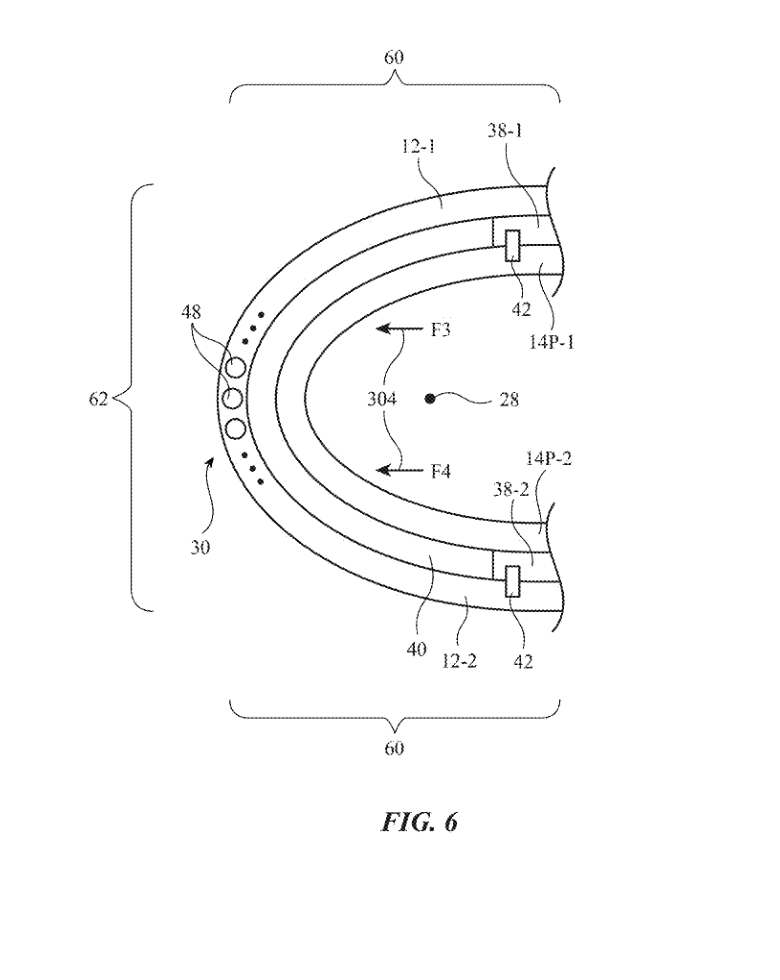
The same publication also considers the opposite state. When the device closes, a compression assembly can push the display into the hinge region, discouraging it from lifting away from its intended folded path. Figure 6 makes the change in direction visible: the mechanism that helps flatten the open screen must also accommodate a controlled bend when closed.2
The claim language is worth one precise distinction here. Published claim 1 requires tension in the unfolded state and compression in the folded state. Independent claim 16 requires the tension arrangement; compression appears in dependent claim 20. The application therefore contains more than one claimed combination. These are published application claims, rather than claims from an issued grant.2
Smoothness needs resistance
A hinge that feels good is a mechanism you barely think about. Apple’s US20260150207A1 shows how much deliberate resistance can sit behind that sensation. Its roller-hinge arrangements use interleaved leaves around parallel shafts. Loading those leaves along a shaft presses their surfaces together and produces frictional torque.3
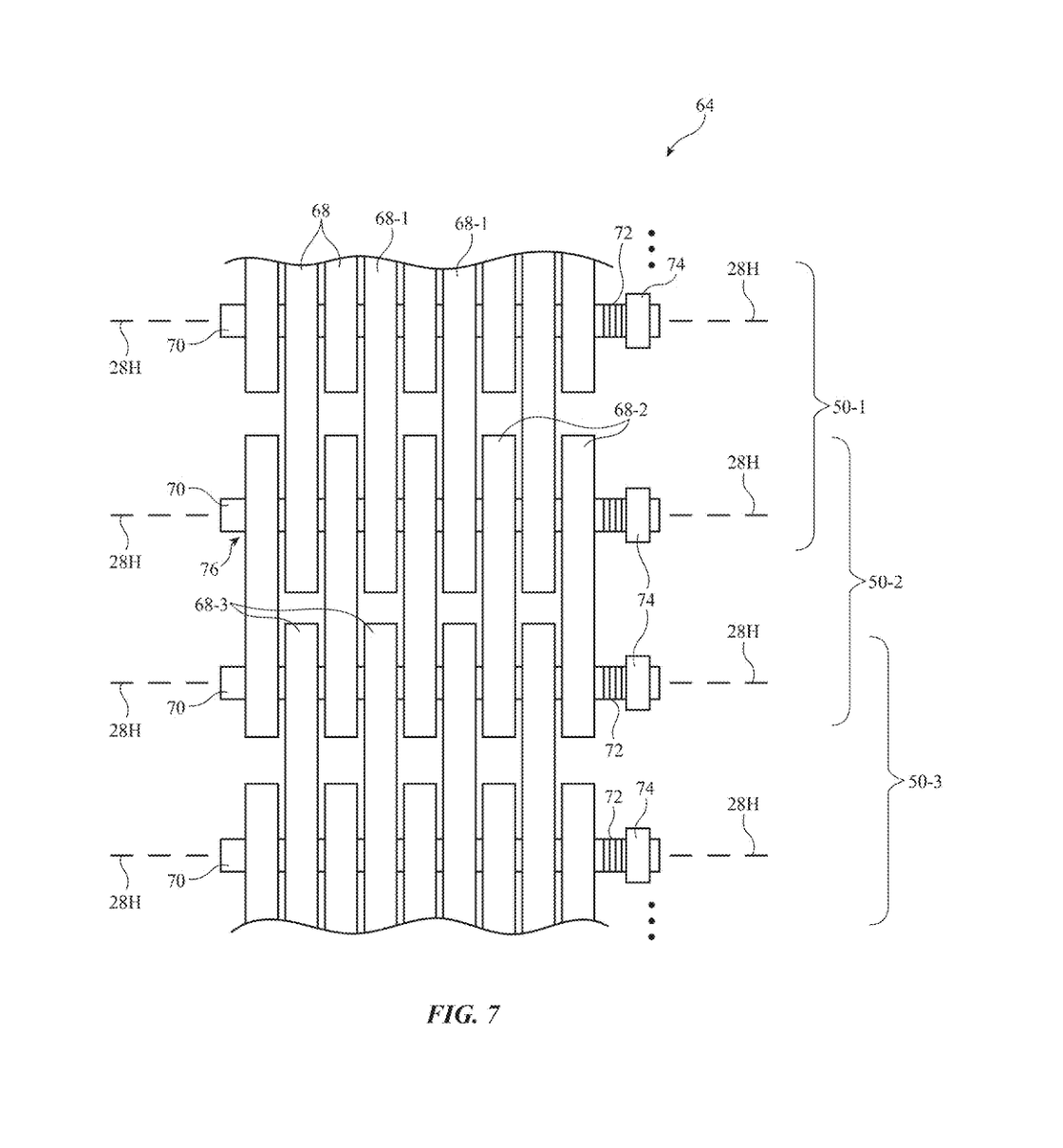
Think of a small stack of friction surfaces. How hard the stack is squeezed affects how much effort rotation takes. The specification describes adjusting the shafts’ friction torque during assembly. Other arrangements coordinate movement with geared leaves or pins and slots, and limit travel with stops. These features give the designer ways to control both the resistance and the sequence of motion.3
Optional cams can reduce friction near an end position or help the mechanism settle into its open state. That is why “smooth” is an incomplete mechanical description: the designer is choosing where resistance should be felt and where it should ease. The filing supplies candidate mechanisms, not a measured torque curve or a durability result for Duo.3
Put the reinforcement beside the bend
US20260079532A1 approaches the fold by splitting the work between glass layers. One layer continues across the bend. Another has a gap along the folding region. In Figure 5, the second layer reinforces the flatter areas on either side while leaving the center free to bend with less glass in its way.4
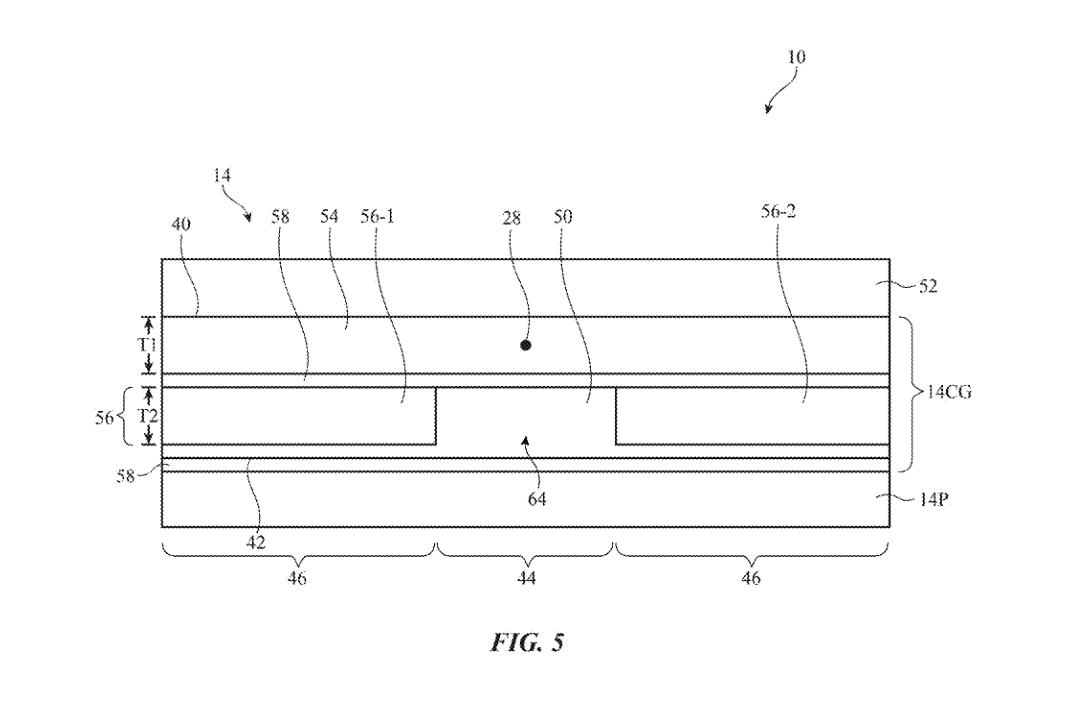
A gap in a display cover also creates an optical problem. The application describes filling it with a flexible polymer and matching refractive properties to reduce a visible discontinuity. Mechanical flexibility and an even-looking image have to be designed together; solving the bend while drawing attention to a stripe down the screen would be an incomplete solution.4
Read the drawing’s layer labels carefully. This proposal puts two glass layers in the cover above the display panel. Apple’s Duo announcement separately describes glass above and below the panel. Those descriptions are not interchangeable, and the announcement does not establish that the illustrated gapped cover is present.41
The thin part gets its own recipe
There is also an issued patent with a more specific answer to the folding-glass problem. Claim 1 of US12596407B2 combines a locally thinner folding portion with thicker portions on either side. It also requires the exterior compressive-stress region to extend less deeply into the thin portion than into its thicker neighbors.5
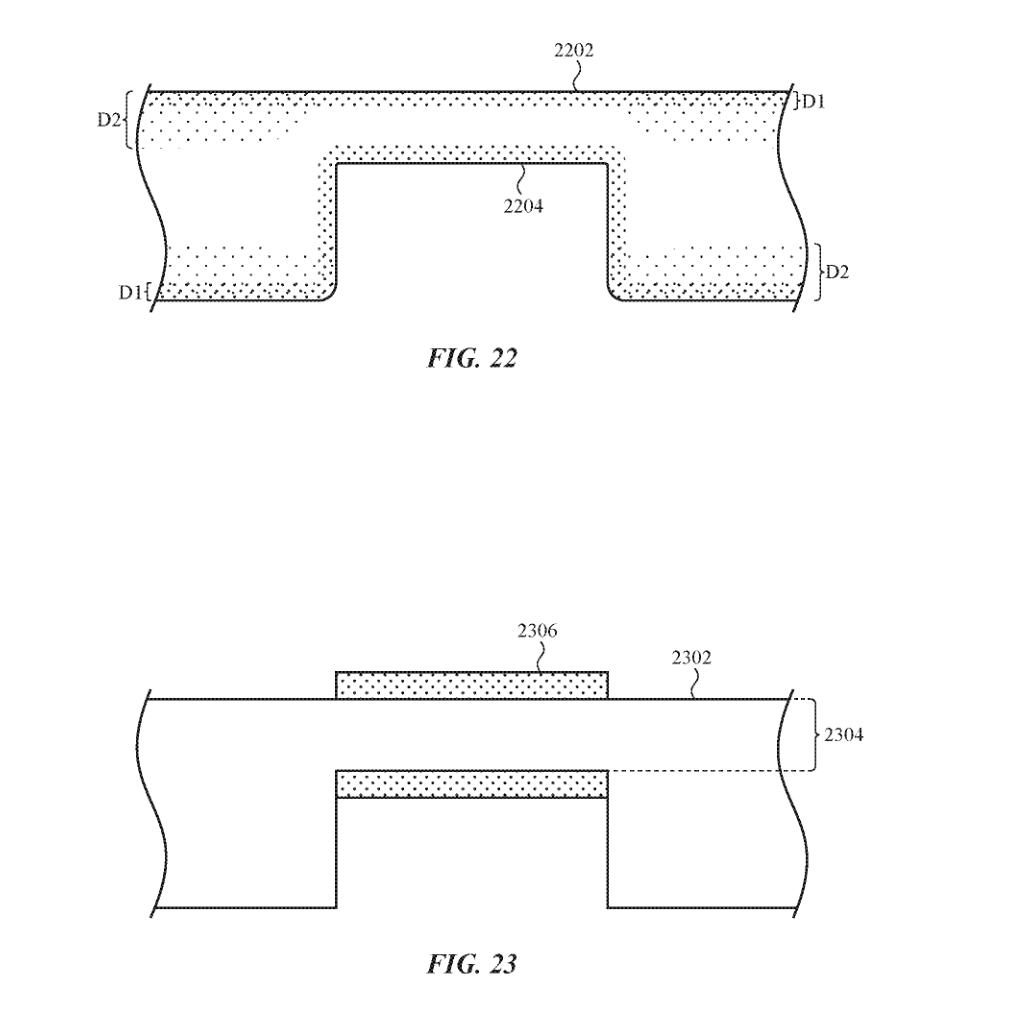
Chemical strengthening can create compression near a glass surface while leaving tension farther inside. The specification explains why depth matters: making the strengthened layer shallower in the locally thin region can limit tension at its center. Figures 22 and 23 show the different depths and a masking process for producing selective strengthening. The image here comes from the original drawings in the application’s file history.58
This detail earned its place in the examination record. The examiner’s reasons for allowance singled out the different stress depths and associated geometry, together with the other claim limitations. The useful finding is a particular thickness-and-stress arrangement that reached an issued claim. It does not establish ownership of every way to make a folding display, or prove which glass recipe Duo uses.95
A sharp point asks a different question
Bending is only one way to damage a cover. US20260082496A1 concerns crack-resistant glass, including an exposed glass surface and a crack-initiation load of at least 10 kilogram-force. The specification discusses that load in the context of pressing a Vickers indenter into the glass: a controlled sharp-contact test.6
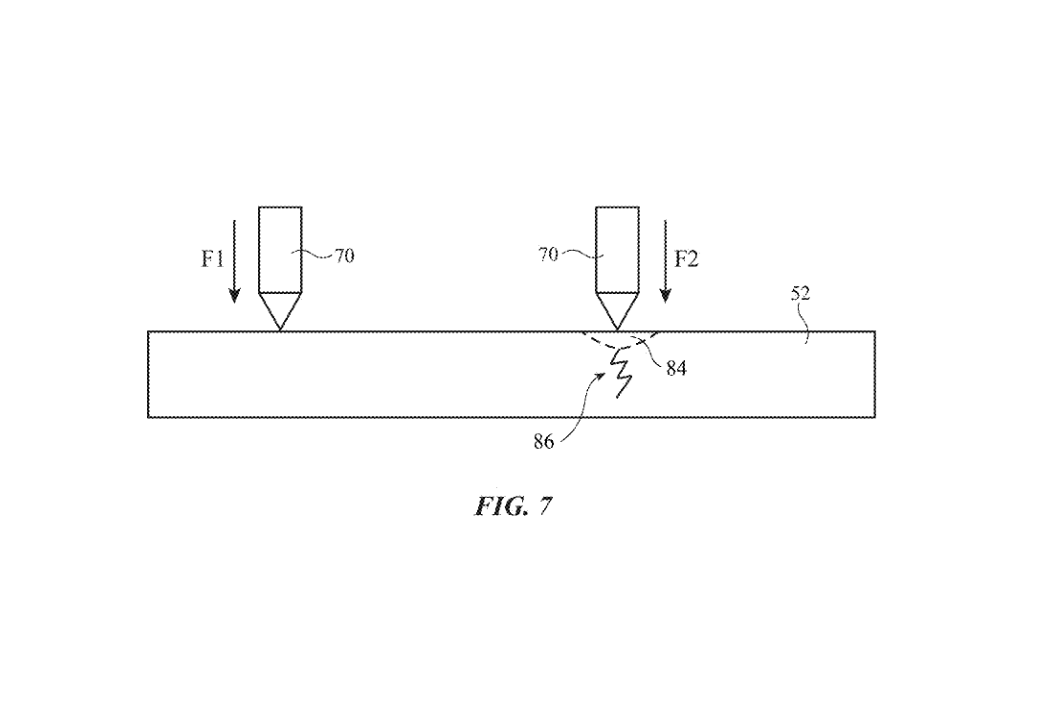
The number needs its test attached. It is not a phone drop rating, a promise that someone can stand on the screen, or a measured result for Duo. The publication also discusses a separate scratch test; those measurements should not be collapsed into one all-purpose claim of toughness.6
This filing is a particularly useful check against reading patents as product specifications. Its exposed-glass approach differs from the polymer outer cover Apple describes for Duo’s inner display. The portfolio gives us alternative engineering paths. The announcement establishes only the construction Apple chose to describe.61
The object you forgot on the screen
Now put a small object on the open display and begin to close it. The fold has turned that forgotten object into something the device can squeeze against its own screen. US12510936B2 considers detecting the object before the motion finishes. Figure 9 shows sensors sending signals across the display and receiving reflections from an object resting on it.7
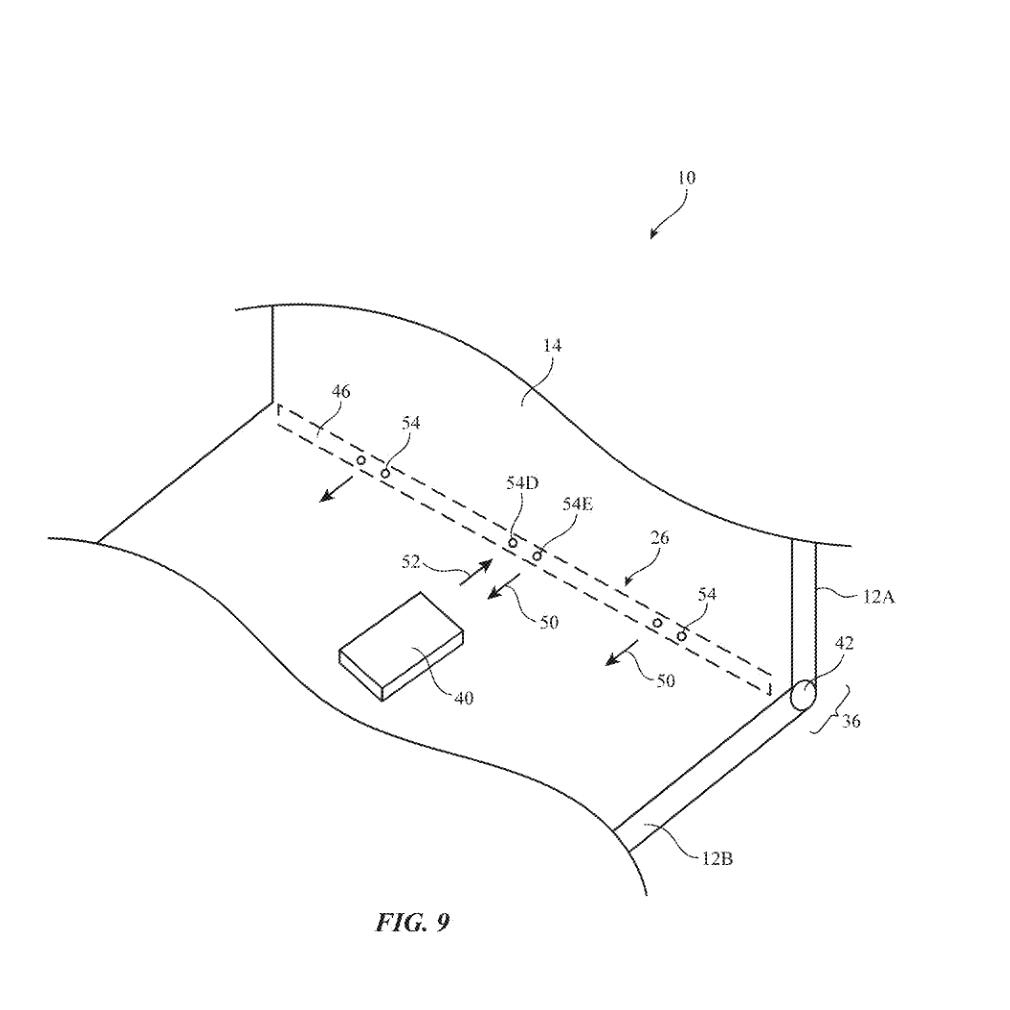
The possible responses are unusually tangible. The disclosure includes a hinge lock, a deployable stop, a warning, and even air used to clear small particles. These are alternatives across the disclosure and claims. Issued claim 1 requires an actuator that restricts movement in response to detection; claim 11 describes a touch-sensor arrangement with a choice of protective responses.7
Nothing in the Duo announcement reviewed here confirms those features. The patent is still worth reading because it changes the question from “can the display fold?” to “when should the device let it fold?” A mechanism can be beautifully controlled and still need to account for what its owner left in the way.7
Opening the phone is an input
The fold also gives software a new input. A device can respond to how far it has opened, changing what the screen is for as its two halves move. Apple’s issued US11079995B1 explores that idea through interfaces that switch modes when the displays change relative position.18
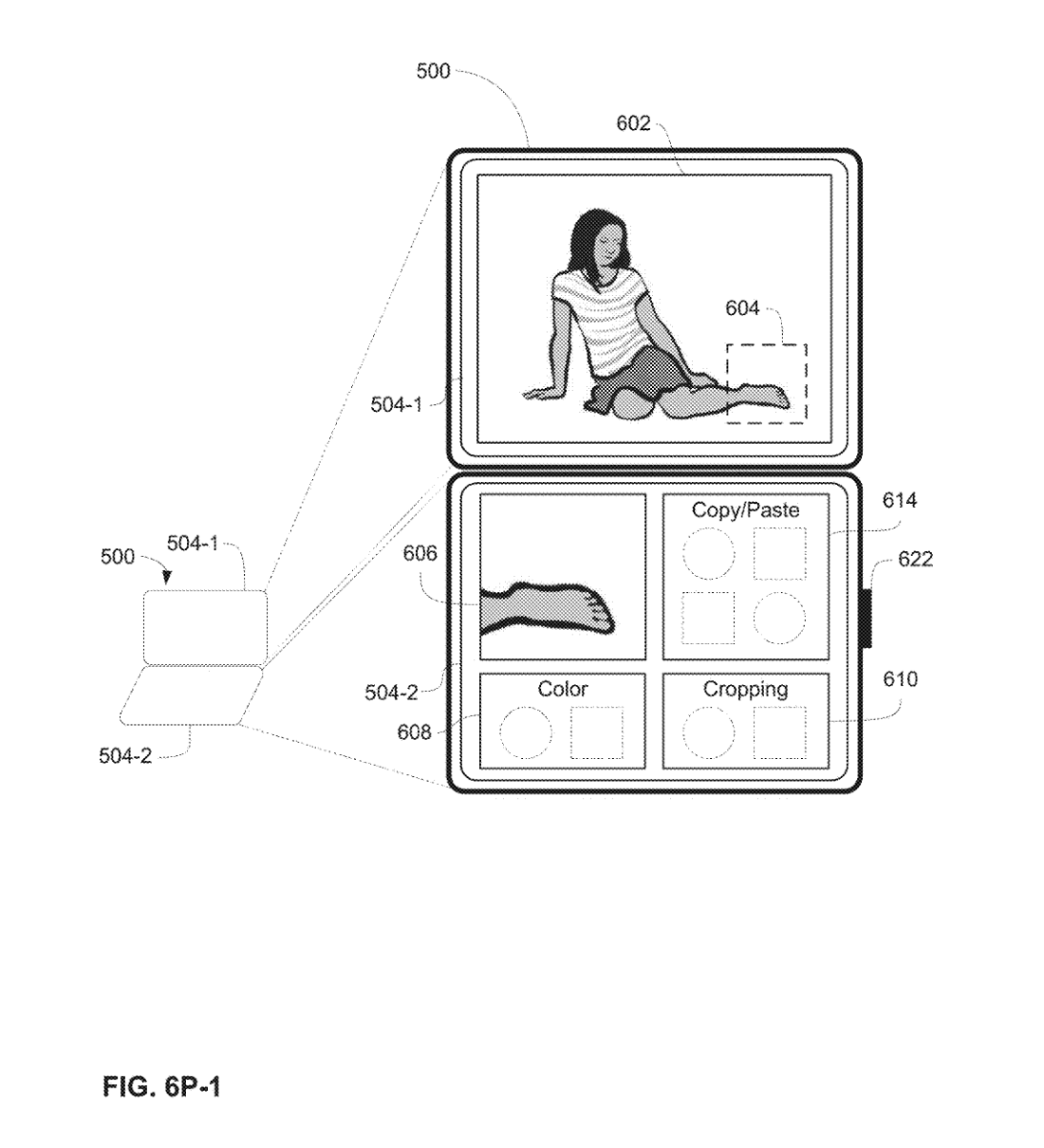
The photo editor in Figure 6P-1 makes the starting point concrete. The bent device puts a full image on one screen and a detail preview with editing controls on the other. It is a workspace divided between seeing the whole and working on a part. The specification describes phones, tablets and laptops as possible devices; this drawing is not a Duo product rendering.18
Duo’s documented software already treats pose as meaningful. Apple’s design guidance describes controls along the sides and interactive elements moving away from the center when the device is partially folded. That establishes announced interface behavior. It does not identify the particular patent claims implemented by Duo.21
Flatten the device, change the workspace
Now push the same illustrated device flat. In Figure 6Q, the detailed preview disappears, the full-image selection marker goes away, and the newly available space holds a Layers control. The fold changes the division of work between the screens. This is one disclosed photo-editing example, not a claim that every app must behave this way.18
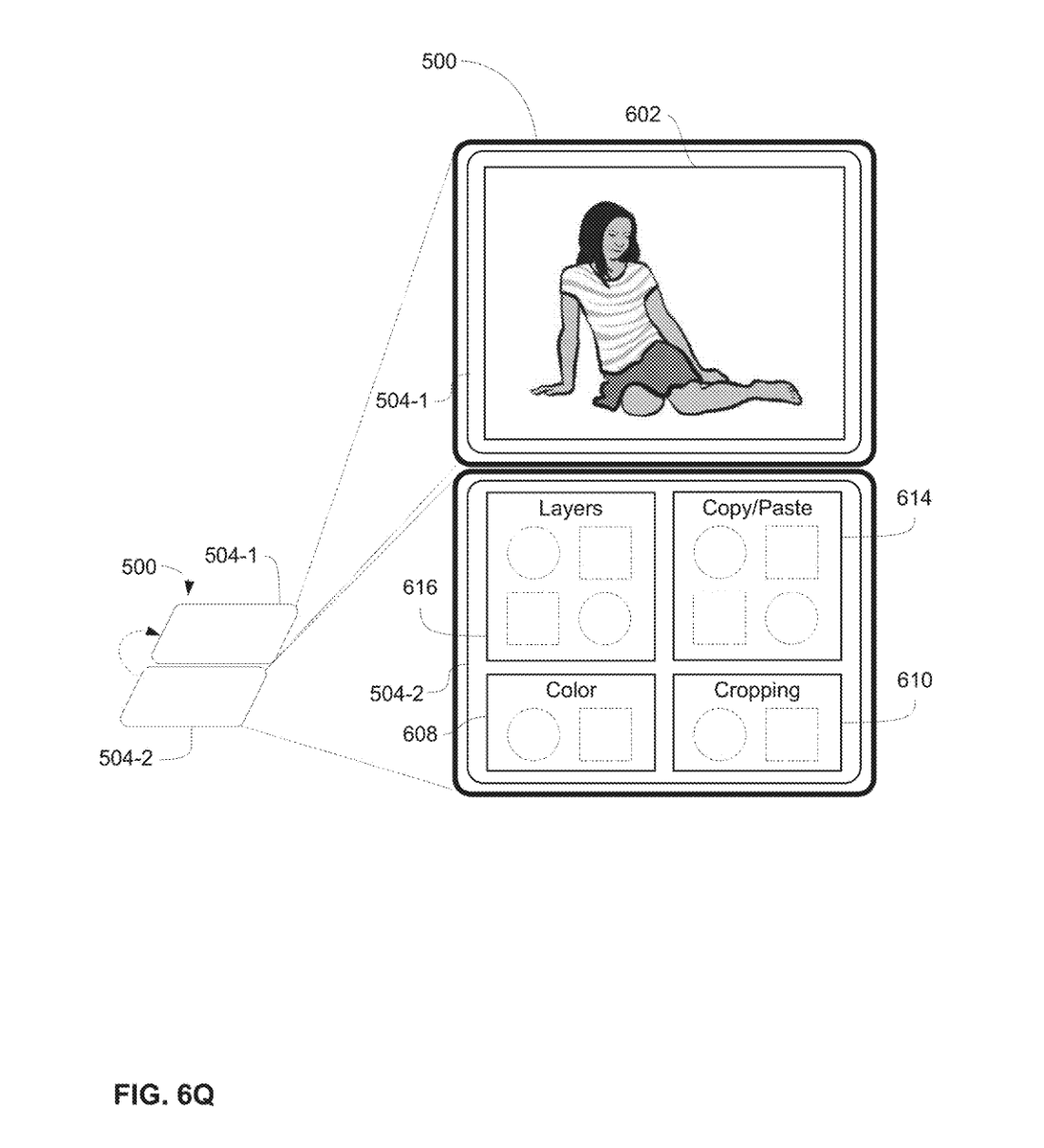
The issued claim reaches a related combination: controls on one display while content is on the other, followed by content across both after their relative position changes. Claim 1 also requires deemphasizing controls during a gesture that manipulates the content. That extra requirement matters; the claim is more specific than the general idea of changing a layout when a device opens.18
A later grant in the same family, US11972164B2, applies flattening to a shared-content workflow. Dependent claims 21–22 describe ending the video-conference interface on one display, showing shared content across both, and relocating a toolbar away from the adjoining edge. Those claims retain the underlying video-conferencing requirements. They do not claim every toolbar that moves on a folding phone.19
Pass the notification across
A newer family member, US20250165207A1, turns the boundary between screens into somewhere a notification can travel. Its published claims describe moving a notification to the other display, including by flicking it toward that display, and bringing up a keyboard and text-entry area there.20
Another dependent claim proposes choosing the display according to where the user is looking. That gaze-based option is a proposal in this application, not a confirmed Duo feature. The useful design question is more general: when the device changes shape, where should the next interaction happen? The answer need not be “where the notification first appeared.”20
The fold is a negotiation
Across these filings, the parts keep negotiating with one another. A sliding display accommodates movement. A loaded hinge shapes resistance. A gap makes room for bending. Selective strengthening changes the stress profile where the glass gets thinner. Sensors consider whether closing is a good idea at all. The interface can turn the changing shape into a different workspace.2345718
For a future teardown and hands-on review, those mechanisms suggest better questions than asking whether the crease is simply “gone.” Does the display move relative to its supports? How is the center supported when open? What does the resistance feel like through the full travel? What happens to surface shape and sharp-contact damage after use? Does the interface move tools and content to useful places as the device bends? These are questions to test, not conclusions the patents can supply.
The attraction of a folding phone is that the gesture should feel ordinary. Apple’s patent record shows how many physical choices can be required to make that ordinariness possible.
Evidence notes, claim details and open questions
What was published, and what was granted
The sliding-display, roller-hinge, multilayer-cover and crack-resistant-cover records analyzed here are published applications. This article describes their published claims as proposals, not issued rights. The glass-cover and object-detection records are issued US patents; their technical descriptions here use the grant claims.234657
For the glass-cover case, the November 18, 2025 submission and December allowance discuss then-pending claims 21–40. The grant uses its own final numbering, and this article’s “claim 1” refers to the issued document. An examiner’s reasons for allowance are evidence about the examined claim combination; they are not a product certification or an exhaustive novelty finding for every sentence in the specification.1295
A long family, with one visible gap
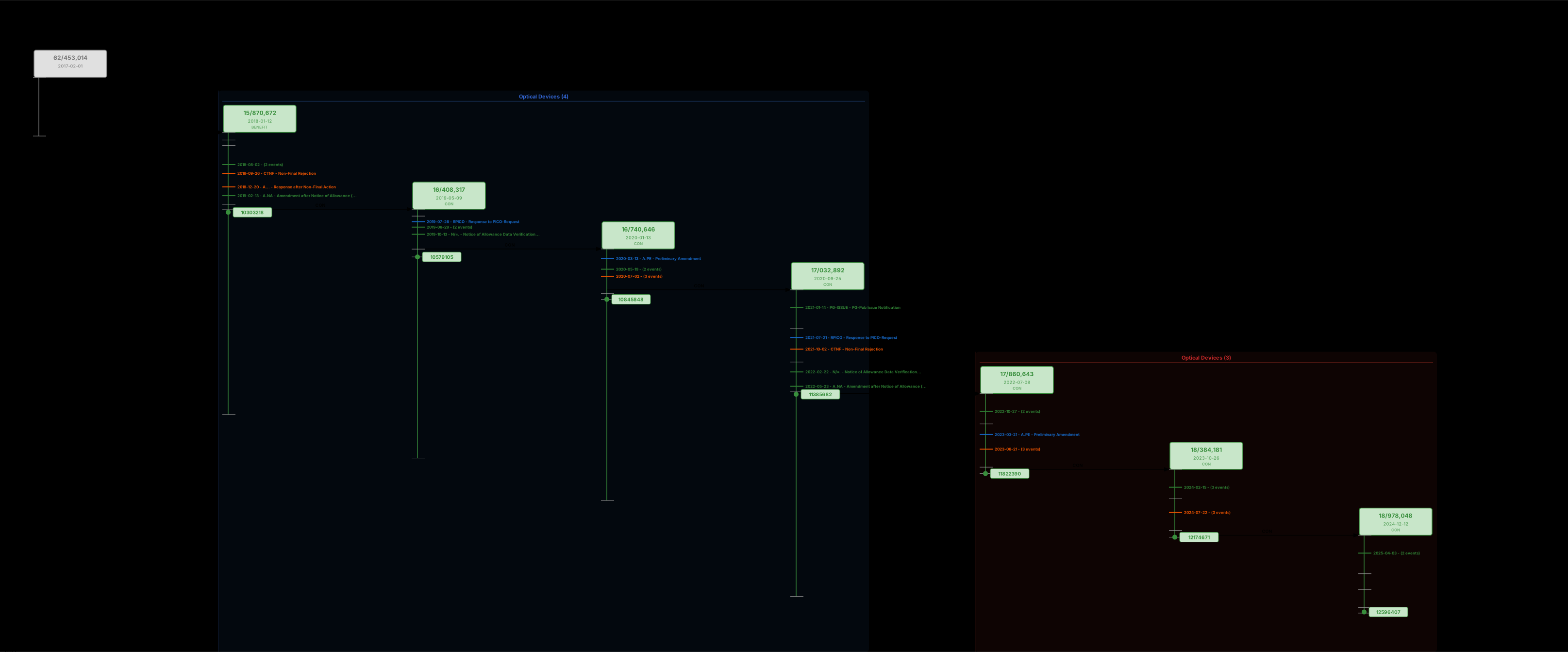
The native patent-platform diagram maps the indexed glass-cover family, with the studied 18/978,048 application highlighted. Its continuity chain reaches a February 1, 2017 provisional. The April 2026 grant date should not be read as the date Apple first conceived everything in the disclosure.165
The export currently contains eight nodes and omits application 19/633,082, published as US20260236068A1 on August 13, 2026. Paragraph 0001 expressly identifies 18/978,048 as its parent. That newer publication is archived and linked here, but the platform’s original SVG is retained without a locally invented node. This is one cover family, not an umbrella family for all the article’s mechanisms or all Duo-related patents.1416
Why Apple’s own earlier patent appears in the rejection
The August 18, 2025 office action in the glass-cover case rejected then-pending claims 21–40 for nonstatutory double patenting over US10303218B2. This was an earlier Apple cover patent. Patent-platform’s assignment record for its application, 15/870,672, reports an assignment of the inventors’ interest to Apple Inc., recorded April 18, 2018 at reel/frame 45573/633.101315
Apple’s November response states that it submits a terminal disclaimer and requests withdrawal of the rejection; the subsequent allowance acknowledges that submission and gives the technical reasons discussed above. Those records explain this case’s path without turning a double-patenting rejection into a story about a competitor defeating the folding-display idea. The assignment statement is limited to the recorded transfer returned by the platform, not a full current ownership opinion.11915
UI claims, continuity and product mapping
The UI examples come from one family. The 2025 publication’s continuity statement links application 19/030,689 through 18/634,130 and 17/389,041 to 16/147,183, with provisional claims reaching September 2017. Patent-platform’s assignment record for 16/147,183 reports an inventor-interest transfer to Apple Inc., recorded January 17, 2019 at reel/frame 48050/694. This identifies the returned transfer; it is not a complete current ownership opinion.2022
The 2021 and 2024 documents are issued grants; the notification document is a published application, with its case shown as docketed and ready for examination in the retrieved platform details. Figure 6P-1 → Figure 6Q illustrates the specification’s photo-editing embodiment. Claim 1’s complete combination also includes content spanning both displays and gesture-related control deemphasis. Claims 21–22 of the 2024 grant depend on the video-conferencing workflow of claim 1.18192022
This UI addition checks publication claims, selected specification passages, original drawings, application details and the recorded assignment. It does not review the complete prosecution histories. The platform returned no family for 16/147,183, so the interactive diagram remains the separate glass-cover family. No substitute UI tree has been drawn. Neither this review nor Apple’s developer guidance establishes a patent covering Duo’s particular unfolding animation.2221
What this pass checked
This pass used patent-platform for publication discovery, specifications, claims, application details, assignment data and the native family export. Eleven original US publication PDFs are self-hosted: six main hardware records, the newer cover continuation, the earlier grant named in the rejection and three UI family members. Five original documents from application 18/978,048 are also archived, including its drawings, rejection, submitted claims, response and allowance.17
The platform returned a 56-document index for that glass-cover application. The five selected originals support the focused prosecution discussion; this is not a claim that every document or every family member was reviewed. File-history index requests for the other five main applications returned upstream failures. Their publication text and application detail records were available, but this pass cannot represent their complete prosecution histories. Product-to-patent mapping remains an open research question.17
The UI addition reviews two grants and a pending application alongside Apple’s Duo design guidance. Its two illustrations come from the 2021 grant’s original drawing sheets. The separate UI evidence ledger records this narrower publication review and the unavailable platform family lookup.2221