Dinner has a peak-power problem
At six in the evening, the kitchen suddenly wants everything at once. Water is coming to a boil. A pan needs to get hot. The oven is already working. For much of the afternoon, those same appliances were doing almost nothing.
A battery gives an appliance a way to use that idle time. It can accumulate energy slowly, then deliver power faster when cooking demands it. That is the shared proposition behind Impulse’s cooktop and Copper’s Charlie range. The interesting question is what happens after the battery goes in: how the appliance routes that power, controls the heat and responds to the person standing over it. 12
There is another contest underneath the cooktop. Before Copper sued Impulse, Copper’s patent counsel was already submitting its earlier disclosure to the Patent Office against Impulse’s pending claims. When Impulse replaced those claims, the filing team came back with a new chart. The patent that eventually issued carried more specific requirements. Those prosecution encounters later entered the lawsuit’s account of what Impulse knew. Following the paper trail connects the engineering distinctions to the business fight. 3334364 30
Store between meals. Spend while cooking.
Impulse describes a cooktop with a 3 kWh lithium iron phosphate battery, compatibility with a 120 V / 15 A connection or a 240 V circuit, and advertised burner output reaching 10 kW. Copper describes Charlie as a complete induction range with a 5 kWh lithium iron phosphate battery and four 2.6 kW cooking zones. These are the manufacturers’ specifications; this article is not a cooking test. 12
Those numbers describe different things. Kilowatts tell you the rate of energy delivery. Kilowatt-hours tell you the amount stored. A larger battery does not, by itself, establish faster boiling, better temperature control or a better dinner. Nor should an individual burner rating be read as a guarantee that every zone can sustain that output together.
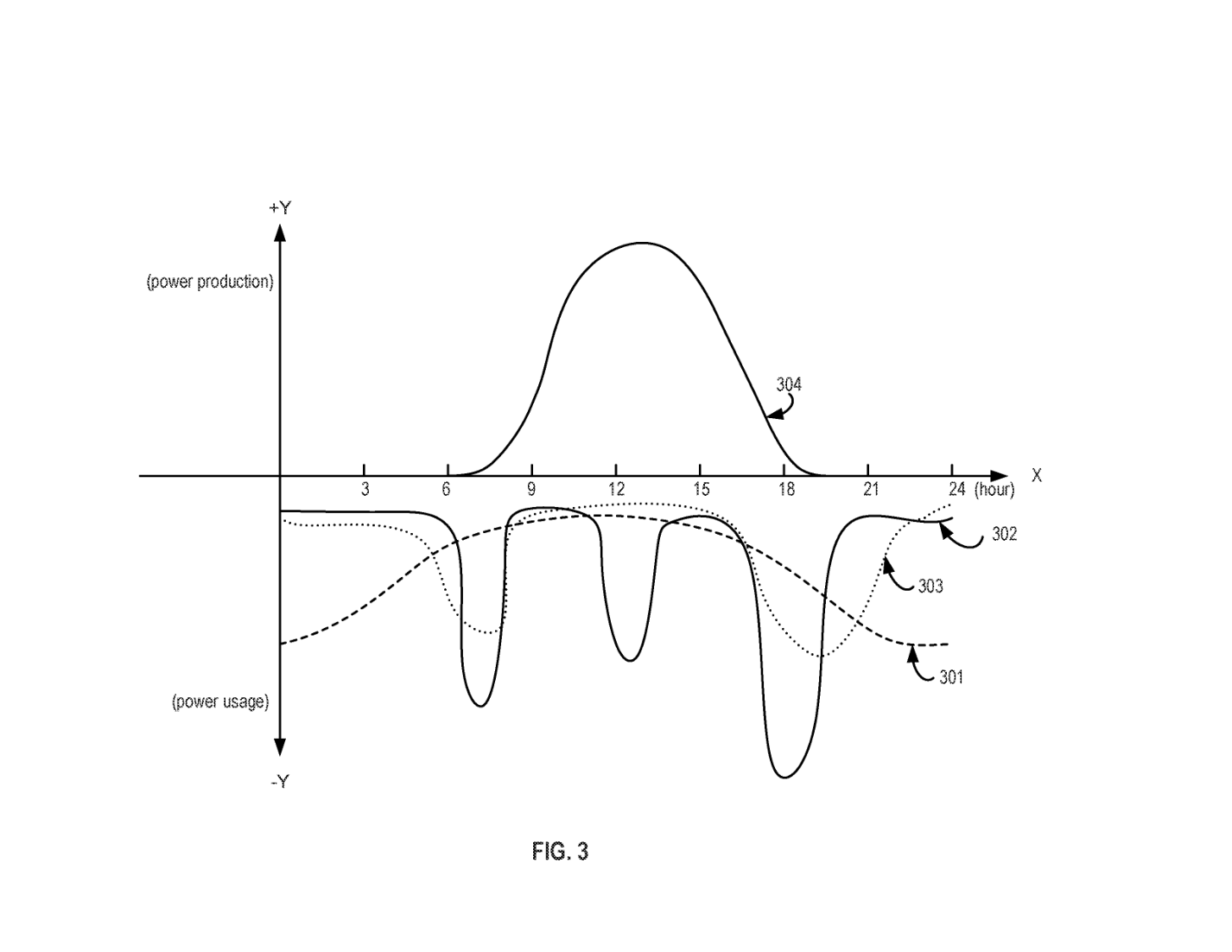
Impulse’s early energy-storage publication, US20230238819A1, sketches the timing problem directly: solar production rises around midday while some appliance demand clusters around meals. Figure 3 is a conceptual set of profiles, expressly not a scaled product measurement. Its useful idea is the separation of when energy is available from when the kitchen needs it. 314
Start with the thing your fingers touch
A knob is a good place to begin because you can understand the problem without opening the appliance. You want it to turn deliberately, register a click and come off when the surface needs cleaning. Impulse’s product description says its magnetic knobs are removable and contain no electronics. 1
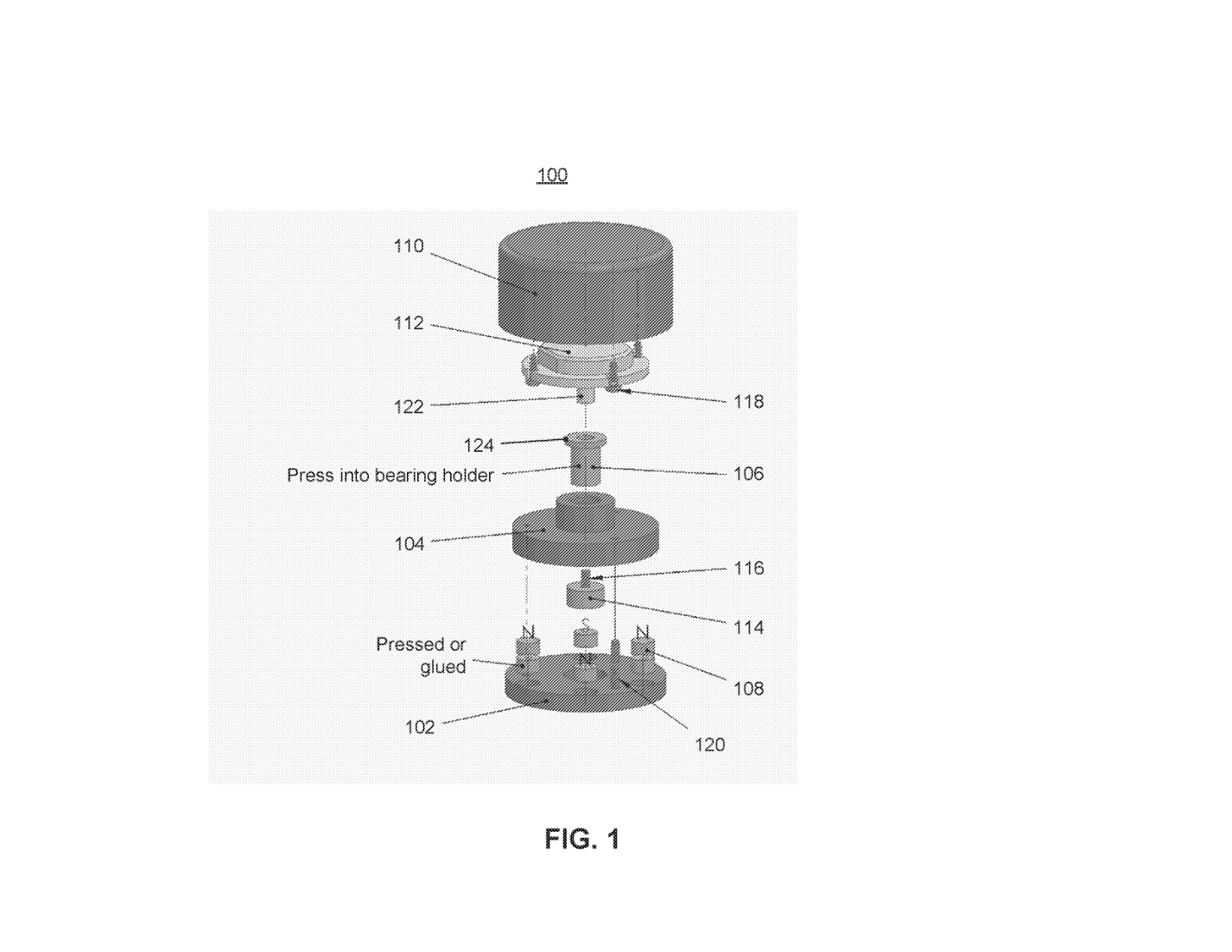
The exploded drawing in US12591264B2 makes that physical interface less mysterious. Issued claim 1 describes a stationary base with a substrate, bearing holder, sleeve bearing and coupling magnets, paired with a moving cap containing a cover, rotor shaft and control magnet. Claim 19 describes the appliance side: coupling magnets with alternating polarity and magnetic sensors beneath the surface that detect rotation or a click. 515
The design implication is appealing: the part that gets greasy can be separated from the electronics that interpret it. But the claim is a particular arrangement of parts. Calling it a patent on “a magnetic knob” throws away the details that make the mechanism—and its legal boundary—interesting.
The hard part is knowing when to stop heating
More available power makes feedback more consequential. A controller needs useful information about the cooking surface quickly enough to decide what to do next. Impulse’s temperature-sensing application, published as US20240288175A1, puts a contact sensor on a plunger supported beneath the cookware. The drawings turn an abstract “temperature sensor” into a mechanical problem: how do you keep the sensing assembly in the right place against the pan? 816
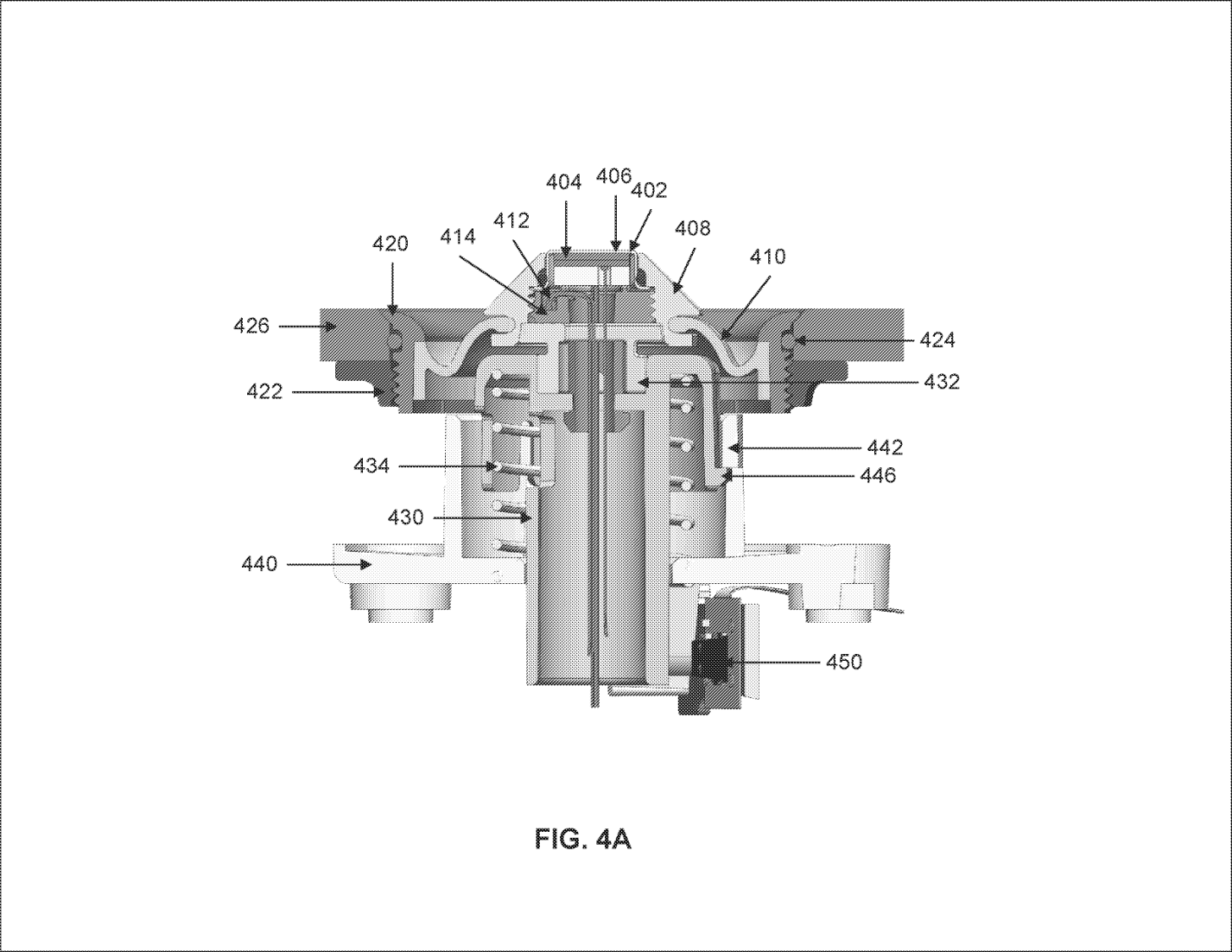
The claim record has changed since spring. In the May 12 amendment, independent claim 1 requires a self-heated flux sensor controlled to a temperature setpoint, together with the plunger and support base. That is a more specific approach than simply putting a thermometer under a pot. The applicant’s remarks distinguish intentional setpoint heating from unwanted heat generated inside a sensor. 1718
Other independent claims take different routes. Claim 4 describes auxiliary sensors between the sensor package and plunger; it does not require claim 1’s heated flux sensor. Claim 20 addresses an assembly using matching sliding-ramp structures. Nineteen claims were allowed in August. This is an allowance-stage application in the record checked here, so those claims should not be presented as an issued patent. 1719
Copper’s patent counsel entered Impulse’s examination
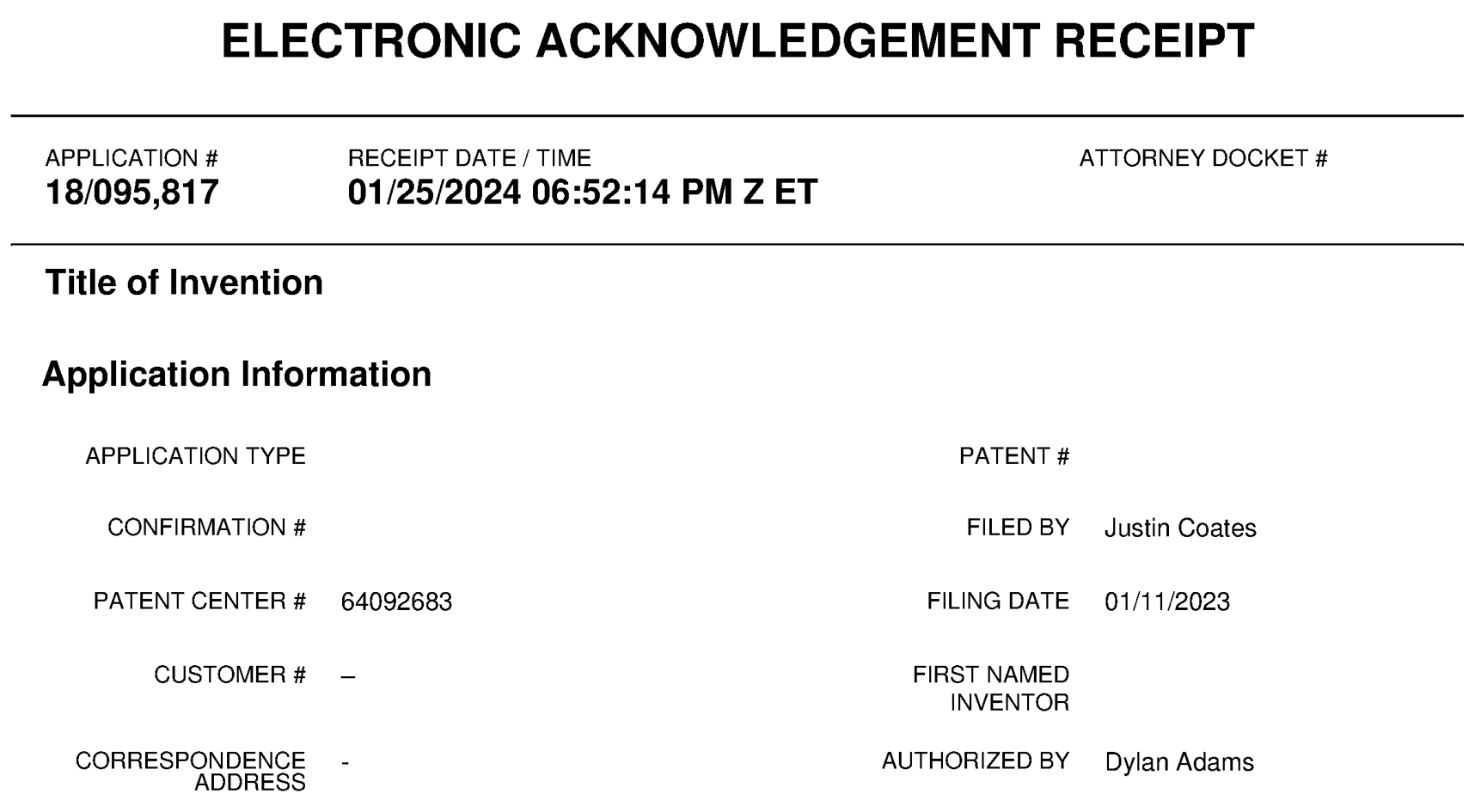
More than two years before Copper’s April 2026 lawsuit, its patent counsel was already putting an earlier disclosure into the examination of Impulse’s integrated-storage application, 18/095,817. The January 25, 2024 USPTO receipt identifies Justin Coates as the filer and Dylan Adams as the authorizing person. It lists an 18-page claim chart whose filename includes “Channing.” The July 3 receipt identifies the same team, and the July submission itself carries the signature /Dylan O. Adams/. 33343529
The connection to Copper is in the other file wrapper. Channing Street Copper Company’s September 2023 power of attorney sits in the family of US11870263B2; the following month, Adams signed that application’s remarks for Davis Wright Tremaine. The attribution rests on this cross-file paper trail: the lawyer authorizing the submissions against Impulse was also prosecuting Copper’s earlier patent family. 3736
The reference was Griffith’s US20220344941A1, the publication of the application that became Copper’s US11870263B2. Recorded assignments identify the inventors transferring to OTHER LAB, LLC in June 2023, then an August 2023 patent-assignment-agreement record from Other Lab to CHANNING STREET COPPER COMPANY. “Griffith” in the examiner’s paperwork therefore means technology from the competing company’s patent family. 1328
The mechanism is a third-party preissuance submission under 35 U.S.C. 122(e) and 37 CFR 1.290. It lets an outsider supply published material and explain its relevance while an application is being examined. Here, the strategic opportunity was to put Copper’s earlier disclosure beside the words Impulse was asking to own, before those words became an issued claim. 4024
Impulse changed the claims. Copper’s counsel came back.
The first submission was detailed. Its 18-page chart placed Impulse’s original claims 1–20 alongside passages from Griffith. For claim 1 alone, the chart mapped the appliance, battery, bidirectional conversion and charge/discharge scheduling to the earlier publication. This gave the examiner a proposed route through the reference, one claim element at a time. 24
On May 29, 2024, Impulse canceled claims 1–20 and introduced claims 21–40. New claim 21 focused on a sensor monitoring an appliance’s operating condition and a controller deciding whether to adjust battery power using that information. The accompanying remarks record the replacement and reserve the ability to pursue other subject matter in later applications; they do not say that the January submission prompted the change. 3839
On July 3, the same filing team submitted a 22-page chart against the replacement claims. Its opening pages put claim 21’s sensor and controller beside Griffith’s battery and environmental sensors, battery-control functions and power-output configuration. The chart had caught up with the moving claim set. The filing receipt and the claim numbers establish this sequence, even though the chart’s column heading still carries the old January 25 date. 3425
That repeated intervention is the interesting competitive move. Copper’s patent counsel was following what Impulse sought to patent and renewing the explanation of why Copper’s earlier disclosure mattered. The eventual examiner decision still needs to be read separately from the submitter’s proposed mapping. 333436
The narrowing that survived examination
On September 25, 2025, the examiner rejected claims 21, 28–33 and 40 as anticipated by Griffith; the remaining claims faced obviousness rejections using Griffith with another reference. Impulse responded on January 6, 2026 with both arguments and amendments. The marked-up page shows the important shift: “operation condition” gives way to a temperature value, and the general appliance gives way to its heat-transfer element. 2320
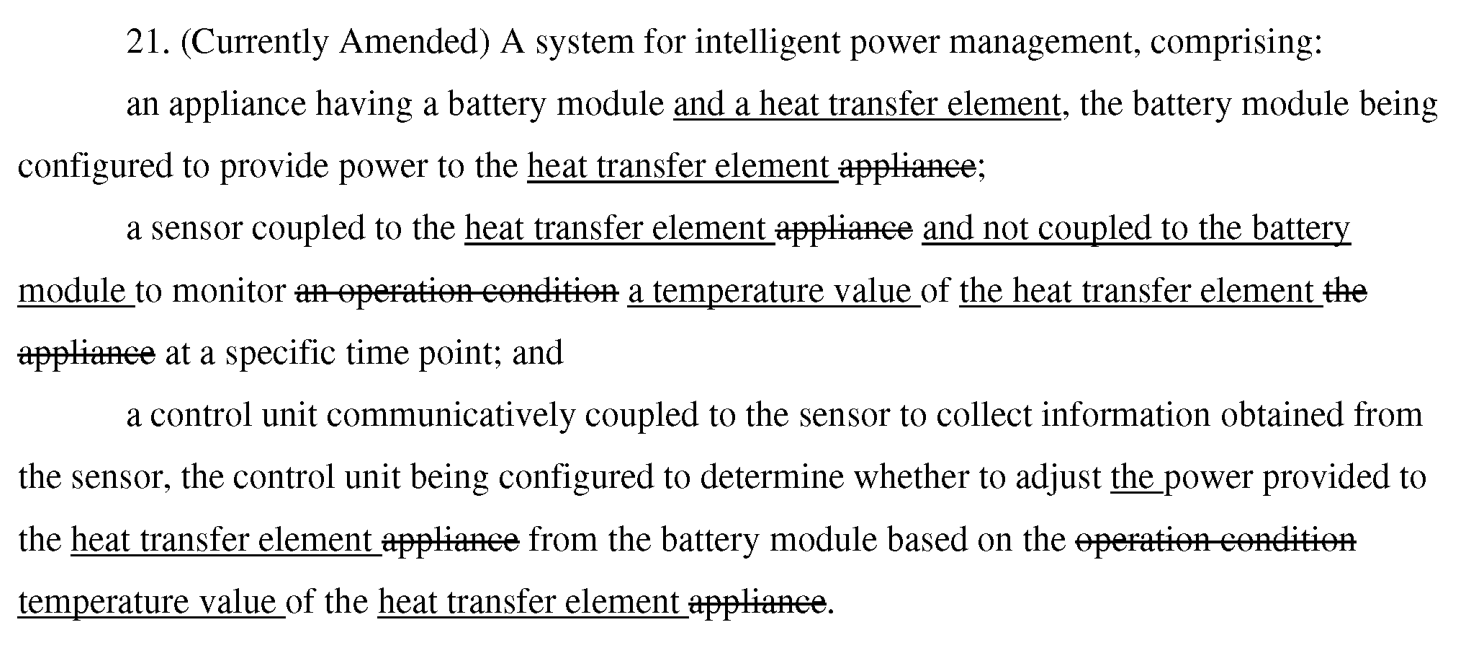
Before: May 2024 claim 21 called for a sensor coupled to the appliance, monitoring its operating condition, and a controller using that condition to decide whether to adjust battery power to the appliance. After: January 2026 claim 21 required a sensor coupled to the heat-transfer element and not coupled to the battery module, monitoring that element’s temperature, with the controller using that temperature to decide whether to adjust battery power to the element. These are substantive restrictions on the sensor and feedback relationship. 3820
Impulse’s explanation made the distinction explicit. It argued that Griffith’s battery-temperature and building-environment measurements did not disclose monitoring the temperature of an appliance’s heat-transfer element in the claimed arrangement. It also distinguished Griffith’s power-use and power-cost information from controlling delivery using the heat-transfer element’s temperature. Those were Impulse’s arguments for the amended claim. 21
The May 13, 2026 allowance then identified that sensor-and-control combination in its reasons for allowing the claims. The application became US12726038B2 on September 1, with former claim 21 issued as claim 1. Impulse obtained its patent with a more specific claim than the one challenged in July 2024. The requirement concerns the recited sensor; it does not prohibit a separate battery-temperature sensor elsewhere in the appliance. 224
The supported sequence is submission, renewed submission, rejection over the same reference, amendment and allowance of the more specific combination. That supports a story about proactive pressure on claim scope. The record reviewed here does not establish that the examiner copied Copper’s charts or that the submissions alone caused the narrowing. The examiner’s own rejection and Impulse’s express response supply the clearest link between the prior art and the change. 2321
The battery can become an appliance module
The newer grants widen the technical story. US12640662B1, issued in May, describes a removable power-manager housing shaped to fit an appliance, with power and communication connections. Claim 1 includes identifying the appliance type and using that information to control a multimode inverter supplied by the grid and/or battery. Claim 15 also describes charging, inversion toward the grid and appliance-output modes. These are claimed capabilities, not evidence that every retail cooktop enables every mode. 6
US12712433B1, issued in August, moves down another level into the driver. Its first claim combines different DC outputs during different appliance operations, feedback from a sensor monitoring the target material, and a full-bridge driver generating different AC outputs, including one for induction heating. The subject is that operating combination, not ownership of the full-bridge circuit in general. 7
There is also an allowed continuation, published as US20240195199A1. Its April claim sheet combines converters for nominal 110 V and 220 V supplies with appliance-related temperature information, automatic voltage acceptance and adjustment of a charge/discharge schedule. “Works with two outlet voltages” is only one part of that claim. The published application, later claim sheet and allowance remain distinct records. 92627
Taken together, these filings suggest an ambition beyond putting a battery in one stove: reusable power hardware, appliance identification and control of the energy’s final conversion into heat. That is an interpretation of the disclosed architectures, not a claim that all of them have shipped.
Copper’s three claims are not interchangeable
Copper’s side begins with an earlier appliance-storage family claiming provisional priority in March 2021. The disclosure considers battery storage distributed among appliances in a building. Three grants from that family appear in the dispute with Impulse. Looking at their actual language is much more useful than reducing the family to “a battery in a stove.” 1029
US11870263B2, claim 12: the claim places a battery system within a load in a powered building with a distribution system and multiple receptacles. The battery charges from the connected receptacle, and the load can operate entirely from the battery, entirely from the receptacle or partly from both. All three operating capabilities matter to this claim. 10
US12191667B2, claim 11: the battery is associated with the load and receptacle; the load can use battery and receptacle together, or the receptacle alone. Placement inside the load is added in dependent claim 12. Battery-only operation is added in dependent claim 14. Those additional requirements should not be silently imported into independent claim 11. 11
US12199435B2, claim 11: the independent claim includes operation using the battery and receptacle together. Internal placement, battery-only operation and receptacle-only operation are added in dependent claims 12, 14 and 15. Again, it is inaccurate to describe this independent claim as requiring all three modes. 12
Each of these independent claims also recites the surrounding building/receptacle arrangement and charging relationship. They allow one or more loads; they do not necessarily require several battery appliances. This comparison identifies meaningful differences in the written claims. It is not a finding that an Impulse product meets them.
The chart changes sides of the page
Copper filed suit on April 3, 2026, after Impulse’s January amendment and before the May allowance and September grant. By then, the contest had two tracks: the scope of the patent Impulse could obtain and whether its cooktop infringed Copper’s existing patents. 2920224
The complaint’s Exhibits D, E and F make the change visible. At the USPTO, the charts compared Impulse’s pending claims with Griffith’s earlier disclosure. In court, Copper placed its own issued claims on one side and Impulse’s product descriptions on the other: claim 12 of US11870263B2, claim 11 of US12191667B2 and claim 11 of US12199435B2. The exhibits draw on Impulse’s website, manuals, installation and troubleshooting materials, and videos to allege that the cooktop has the claimed features. 24414243
Those are different comparisons. Patentability asks whether the claimed invention clears the earlier record. Infringement compares the accused product with an asserted claim. Impulse could obtain a patent on a specific temperature-feedback improvement while still facing Copper’s allegation about the surrounding battery-and-appliance system. Its grant is a right to exclude others from its claimed invention; it does not itself provide clearance to practice every part of the product. 3241
The file wrapper became a knowledge allegation
The prosecution history also appears under “Impulse’s Actual Knowledge of Copper’s Asserted Patents” in Impulse’s June 11 answer. Paragraph 46 addresses the ’817 application’s September 2025 rejection and January 2026 amendment. Paragraphs 41–45 address its related ’557 application; paragraph 61 admits citation of Copper’s ’263 patent. Impulse disputes the conclusions Copper draws from those records. 30
The underlying documents explain why this was useful material for a knowledge allegation. In the ’557 application, the September 2024 examiner action rejected claims over Griffith. Impulse’s December response then discussed Griffith in detail and argued for a distinction based on its two voltage-specific converters. In the ’817 application, its January 2026 response likewise addressed Griffith’s sensors and power-control disclosure. The paper trail records repeated, substantive engagement with the same earlier family. 444521
This is how the two efforts connect: the patent-office contest generated a record relevant both to the boundaries of Impulse’s claims and to allegations about what Impulse knew. That is an interpretation of the combined records, not evidence that Copper planned every prosecution step for a future suit. Impulse’s answer denies infringement and willfulness, asserts invalidity and opposes enhanced damages; it also brings advertising counterclaims. 30
A response distinguishing an earlier disclosure can show that the applicant encountered it. Whether a product satisfies a valid issued claim remains a separate inquiry. Nothing in these cited filings establishes that the USPTO narrowing was an admission of infringement, or that the court has treated it as one. 4120
Where the court record stops
The original complaint’s exhibits establish the three specific claims compared above. A later docket index lists a July 30 amended complaint, an August 17 scheduling order and an August 27 counterclaim. The July and August pleadings were not available for close reading in this update. The original charts therefore should not be presented as an exhaustive list of the claims currently asserted. 41424331
The verified story is already substantial: Copper’s counsel intervened in examination, Impulse amended around an earlier disclosure, and those prosecution encounters became part of the subsequent dispute over knowledge and infringement. The reviewed record does not establish a court winner.
What should disappear into the appliance
For the person cooking, the desirable outcome is ordinary: the pan gets hot, holds the temperature they asked for and responds when the knob moves. The battery and converter can stay out of the conversation.
The records expose how much engineering sits behind that ordinary experience. Stored energy changes the available power. Sensors decide what is happening at the cookware. Control electronics decide how to respond. The removable knob lets a person make that decision feel immediate.
That suggests a useful way to evaluate these appliances when testing becomes possible: watch what happens during a long meal as the battery charge falls; see how the temperature responds when food enters the pan; find out whether the interface remains predictable when several things happen at once. Battery capacity is the opening specification. The behavior of the complete cooking system is the story still worth following.
For the companies, there is another test: what claim language survives the encounter with the earlier record. Copper’s counsel brought that encounter into Impulse’s examination before the lawsuit. Impulse’s eventual grant shows both the pressure and a route through it—a specific feedback arrangement that the examiner accepted. 333622
Evidence notes, claim details and open questions
Evidence scope and open questions
This article replaces the earlier research lead using current grants, selected claim amendments, examiner records, original drawings and company product descriptions. The four Impulse grants discussed here issued between March and September 2026. The temperature-sensing and converter applications are identified separately as allowance-stage records. Published claim sets should not be substituted for the later claims discussed in the text.
The Impulse collection contains 631 downloaded file-history records across the ten identified US applications, including three provisionals: 609 had completed text extraction and 22 were marked skipped when checked. That is collection coverage, not a claim that every page has been read. Close reading for this article focused on the documents cited beside each passage. Copper’s core family now has all 518 indexed documents downloaded across eight members, with text extraction still in progress. The issued claim comparison uses the original grant PDFs and patent-platform’s claim text.
The four family diagrams are native patent-platform SVG exports. Three cover indexed Impulse storage, sensing and knob families; one covers Copper’s eight-member core family. The platform has no family export for Impulse applications 19/292,678 and 19/461,479, so their grants are linked individually instead of drawing substitute trees. These diagrams are not a complete map of either company’s portfolio.
The assignment paragraph reports specific recorded parties and dates, not a complete title opinion. The July amended complaint and August counterclaim remain to be obtained and compared with the June answer. Product implementation, infringement, validity and comparative performance have not been established by the evidence reviewed here.
September 14 update: the third-party-submission account adds close reading of both USPTO filing receipts, the signed July submission, Copper’s power of attorney and counsel’s signed remarks, and Impulse’s May 2024 replacement claims and remarks. Original pages were checked for signatures and amendment markings. Both receipts name Coates as filer and Adams as authorizing person; Adams’s work for Copper is established by the Copper-family records. The submission forms do not themselves name the underlying client. Attribution to Copper’s patent counsel is based on the combined records; the client’s private instructions are not in this record. The January 2026 amendment followed an express Griffith rejection and was defended against Griffith, but the examiner did not expressly attribute the narrowing to a third-party submission. Other research and collection totals retain their September 13 cutoff.
Litigation connection: the original complaint’s Exhibits D–F and the June answer were read through the court-record mirror, with paragraph and document-page references. The full original complaint and later amended pleadings were not obtained; the knowledge discussion identifies what the June answer expressly addresses. Court PDF downloads returned HTTP 403, so those court filings link to their readable external document pages. The underlying patent-office documents and all patent publications remain self-hosted. No image of an unavailable court PDF has been recreated.