One hand problem, several mechanical answers
A useful robot hand needs more than fingers that curl. It has to make room for the drives, carry force through a moving wrist, and detect what happens at contact. Figure’s filings distribute those jobs in different ways: one branch sends tendons from the forearm, another puts motors inside removable fingers, and a third builds sensing into the fingertip. Together they reveal a portfolio of engineering choices, rather than a single documented production design.1245
Two of the main records have become US patents: the finger-kinematics grant US12420434B1, issued September 23, 2025, and the tactile-sensing grant US12722306B2, issued September 1, 2026. The forearm application US20250319614A1 remains contested; the latest action found rejects its amended claims. The distinction matters because the drawings tell us what Figure disclosed, while the examination record tells us which combinations it has secured or is still pursuing.451636
The forearm has to make room
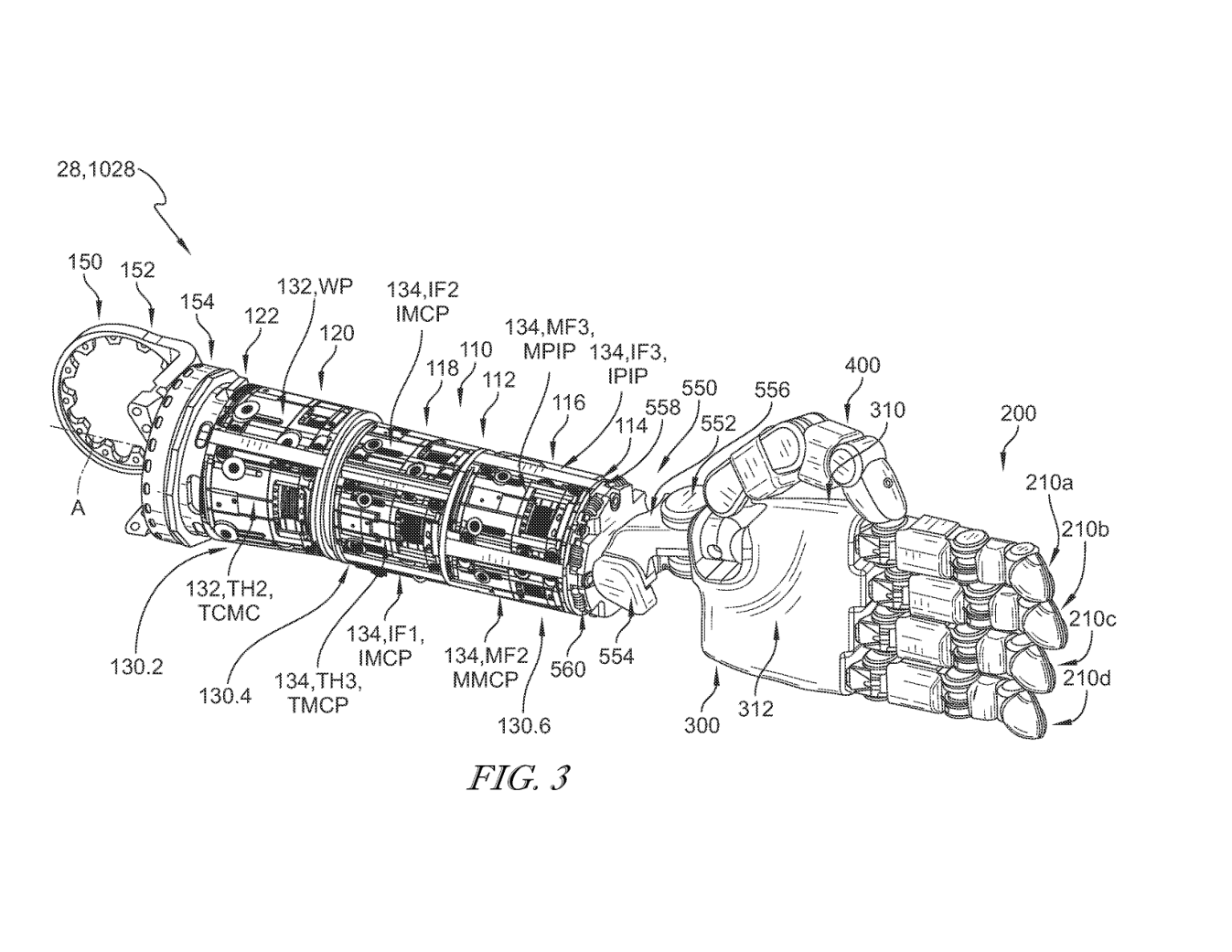
Moving the drives out of the fingers creates a packing problem in the arm. US20250319614A1 distributes actuator groups around the forearm and along its length. Paragraph 0162 describes twelve actuators: a direct-drive twist actuator and eleven rotary tendon actuators. Their placement has to leave room for the arm’s taper and for tendons to depart toward the hand.1
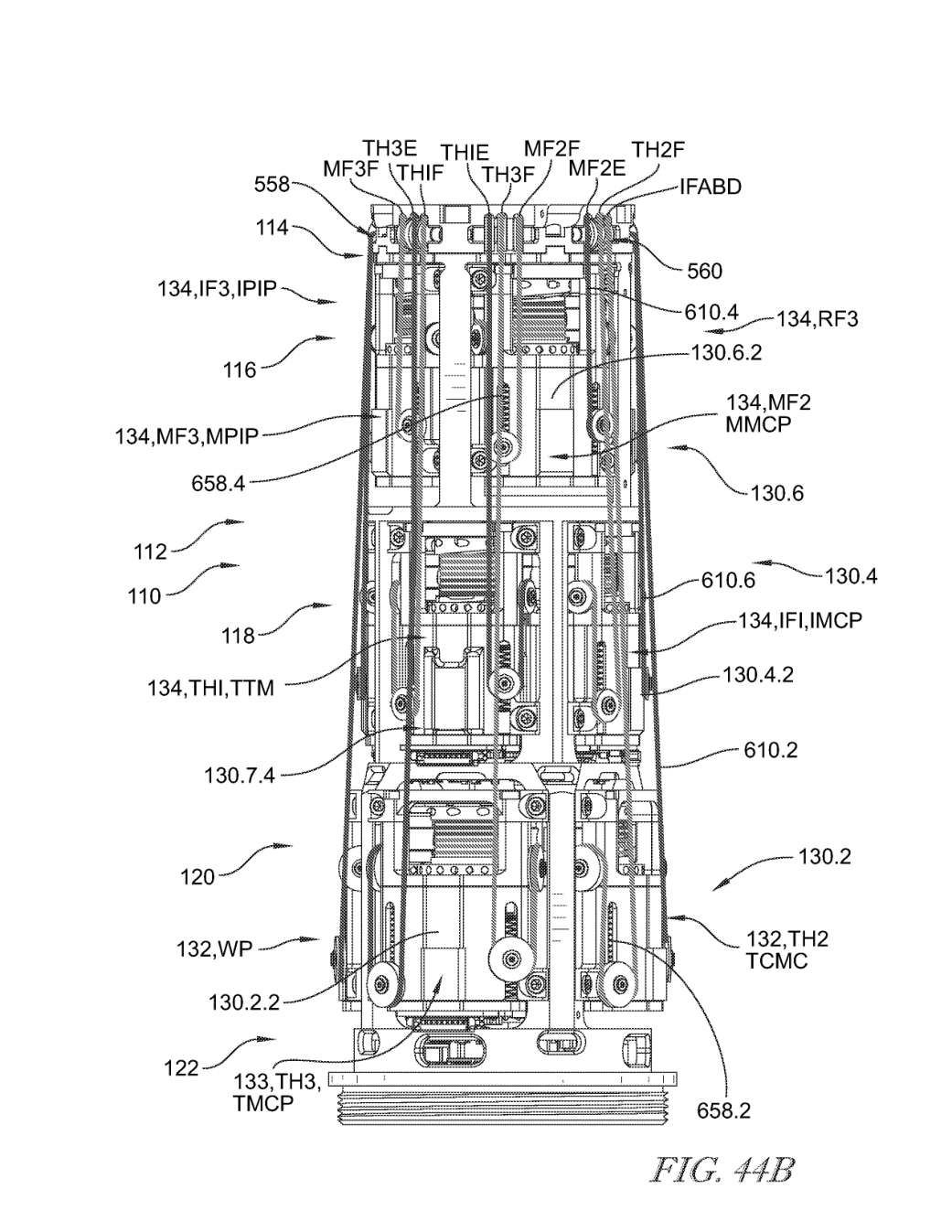
The specification gives the thumb particular attention: shorter or less curved tendon routes can serve its greater force demand. It also describes compact cycloidal transmissions. The resulting design problem is the coexistence of motors, transmissions, cable paths, and a usable forearm envelope.113
The twelve-actuator count belongs to that embodiment. The proximal-group enumeration in paragraph 0163 is inconsistent, and the number of actuators does not establish how many finger joints can move independently. The disclosure’s claimed efficiency and durability benefits also remain design assertions; the reviewed record supplies no independent endurance comparison.1
Every tendon must get past the wrist
The tendons must reach the palm through a wrist that can bend. Paragraphs 0186–0189 describe a carpal-tunnel structure whose centroid is offset from the wrist’s pitch axis. The opening therefore occupies a deliberate position relative to the wrist mechanism. Other disclosed arrangements can omit that tunnel structure.1
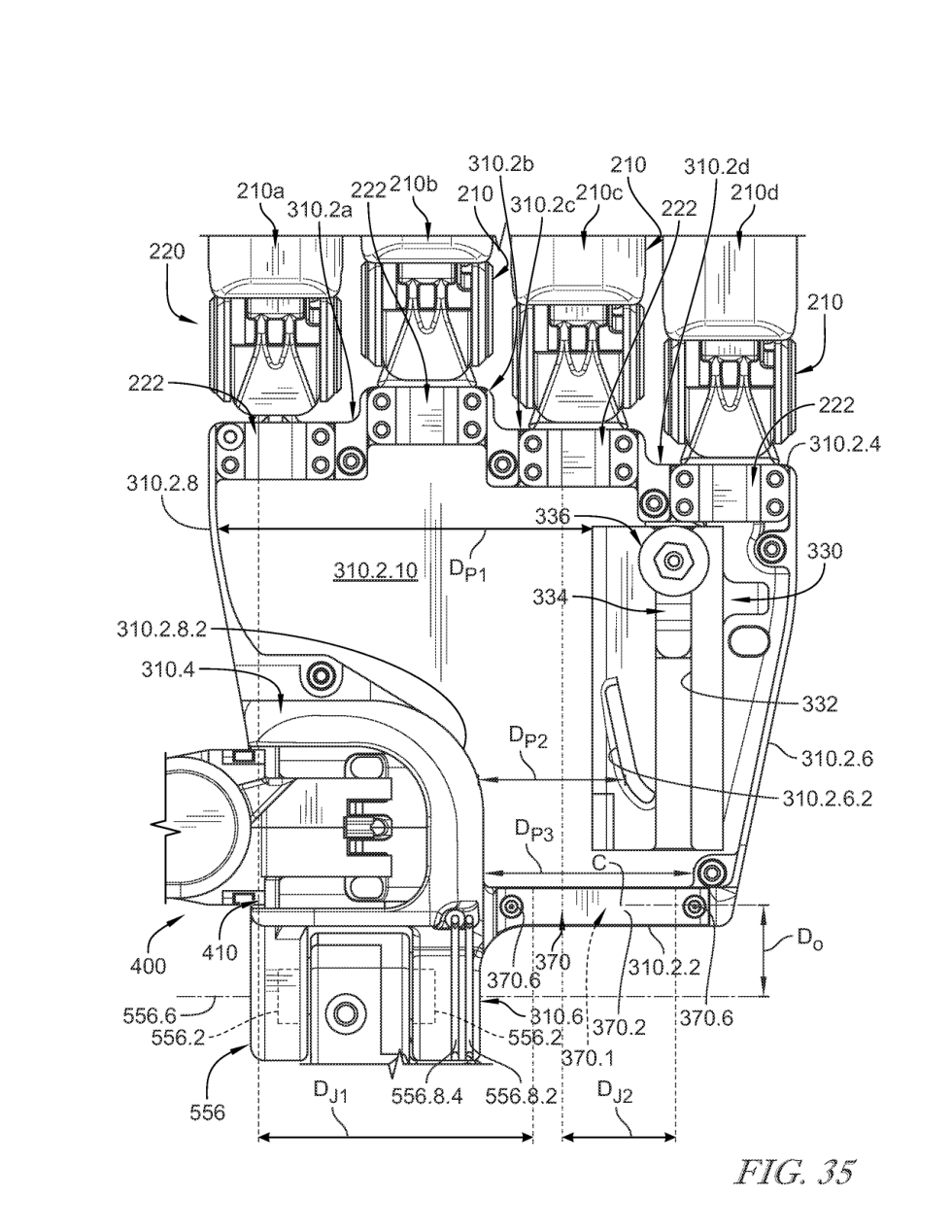
Figure 35 makes the internal clearance visible. Paragraph 0241 describes the lower middle cavity distance DP2 as less than 45 percent of the upper entrance distance DP1. This is a relationship between two measured spaces inside the housing. It will reappear in the amended claims—and in a disputed passage of the examiner’s action.113
Routing also changes with posture. Paragraph 0249 describes cable-and-slide arrangements coupling ring- and little-finger movement; paragraphs 0252–0255 discuss changing tendon curvature. The engineering challenge is to carry force across those configurations. A drawing of the route alone cannot establish friction, fatigue life, or independent control of every joint.1
What if the fingers carried their own motors?
Figure’s modular-hand filings move complexity back into the digits. Published claim 10 of US20250205908A1 describes four substantially identical removable finger assemblies with specified attachment and angular relationships, and no mechanical cables configured to actuate their components. US20250214259A1 separately describes motorized removable fingers and a removable two-motor thumb.23
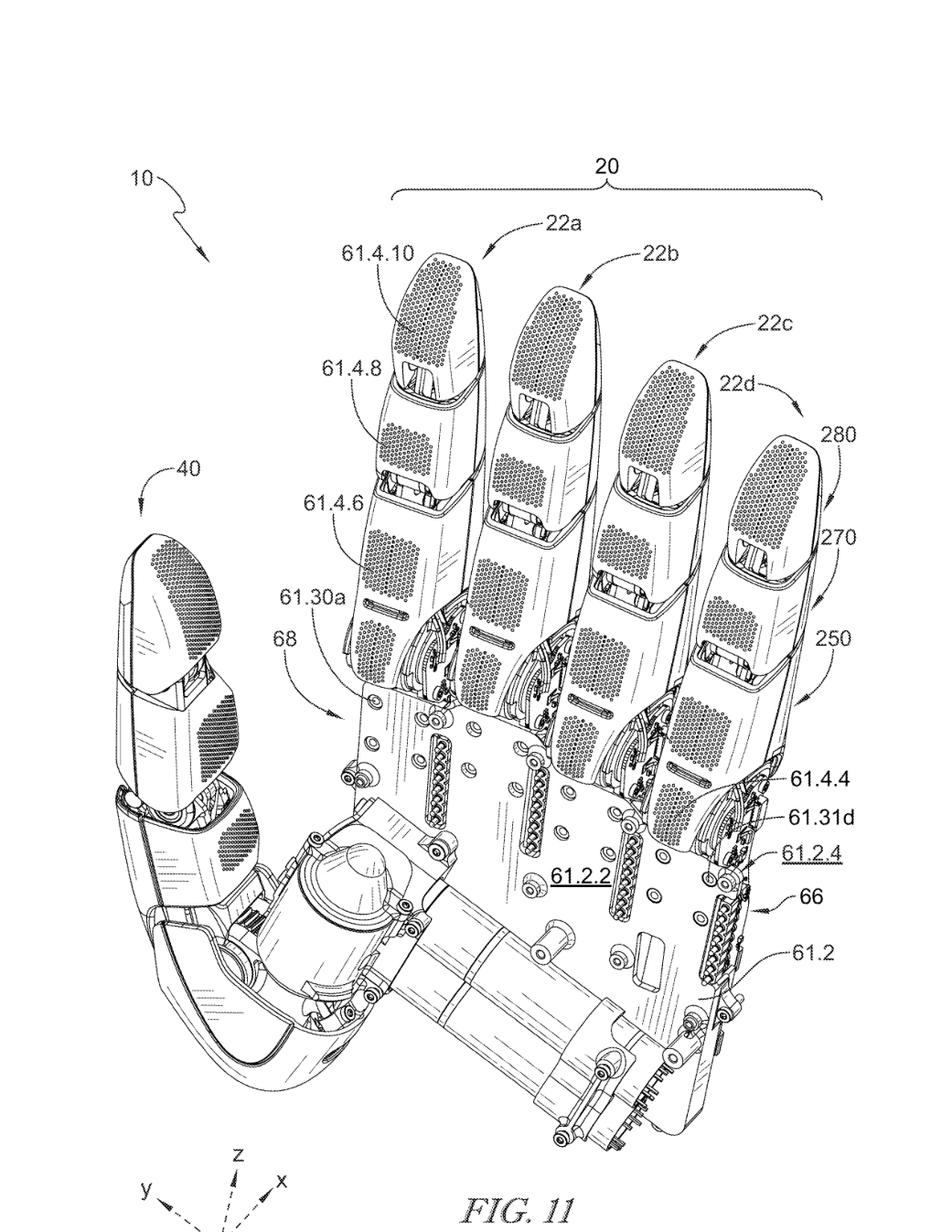
The amended files make the packing problem more concrete. In the June 26, 2025 amendment for 19/000,626, claim 1 specifies portions of the worm drive link and proximal drive link moving into a recess as the finger curls. In 19/006,191, amended claim 1 combines removable motorized fingers with a two-motor thumb whose motor-shaft axes and motor-gear axes have stated parallel relationships. These are amended pending combinations; neither application has a merits office action or allowance in the retrieved index.495037
A removable finger could localize replacement work, while its motor and transmission must fit within the digit through its motion. That is an engineering implication, not measured maintenance savings. The record does not establish that this motorized branch replaced the tendon branch in a named Figure product.23
A shared axis, with room to move independently
Inside the finger described in US12420434B1, a motor-driven worm turns a worm wheel on a perpendicular axis. Links carry that motion into the finger. Issued claim 1 requires a main proximal link that shares the worm wheel’s pivot axis but can rotate independently of the wheel, alongside the worm drive link and pivotably coupled proximal drive link. Sharing an axis does not make the parts one rigid rotating unit.4
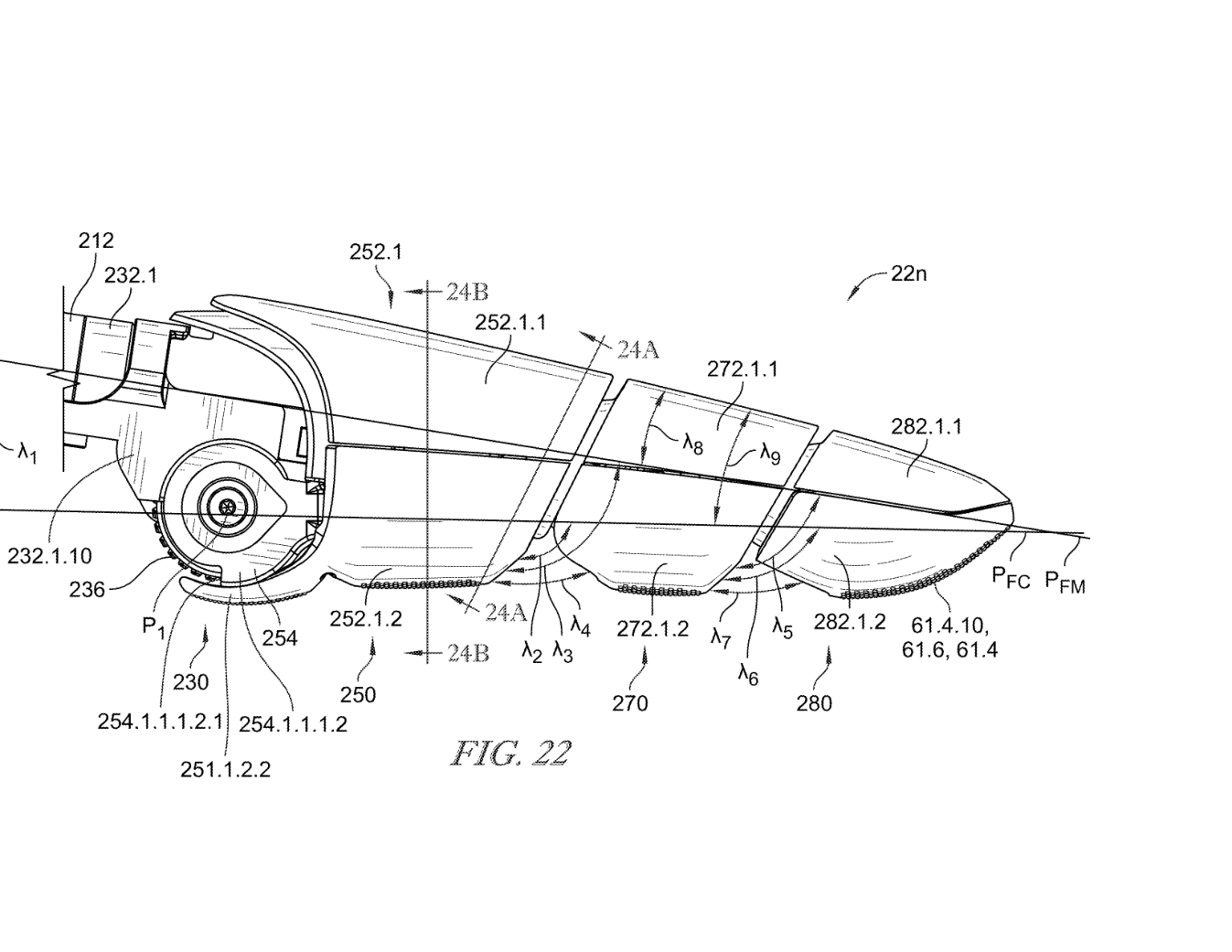
That distinction helped secure the grant. In the July 21, 2025 reasons for allowance, the examiner identified the coaxial main proximal link’s independent rotation as a feature absent from the prior art of record. Independent claim 16 addresses removable fingers using the transmission, with a member biasing them toward the uncurled position. The claimed relationships between these parts explain the grant more precisely than the broad idea of a motorized finger.194
The file also explains part of the procedural path: the USPTO granted Figure’s Patent Prosecution Highway request on June 13, 2025, before the July allowance and September grant. The special-status decision and the examiner’s reasons are different pieces of evidence: one concerns how examination proceeds; the other explains the allowed combination.44194
The thumb cannot be just another finger
The thumb must curl and also move into position against the fingers. US20250375897A1 and US20250375905A1, both published December 11, 2025, describe removable thumb assemblies with two motors. Their claims distinguish flexion from interposition and address shaft angles, gearing, and component space in curled and uncurled configurations.67
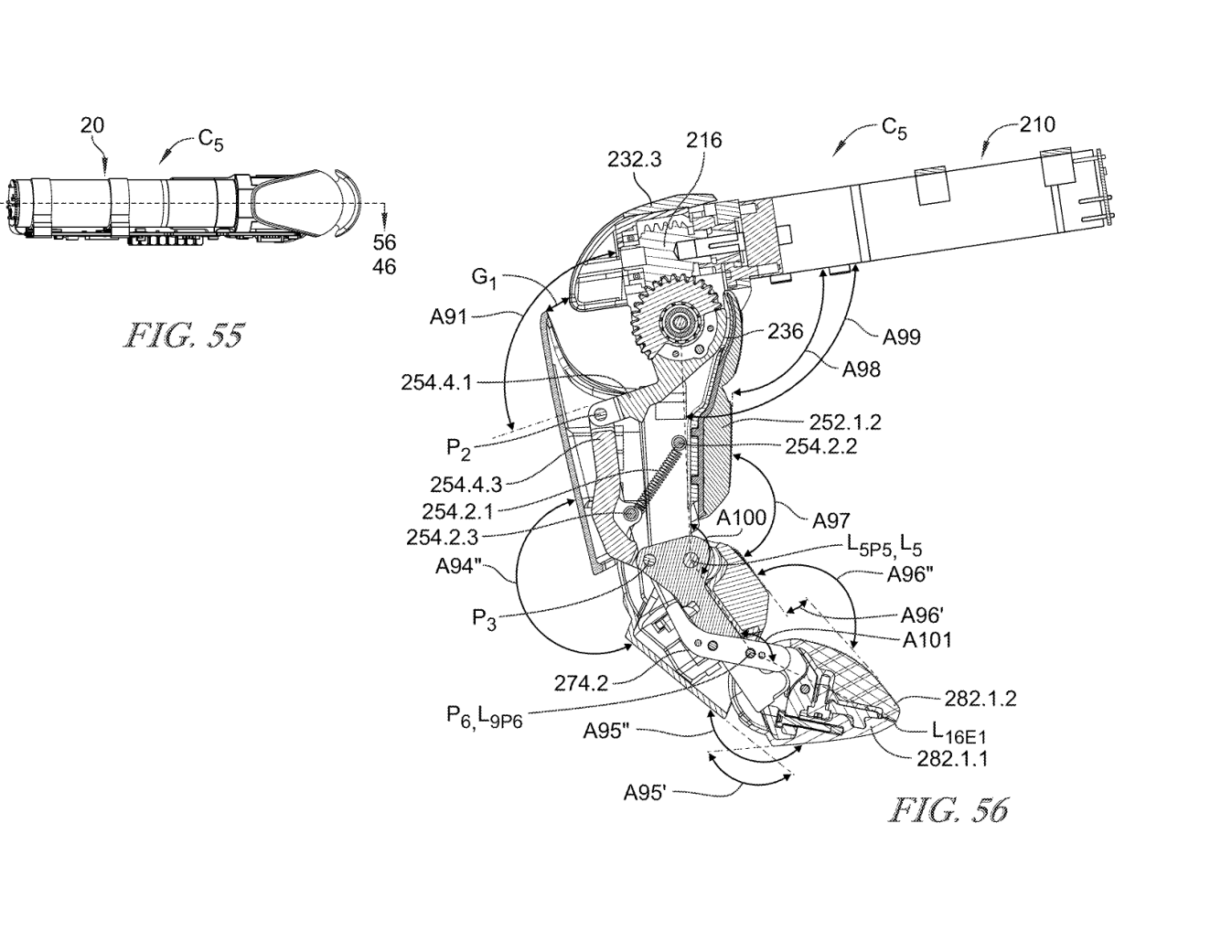
The fresh file review now covers both prosecution records. Application 19/224,109 received PPH special status on July 3, 2025. Application 19/224,252 received it on September 18 after a renewed request. Its September 9 amendment corrects the preamble of dependent claim 24; the remarks tie that correction to PPH processing. It does not replace the independent two-motor architecture with a new one.45464748
Both applications remain docketed and ready for examination in the September 13 platform records, and neither retrieved index contains a US merits action or allowance. Special status therefore should not be read as a third or fourth granted hand patent.37
The fingertip is part of the sensor
Contact force reaches a sensor through whatever covers it. In US12722306B2, the covering is part of the claimed sensing arrangement. Issued claim 1 recites a humanoid robot with a torso, head, articulated arm and end effector, including a strain gauge, processing electronics and an energy attenuation member. Its exterior region at least partly surrounds its interior region and has a lower compression/deflection ratio. The member transfers at least some applied force to the sensor.5
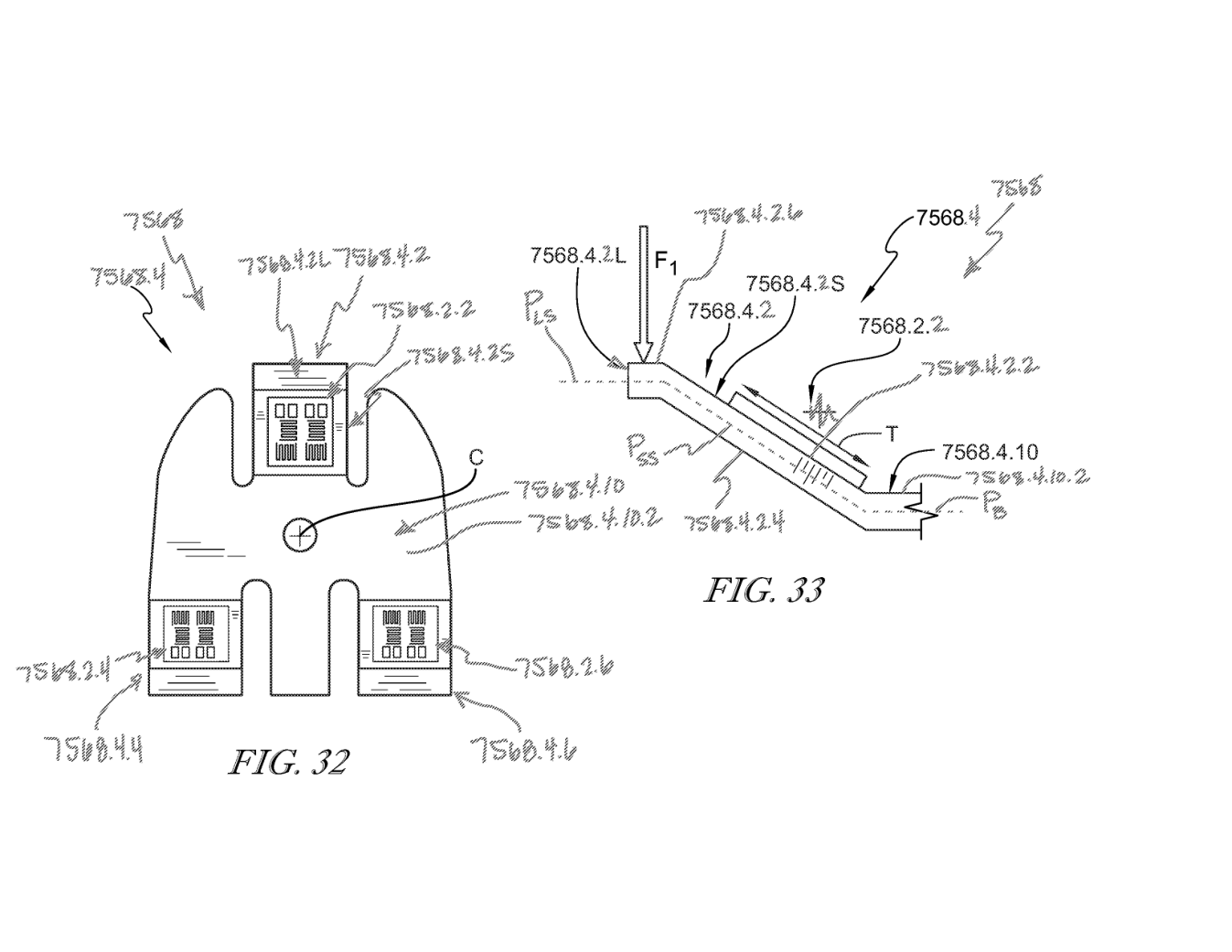
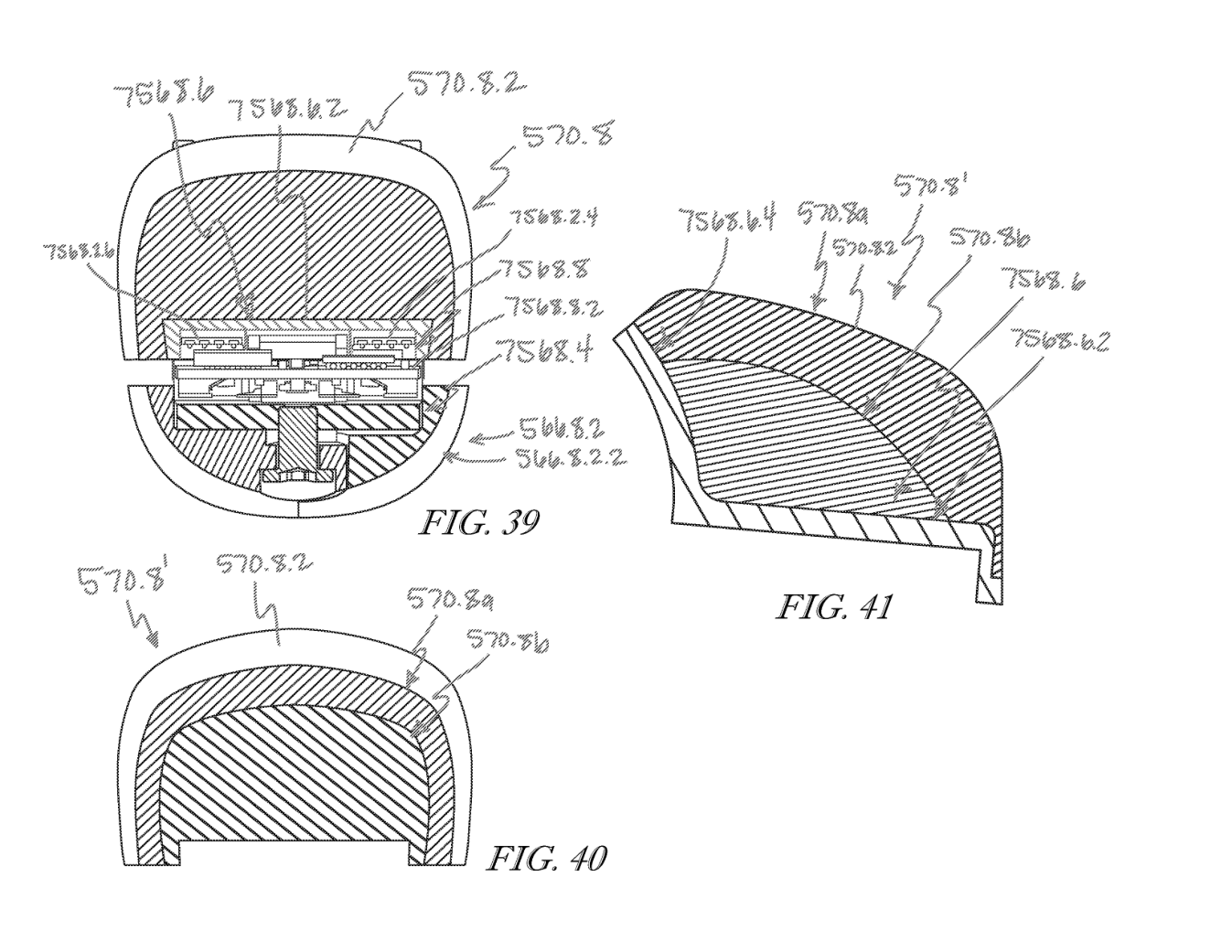
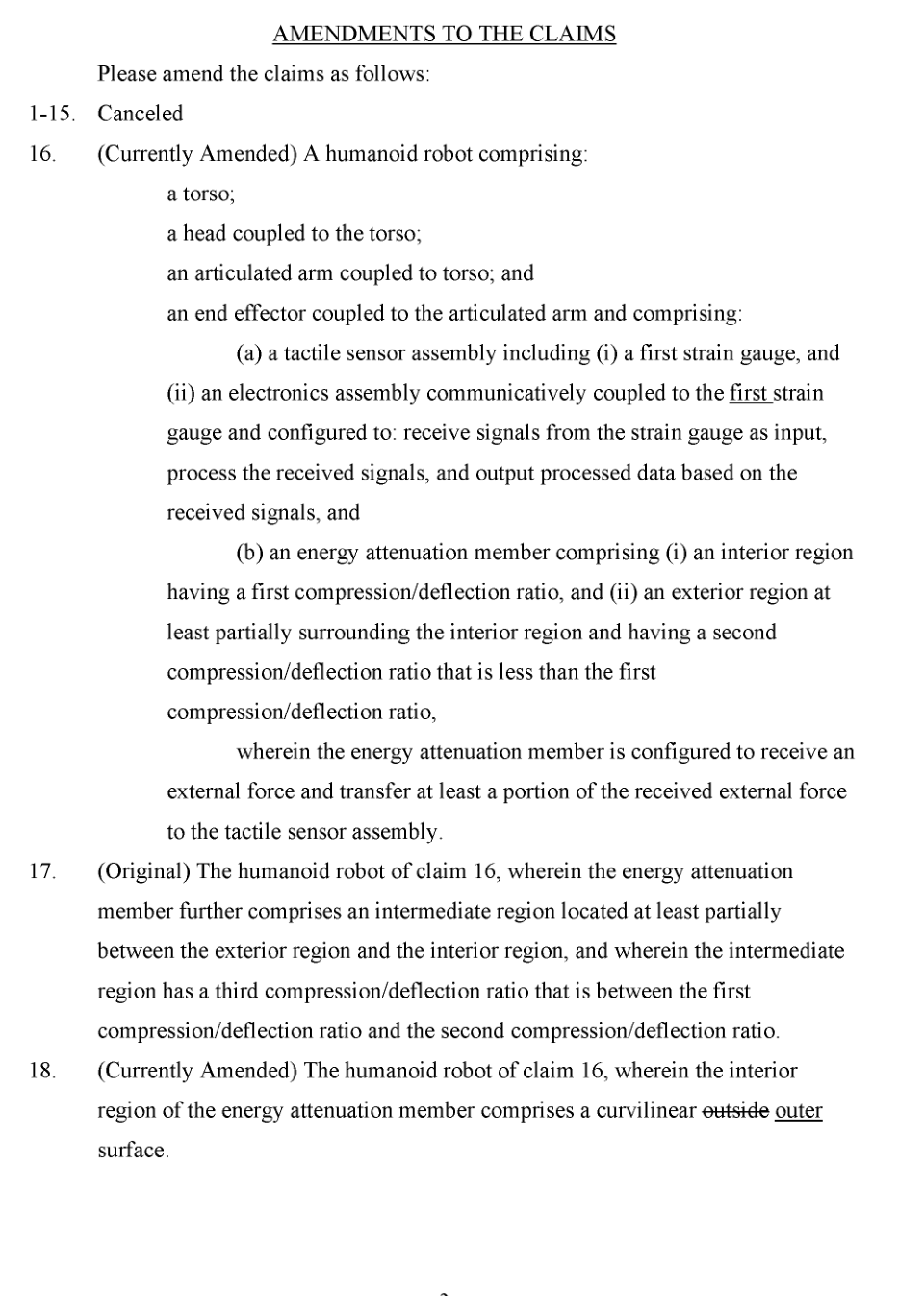
The surrounding robot requirements matter: claim 1 is not simply a claim to any soft sensor covering. Nor does it require every feature highlighted in the abstract. Claim 2 adds an intermediate material region with a ratio between the other two; claim 8 adds the three-arm bridge. Other dependent claims add a force distributor and a mechanical stop. Those features address the balance between measurable deformation and excessive movement.5
The file history now confirms the numbering. October’s independent claim 16 became issued claim 1; dependent claim 17 became claim 2; dependent claim 23 became claim 8. The amendment and the original issue-classification table agree with the grant pages. The intermediate region remained a dependent limitation throughout this documented sequence.38415
Ten claims, and a deliberate route through examination
Figure reduced the tactile case before its first merits examination. On October 28, 2025 it canceled claims 1–15, leaving independent claim 16 and nine dependent claims. Its remarks expressly connected that one-independent, ten-total claim set to the Streamlined Claim Set Pilot. The USPTO accepted the application on December 5 and granted special status until the first Office action.383940
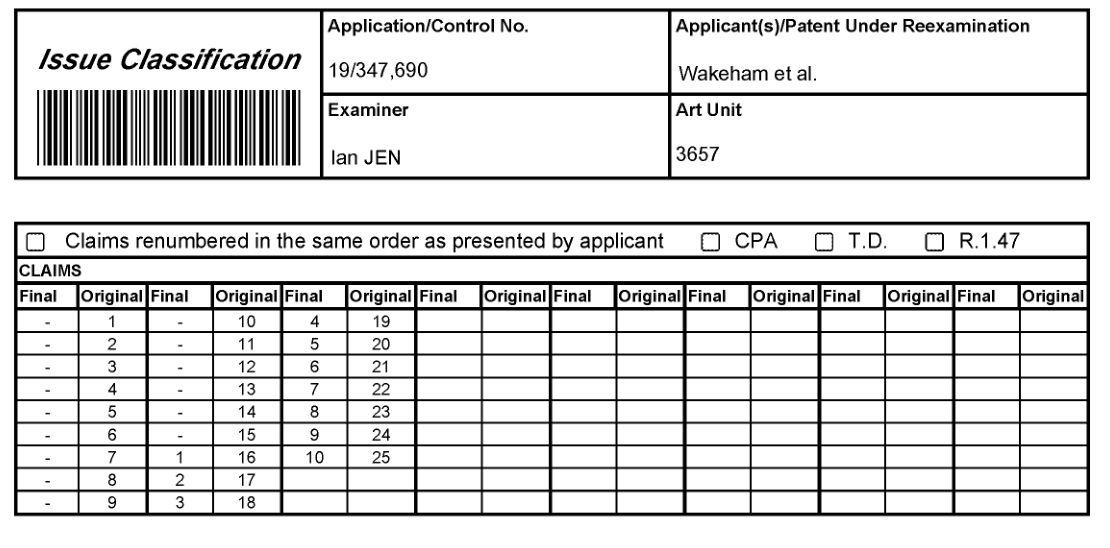
The June allowance then identified claims 16–25 as allowed. Its reasons quoted a combination that included the intermediate region from dependent claim 17. The reasons therefore discuss a more specific combination than independent claim 16 requires. The two-region independent claim and the narrower three-region dependent claim both proceeded to issuance.2038415
Figure also responded after allowance. In June 23 comments, it disputed any implication that patentability rested solely on the examiner’s stated reasons or selected features, and resisted extending those reasons to other applications. Those comments are a general reservation of its position; they do not specifically identify the intermediate-region discrepancy. The careful reading is to keep the applicant’s comments, the examiner’s explanation and the issued claim requirements distinct.42
The record establishes that Figure selected a smaller claim set and obtained special status. It does not establish that the canceled claims were rejected or unpatentable, or that the pilot alone caused the later allowance.394020
When the hand blocks the view
A hand also needs information before and during contact. US20260102926A1 describes end-effector vision, including a view directed toward the palmar side and combinations of cameras, tactile sensing, and attenuation material. US20260102903A1 addresses sensors and illumination. Both were published April 16, 2026.89
Figure’s October 9, 2025 introduction of Figure 03 provides company context: it describes compliant fingertips, tactile sensing, and palm cameras that help when the hand obstructs other views. That account connects sensing to a practical manipulation problem. It does not establish that any particular patent drawing or claim maps to the production Figure 03 hand.10
Related applications, different outcomes
The expanded review screened 110 collected US members in Figure’s platform family and followed eleven hand-related applications in detail. The finger-kinematics and tactile cases have issued; the forearm remains under a non-final rejection; the modular, thumb, finger-continuation and vision/sensor cases reviewed remain pending. These outcomes coexist within a broad portfolio.37
The abandoned forearm parent also has a specific story. On July 18, 2025, the USPTO granted an express-abandonment petition for 19/173,793 to avoid publication. That document records a requested withdrawal from publication, not a rejection of the engineering concept. Its continuation-in-part child, 19/249,517, has its own ongoing examination.43137
The original patent-platform SVG highlights the forearm, finger and tactile reading points among 114 nodes, including four PCT applications. Continuity lines record relationships; they do not establish that every claim has support back to the earliest provisional. A connected family also does not mean that all its drawings depict one production hand.321
An allowable detail meets a new reference
The forearm examination turned on a tendon route. In the December 12, 2025 final action, the examiner said then-dependent claim 29 would be allowable if rewritten in independent form with its inherited limitations. The discussion singled out routing above one finger structure and below another that the cited Walters reference did not supply.17
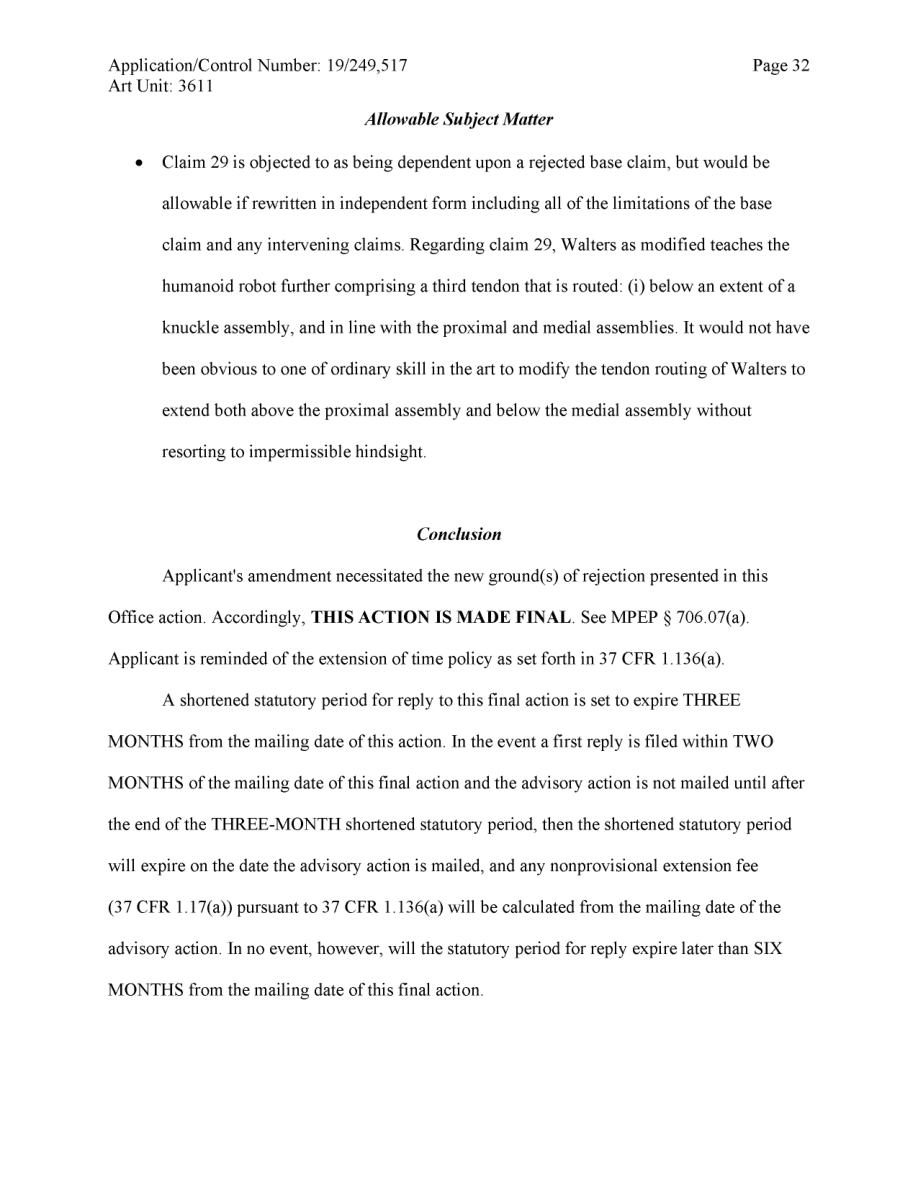
Figure tried to amend after that final action. The February 13, 2026 advisory action declined to enter the amendment, citing removed limitations and new combinations requiring further search. Figure then filed a request for continued examination, or RCE, on March 4. Its amended independent claims incorporated the route below the knuckle, above the proximal phalanx, and below the medial phalanx. The accompanying remarks argued that the previously allowable subject matter should lead to allowance.181415
The renewed search changed the situation. An action recorded June 24 and mailed July 2, 2026 rejected all 28 pending claims. It introduced Wang CN115070744A, indexed to Zhejiang University of Technology, against the amended routing limitation. A detail the examiner had previously accepted in a dependent combination was now challenged with a new reference.163033
That is a continuing examination, not an invalidated patent. The next question is whether the examiner’s combinations account for the amended requirements and whether Figure can answer them. The available record establishes the change in position, not which side ultimately prevails.1416
The September 13 recheck found no later substantive response or merits action in this forearm index. The July action remains the latest examined position, despite the much larger set of supporting documents now held by the platform.37
Three independent claims, one recurring tendon route
The March 4 amendment leaves three independent claims—1, 11, and 16—and 28 pending claims in total. Claims 2, 8, 22, 23, and 29 are canceled. The former claim 29 survives as part of the prosecution story, rather than as a fourth independent claim.14
Claim 1 combines a forearm frame and two actuator groups with unequal tendon-departure distances from the wrist. It also specifies lower and central robot regions and the below–above–below tendon route through the finger. The full combination spans the first two PDF pages.14
Claim 11 starts from the hand: finger assemblies, lateral movement at the index finger’s MCP joint, two measured housing spaces, and a second distance less than 45 percent of the first. It adds the same tendon route. The amendment deletes the old fifth/sixth wall-extents and third-distance language; those struck-out passages are not additional requirements.14
Claim 16 combines wrist base members and a rotational axis with an offset carpal-tunnel centroid, again adding the tendon route. Each independent claim is a different combination. Reading the recurring route in isolation would miss the structures around it.14
The earlier hands behind the rejection
The July action builds combinations from earlier work on robot hands. Against claim 1 it uses Ihrke US20110071671A1, on a dexterous humanoid wrist, and US20110071673A1, on actuator and electronics packaging, together with Wang CN115070744A. The Ihrke US assignment chains record interests in GM Global Technology Operations LLC and the United States represented by NASA; Wang is indexed to Zhejiang University of Technology.161112272830
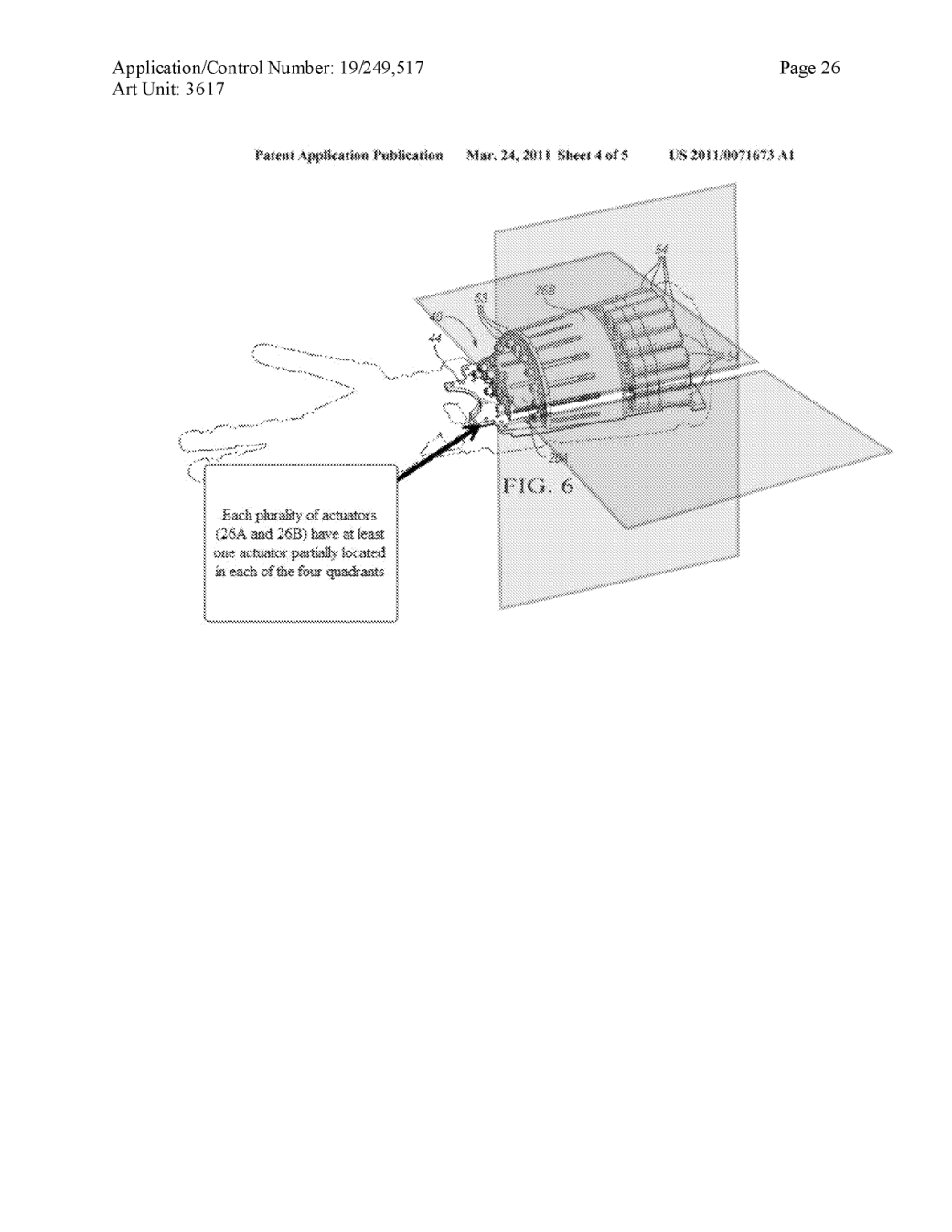
Against claim 11, the action adds Lee KR20180107353A and another GM/NASA Ihrke publication, US20110068595A1, alongside Ihrke and Wang. Lee was originally attributed to the Korea Institute of Industrial Technology; an indexed December 27, 2024 event records transfer of all rights to the Republic of Korea, represented by the Minister of Trade, Industry and Energy. Claim 16 is addressed with Ihrke US20110071671A1 and Wang.1624262931
These combinations place Figure’s proposed geometry against earlier wrist, actuator, and finger arrangements. The US texts were retrieved independently. The foreign references’ technical role here comes from the examiner’s mapping; their original Chinese and Korean texts still need full review and translation. Likewise, the foreign ownership fields are indexed attributions, while the US ownership account uses recorded assignment chains.1112162728293031
Two distances, reversed
One comparison needs especially close reading. The March amendment says the second distance is less than 45 percent of the first. The July action’s discussion reverses that order, describing the first as less than 45 percent of the second. The specification’s paragraph 0241 agrees with the amendment’s ordering.14161
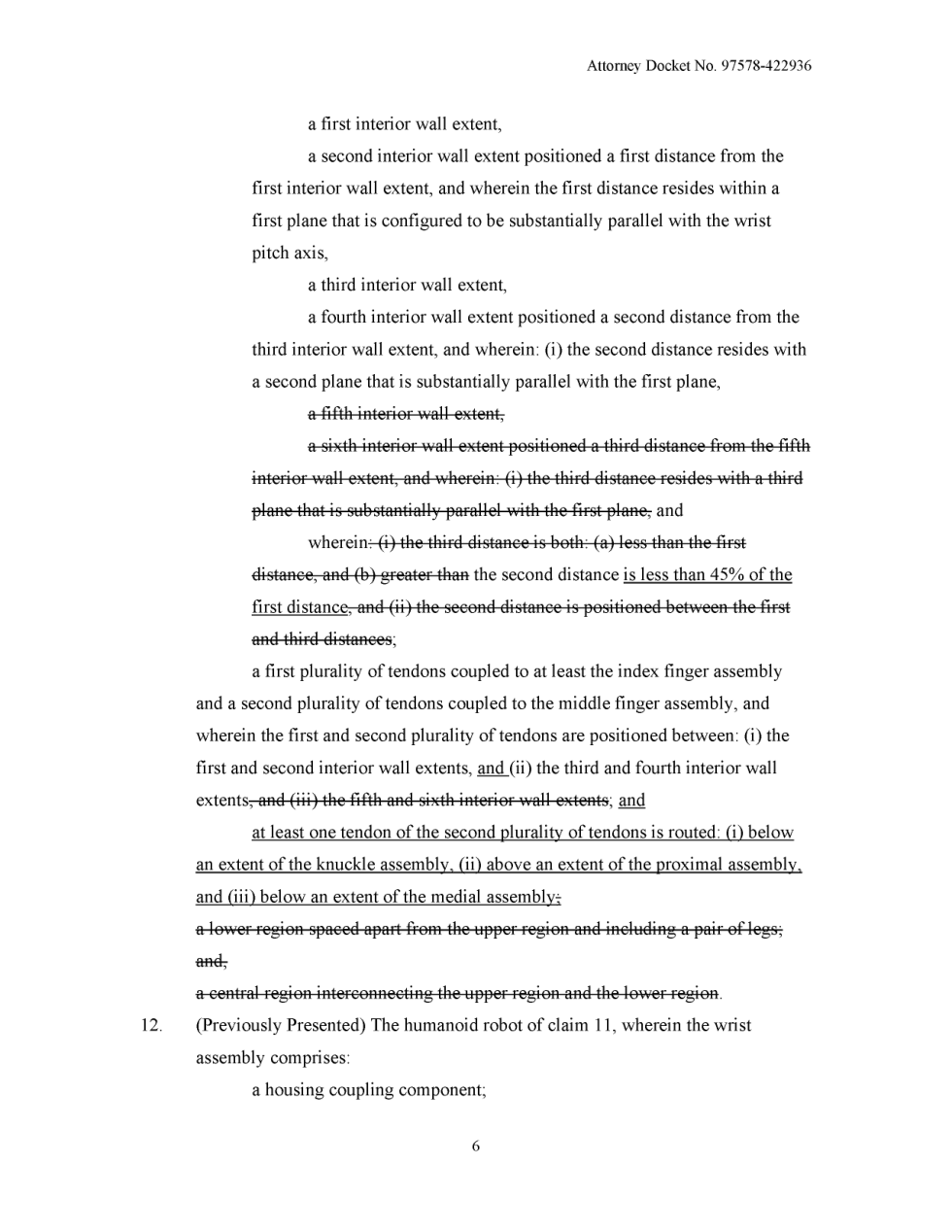
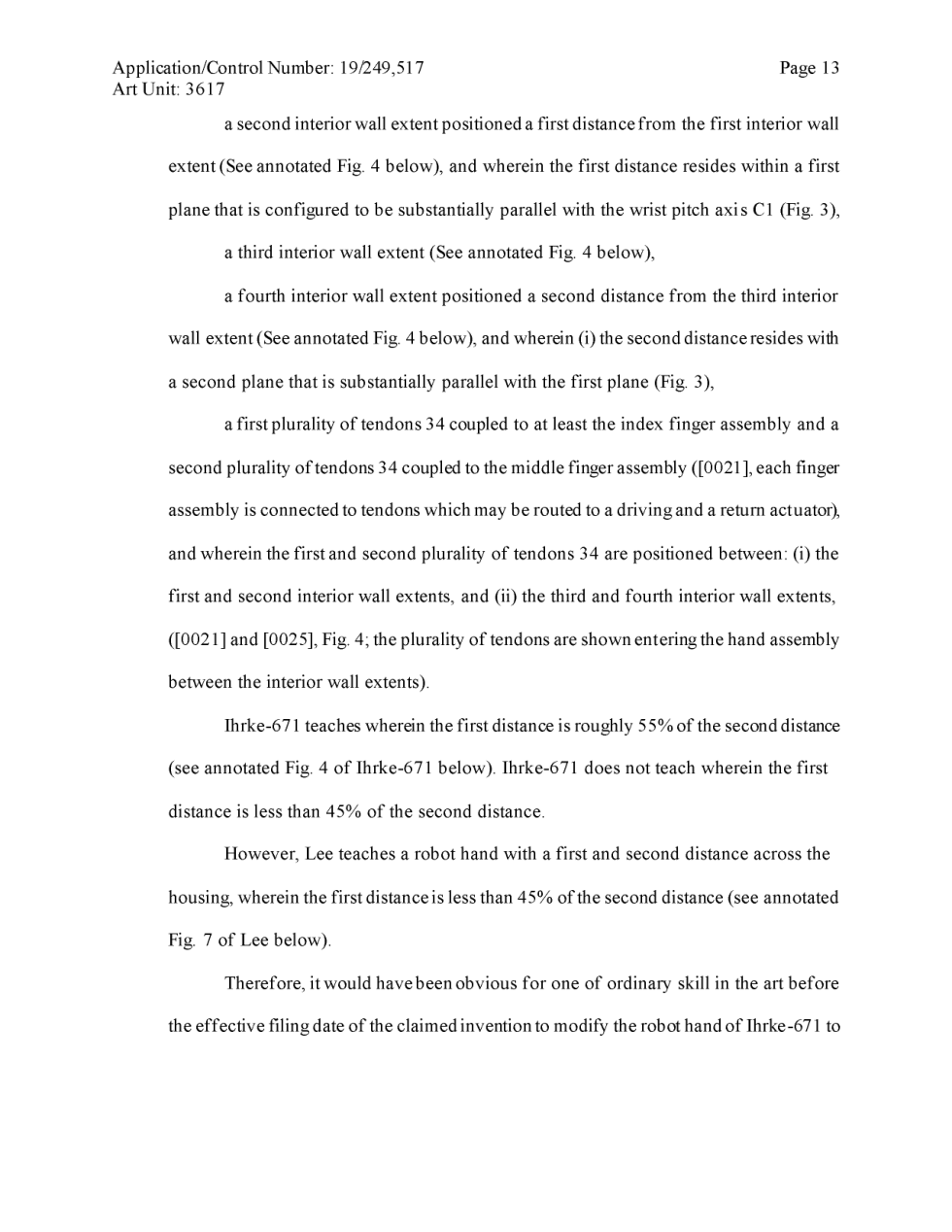
The two original pages below preserve the discrepancy: amendment PDF page 4 and action PDF page 14. Its consequence remains unresolved. The entered claims and the examiner’s full measurement mapping must be reconciled before treating it as a flaw that defeats the rejection. A separate claim 1 issue concerns “the first quadrant” after the amendment deleted wording defining it; that antecedent-basis objection is distinct from the ratio comparison.1416
What these records let us say
Figure’s disclosed hand work spans three engineering bets: make room for actuation in the forearm, make a motorized finger into a removable mechanism, and make the contact material part of the sensing system. The finger and tactile grants protect particular combinations. The forearm history shows a proposed tendon route facing new prior art, while the pending modular and thumb files preserve other approaches.145495016
This September 13 review follows the expanded family download and repaired text extraction. All 110 collected Figure US-member inventories were screened; eleven hand-related application records and their document indexes were refreshed, with selected claims, amendments, arguments and decisions read. The old statement that only sixteen forearm PDFs were available is superseded. Downloaded documents and text availability do not mean the entire family has been read or that all international records are present.37
The tactile allowance-to-grant numbering is now resolved from original pages. The remaining substantive checks concern the forearm distance mapping, full technical translation of the Wang and Lee references, and any connection to a named production hand. The platform snapshots establish what it returned on the review date; they do not certify a fresh upstream USPTO synchronization.38411637