The arm in the glass case
In Terminator 2, the future fits inside a glass case. At Cyberdyne, Miles Dyson studies a metal arm and a processor recovered from the first Terminator. The machine is gone. Enough of it remains to give the engineers somewhere to begin.1
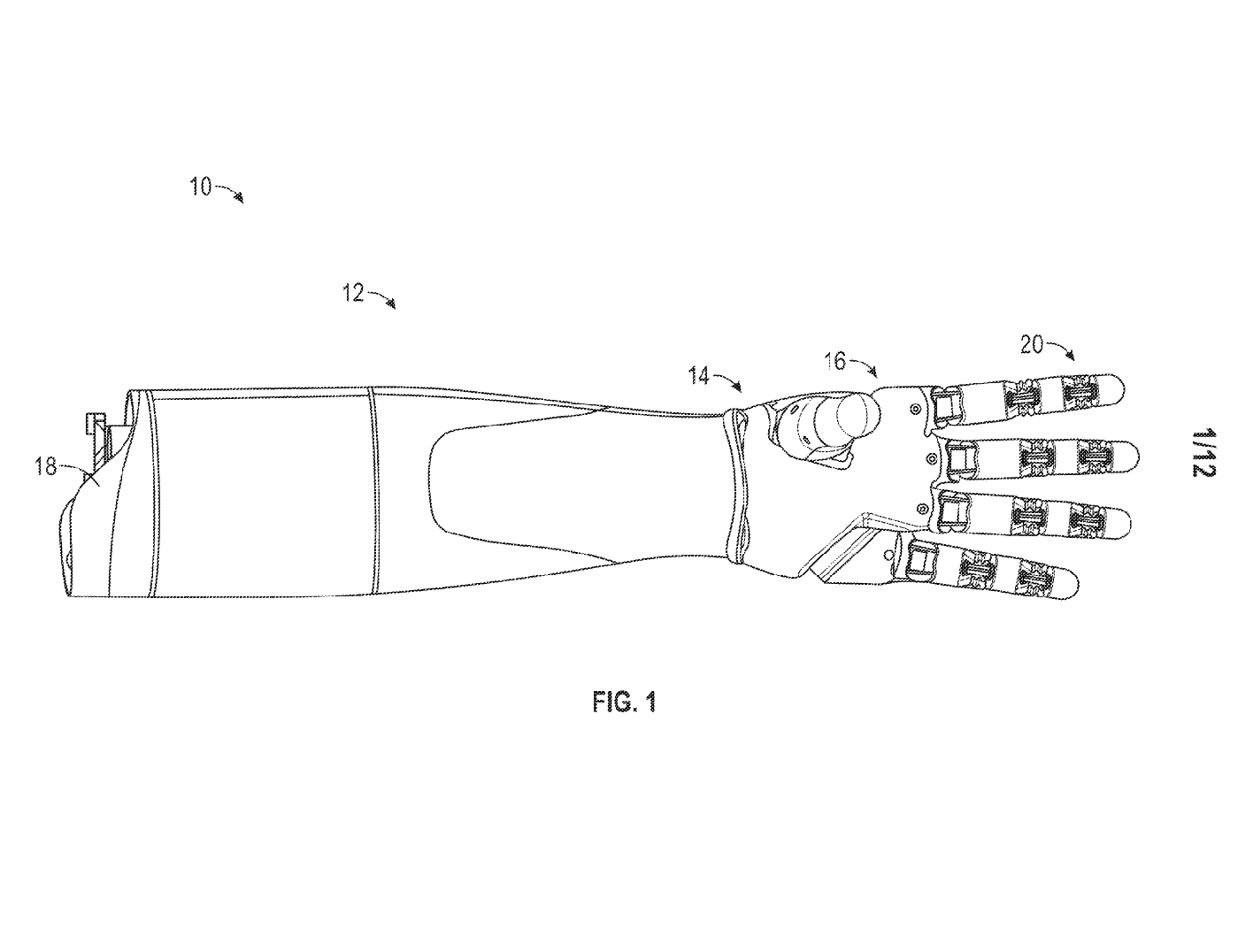
Thirty-five years later, a humanoid-hand patent can produce a flicker of recognition. There are the metal fingers. There is the crowded forearm. Look closer and the drawing becomes a collection of decisions: where to put the drives, how to turn a wrist without disturbing the grip, and how to make a finger bend.23
The Tesla side of this comparison centers on five newer international filings, submitted in October 2025 and published in April 2026. Together they cover the forearm, wrist, cable routing, flexible joints and the grasping appendage. They provide a much richer picture than the older floating-cable-end finger. Each remains a disclosed design; the records do not establish that every embodiment appears together in one production Optimus hand.30424324445
Figure supplies two useful comparisons: forearm-driven tendons and removable fingers with motors inside them. Follow the force from the drive to the object. The interesting differences appear along the way.365
When intelligence reaches for something
The prospect of recursive self-improvement gives the old movie image a new charge: an AI system improves its ability to make further improvements. There are already bounded experiments in that direction. Sakana AI’s Darwin Gödel Machine rewrites its agent code and evaluates new versions on programming tasks. That is evidence of a specific software experiment, with a long distance still between it and an open-ended intelligence explosion.7
On the hardware side, Figure’s January 2026 Helix 02 announcement shows a robot working through a four-minute dishwasher task and manipulating small objects. Figure describes the demonstrations as autonomous. They offer a concrete glimpse of learned control reaching through a physical hand; they are company demonstrations, without an established mapping to the patent embodiments examined here.8
Software self-improvement can happen without a humanoid body. But if more capable AI is to assemble equipment, handle tools or conduct physical experiments, the machinery has to deliver. A better plan still needs a grip that works. These patents let us examine that part of the problem in detail.
Where the machinery lives
Start just behind the wrist. Tesla’s WO2026080691A1 places longitudinal linear actuators in the forearm, alongside a separate rotary stage for roll. The cross-section packs hand actuators around larger wrist actuators. The mechanism has to deliver many pulling outputs through a narrow end of the arm.2
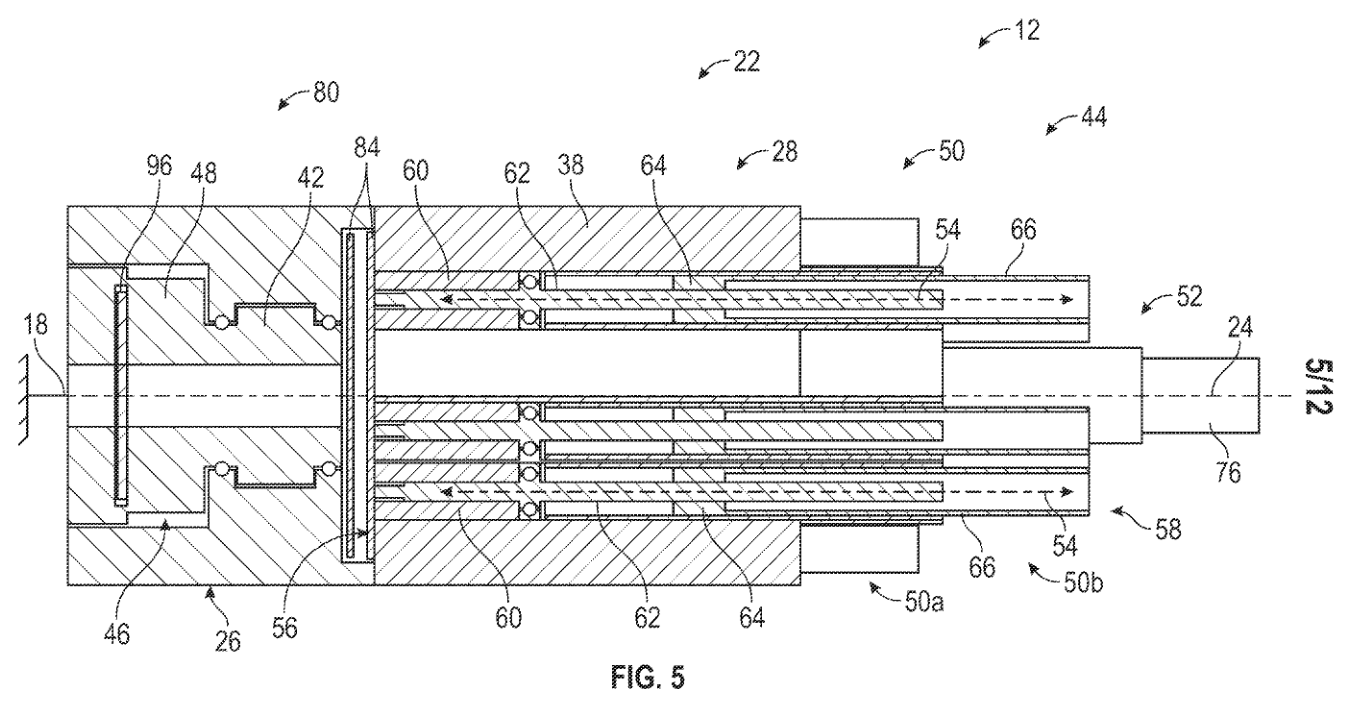
Figure’s US20250319614A1 also moves finger drives into the forearm, but describes rotary tendon drives, including cycloidal transmissions, positioned at different distances from the wrist. Both approaches free space farther out in the hand. Their drive arrangements and the paths leaving them differ.32
This is the first meaningful comparison: how to package the machinery that supplies the grip. Tesla attributes assembly benefits to separating its rotary stage from the linear bank. Figure gives close attention to the distribution of the tendon drives. Manufacturing access, cooling and service time would tell us how those choices work in practice.23
Turn the wrist. Keep the grip.
Imagine holding a cup and turning your wrist. A tendon driven from the forearm still has to reach the fingers while the joints around its path change position. Unwanted changes in cable length can interfere with the grip.
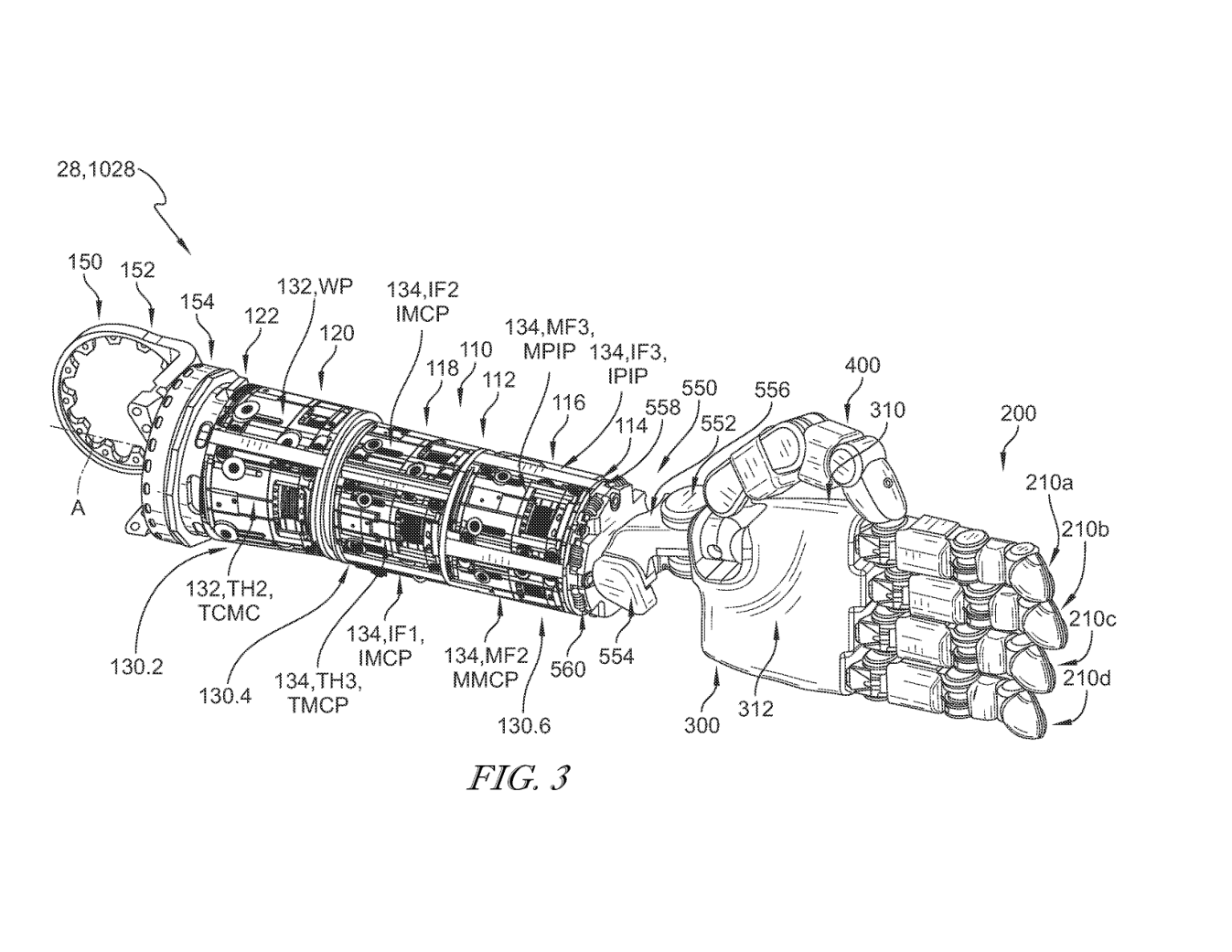
Figure’s forearm disclosure addresses that geometry with tendon-departure positions, routing curvature and, in some embodiments, a carpal tunnel offset from the wrist’s pitch axis.3
Tesla’s newer WO2026080687A1 makes the cables change arrangement across the wrist: a lateral stack on one side becomes a vertical stack on the other. Supports organize the transition around the two rotation axes. The stated aim is to limit cable-length changes and interference between wrist and finger movement; the publication supplies a proposed geometry rather than measured grip stability.42
That puts the two designs on comparable ground. Both have to deliver a controlled pull through a moving wrist. Figure’s passage geometry and Tesla’s rearranged cable bundle give us specific routes to inspect and test.342
Two drives cooperate to move the wrist
The wrist itself has work to do. In Tesla’s WO2026080690A1, two actuators connect through side links to a hand supported by a central universal joint. Move the actuators together and the hand pitches; drive them differentially and it yaws. Both drives participate in controlling both axes.43
The publication also makes room for the hand’s tendons: a cantilevered joint arrangement leaves space beneath it, while a notch accommodates the structure during extension. The wrist mechanism and the cable corridor have to fit into the same small volume.43
Read beside Figure’s carpal-tunnel arrangement, this makes the packaging problem tangible. The space available for transmitting finger force depends on how the wrist is supported and moved. A convincing comparison needs both parts of that drawing.433
Or put the motor in the finger
Figure’s portfolio also contains a more local answer. In US20250205908A1, four substantially identical fingers can be removed from the hand’s frame, and published claim 10 specifies that each lacks a mechanical cable for actuating its components. This is a separate architectural branch, not another view of the same forearm-driven hand.6
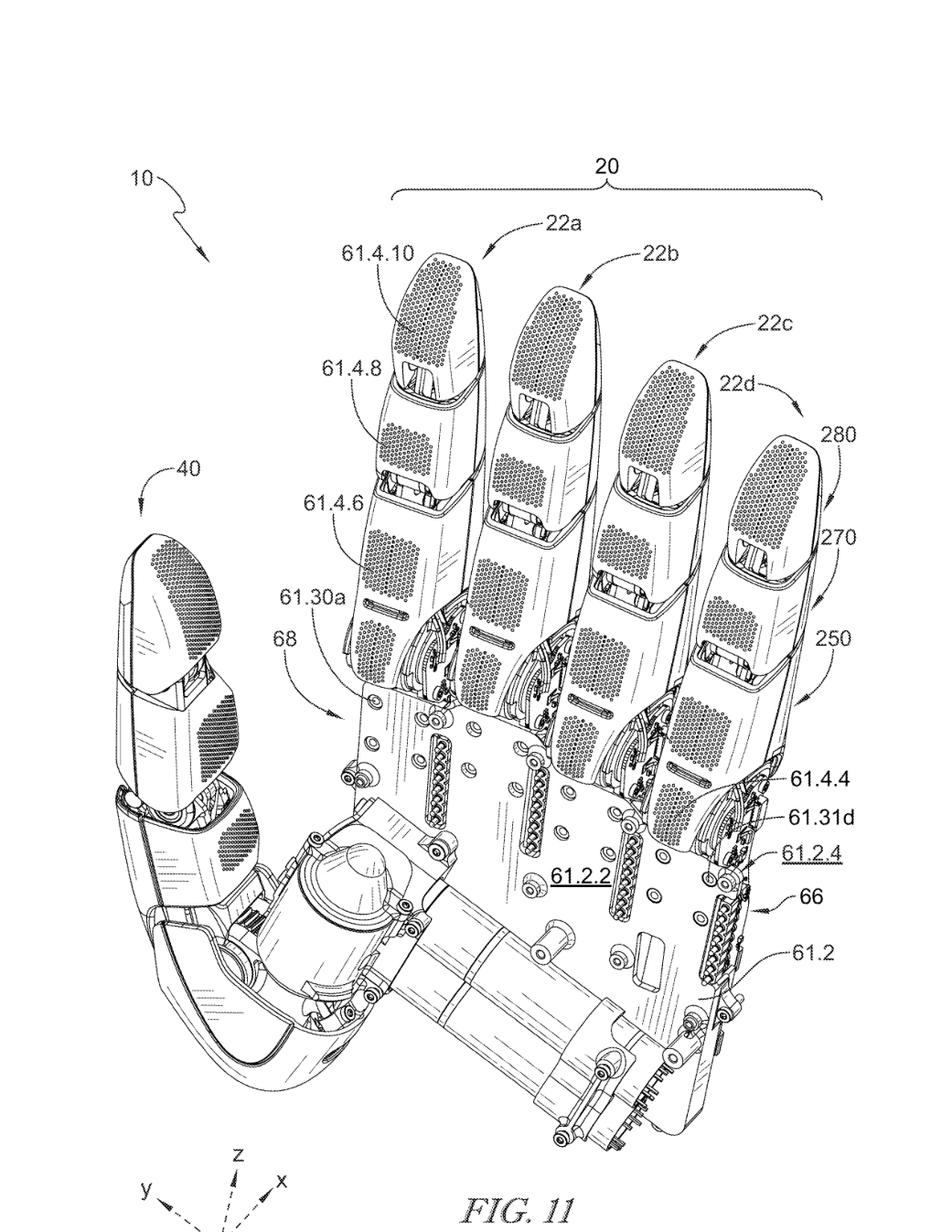
The related issued finger patent, US12420434B1, shows how a motorized digit can work. A motor turns a worm drive, which engages a perpendicular worm wheel and moves a linkage. Independent claim 16 combines removable motorized fingers with a member that biases part of the mechanism toward its uncurled position.5
This changes what a repair might involve. Instead of tracing a drive path back through the wrist, an engineer could work at the finger module. The price of that arrangement is space for the motor and transmission at the hand. Whether it makes replacement faster or operation cheaper remains a question for the built system.65
Tesla’s newer finger rolls as it bends
A finger joint does not have to turn around a stationary pin. Tesla’s newer WO2026080693A1 describes curved surfaces that roll against one another. As the finger bends, the rotational axis moves along the contacting surfaces. A flexible composite member attaches to both sides and keeps the joint connected.44
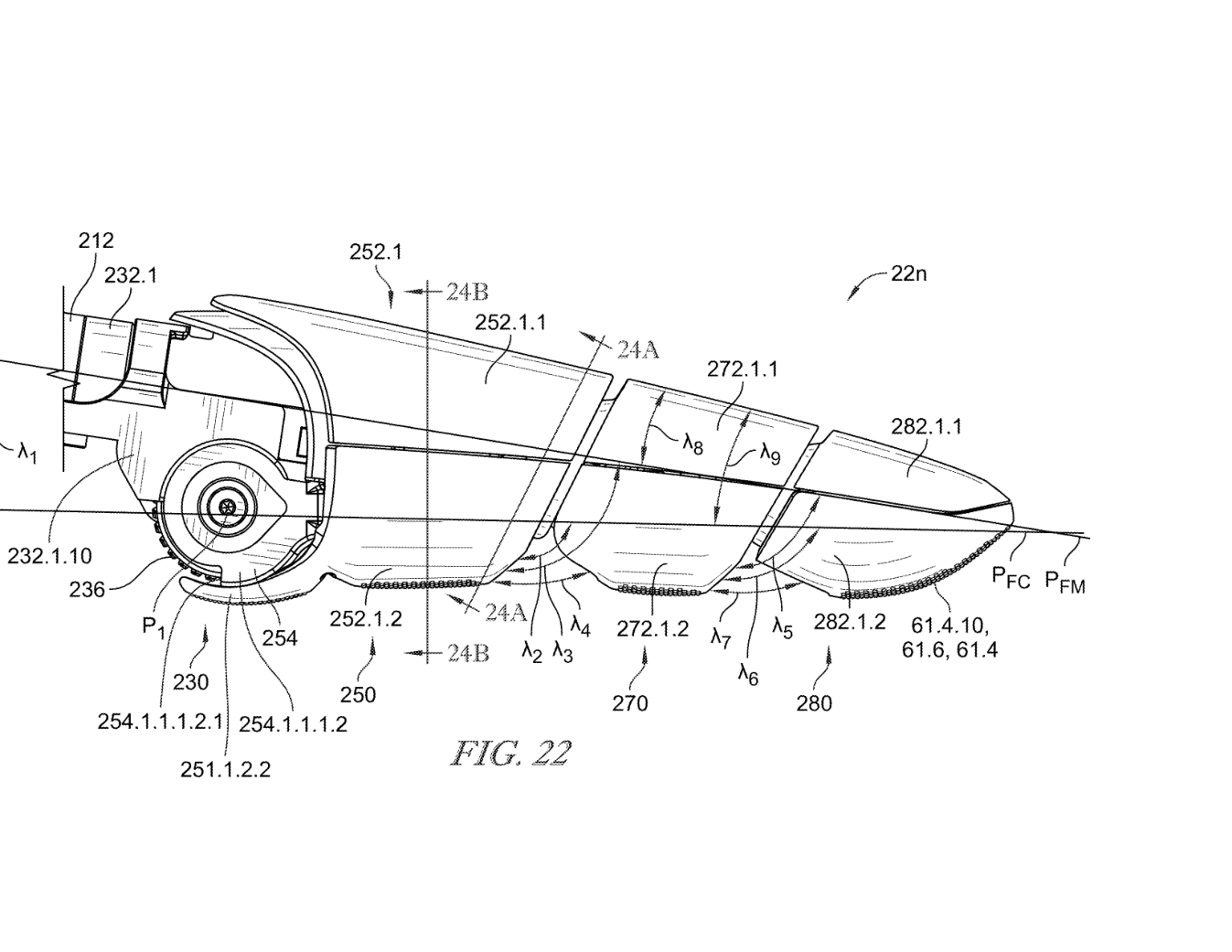
The material has two jobs: bend readily and resist unwanted stretching. Dependent claims describe flexible outer layers around a stretch-resistant fabric or metal layer; other claims place a flexible electrical harness between layers. The joint can therefore make room for both movement and communication.44
Figure’s motorized finger takes a different route. In US12420434B1, a worm wheel and the main proximal link share an axis while remaining able to rotate independently. One approach puts a reinforced flexible connection across rolling surfaces; the other organizes a motor, gears and independently moving links inside a digit. They raise different questions about wear, stiffness and repair.544
The pinky helps shape the grasp
Curling all the fingers is only one way to close a hand. Tesla’s WO2026080701A1 separates the tendon paths that curl the outer finger joints from paired paths at the finger base. Unequal tension in that pair spreads the finger sideways; pulling both can flex its base.45
The thumb and pinky also have opposition joints. The pinky’s extra motion brings it inward toward the palm, helping the edge of the hand wrap around an object. The mechanism gives a concrete reason to care about that fifth digit.45
Figure’s cited forearm embodiment includes a coupling between ring- and little-finger motion. Its modular branch pursues four substantially identical removable fingers. Tesla’s specialized pinky and Figure’s coupling or repeated modules expose different priorities: shaping motion, sharing a drive path and standardizing a replaceable part. Their practical value depends on the grasp being attempted.3645
Both hands need to know what they touched
Closing around an object is only part of a useful grasp. Figure’s US12722306B2 makes the material around a strain-gauge assembly part of the sensing process: it receives force and transfers some of it to the sensor.9
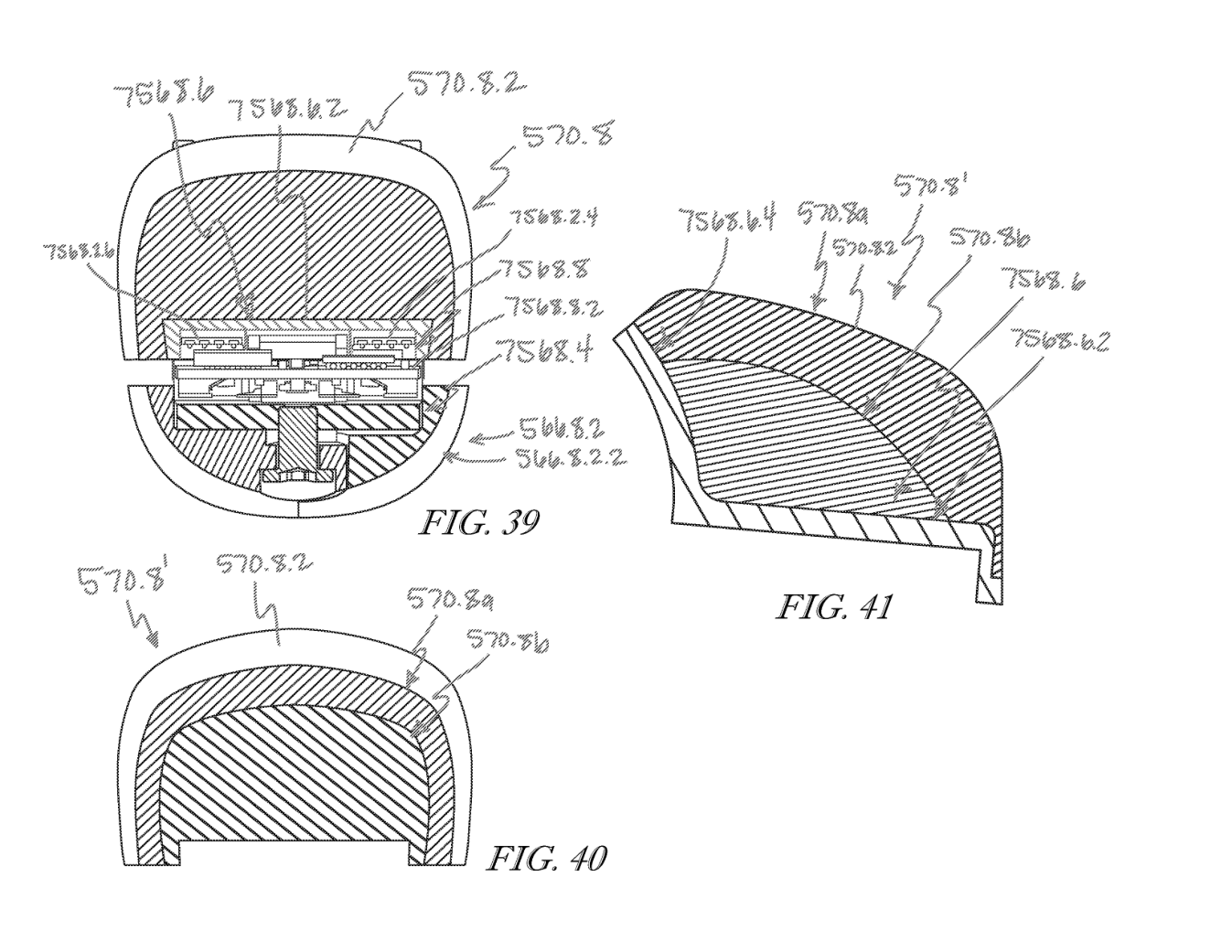
Its issued independent claim combines a humanoid robot, the sensor and electronics with interior and exterior regions having different compression/deflection ratios. The material changes how contact reaches the sensing structure.9
Tesla’s newer appendage filing also describes sensing: sensors on the finger segments, thumb and pinky opposition members, and palm, with wiring through the joints. That provides a distribution of sensing locations to compare with Figure’s detailed treatment of force transfer through the covering material.459
These documents illuminate different parts of the sensing problem. A useful hardware test would ask how accurately each hand detects contact and slip across its working surfaces, then repeat the test after wear. Neither the number of sensor locations nor a material stack settles that result.
A useful hand has to do it again
Picture a hand lifting one cup. Then picture it doing that job all day, at changing wrist angles and with worn contact surfaces. The comparison becomes a set of demanding tests.
For the tendon-driven hands, measure whether wrist motion disturbs finger force. For Tesla’s rolling joints, measure stiffness, hysteresis and fatigue in the flexible connections. For Figure’s motorized digits, measure heat, connection reliability and the time needed to replace and recalibrate a module. Then test how both hands maintain contact information as their surfaces wear. These are questions suggested by the disclosed mechanisms, not results reported here.4244369
The file histories add a different kind of evidence: how specific claim language fares against earlier work. Figure’s changing tendon-route examination and Tesla’s older cable-end argument are preserved below. They help explain what the applicants sought to protect; the newer mechanisms deserve the center of this engineering comparison.131819
The future has to fit inside the hand
The arm in the glass case arrived as a finished mystery. The newer Tesla filings let us work inward: from a crowded forearm, through a wrist that reorganizes its cables, to rolling finger joints. Figure’s portfolio puts different drive layouts and removable motorized digits beside that picture.2424435
The interesting contest is how those choices support useful work. Can the hand maintain its grasp as the wrist turns? Can it adapt contact around an awkward object? Can a worn part be replaced without rebuilding the whole mechanism?
More capable AI would make those questions more consequential. A system that can devise a better experiment still needs dependable machinery to carry it out. These patents establish no timetable for that future and no performance winner. They reveal enough of the machinery to make the questions specific.
A useful robot hand has to grasp, feel and keep working. That ambition is becoming a set of parts we can inspect.
Evidence notes, claim details and open questions
Figure’s promising route meets an older hand
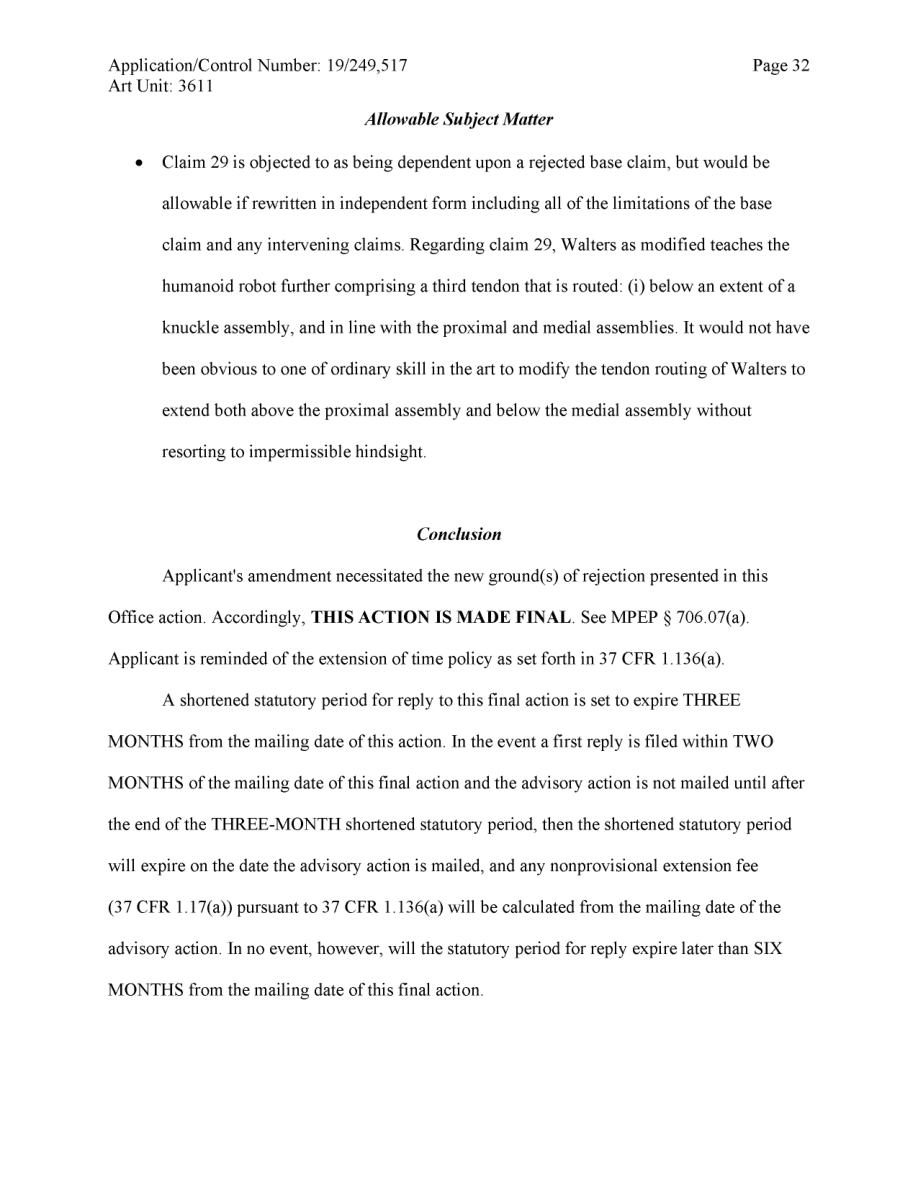
For a moment, Figure appeared to have found a way forward. In December 2025, the examiner identified a dependent tendon-routing claim as allowable if rewritten with all its inherited limitations. Figure later brought the route into its independent claims: below the knuckle, above the proximal phalanx, below the medial phalanx.1112
Then the search found another hand. The July 2026 action introduced Wang CN115070744A, indexed to Zhejiang University of Technology, against the routing limitation. All 28 pending claims were rejected. A geometry that had looked promising now had to be distinguished from a newly cited reference.131415
That turn earns its place in the engineering story. The route is both a way of moving a finger and a proposed distinction from earlier designs. The examination asks whether the claimed combination actually supplies that distinction. Figure’s granted motorized-finger and tactile claims remain separate outcomes; this forearm contest is still open.1359
Earlier Tesla hand: the floating cable end and its examination
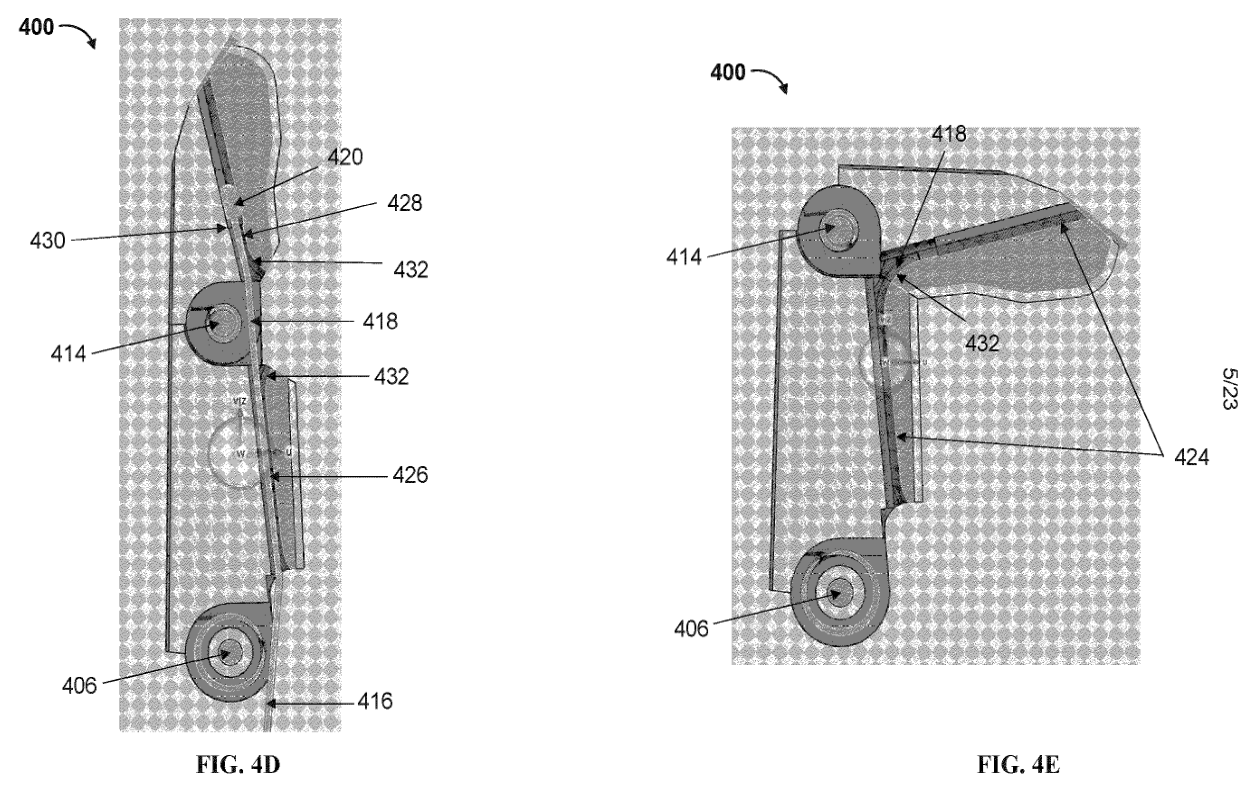
The older WO2024073138A1 gives an enlarged cable end room to move inside a region of the distal finger member, with the stated aim of accommodating movement and limiting cable damage. This is background to the newer hand comparison, not evidence of the newer rolling joint’s construction.4
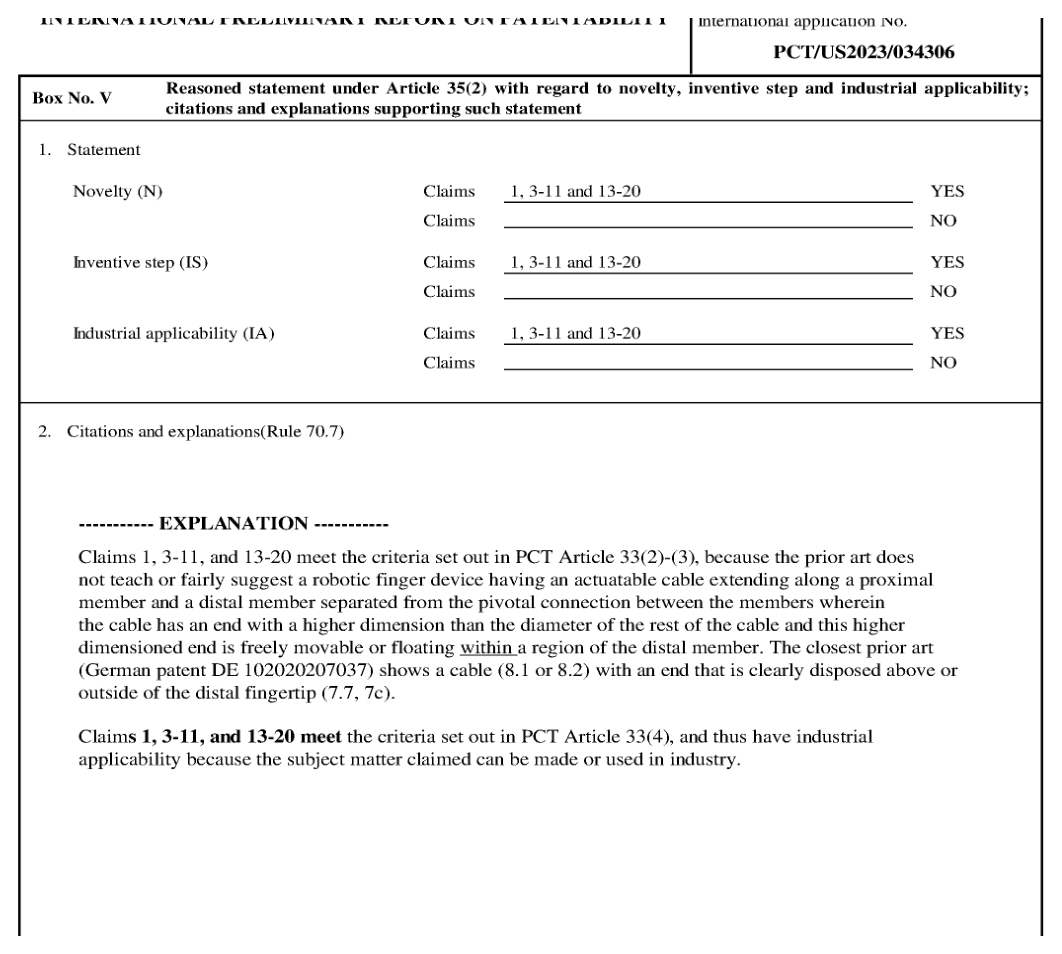
Tesla’s older hand history also turns on a small piece of geometry. The first international opinion challenged its claims using DE102020207037B4, whose publication names KUKA Deutschland GmbH as owner, alone or with another reference. The opinion had already considered dependent claims containing the floating-end feature.1617
Tesla’s response asked the authority to look again at where the cable terminated. It amended the independent claims and argued that KUKA’s cable end sat outside the fingertip, while Tesla’s claimed end could move inside a region of the distal member. The later international report accepted the distinction and gave favorable findings for the amended claims.1819
The location mattered. A phrase such as “floating cable end” was not enough to explain the difference; the argument depended on the physical relationship between the cable and the fingertip. The favorable report is an international examination result, not a US grant. The unresolved US claim-record question is preserved in the evidence notes.2010
Why the actuator counts cannot settle the comparison
The numbers look easy to compare until their definitions come into view. Tesla’s first forearm embodiment has 25 linear actuators—23 for the hand and two for the wrist—with a separate rotary actuator for roll. Figure’s cited forearm embodiment has twelve actuators including twist. Those are counts in particular embodiments, with different drive arrangements and allocations.23
Tesla’s separate whole-appendage embodiment specifies seventeen finger actuators for twenty-two finger degrees of freedom. That count belongs to that embodiment; it must not be merged with the forearm publication’s twenty-five linear actuators.45
A degree of freedom is a movement coordinate; an actuator is a drive. The relationship depends on the transmission and on whether joints move independently or are coupled. Figure, for example, describes coupling between ring- and little-finger motion. Tesla’s forearm claims also use different minimum actuator thresholds from its first illustrated example.32
A useful engineering comparison would follow each drive to the joints it controls, then measure force, speed and independence under the same task. Dividing one published actuator count by the other would skip that work. These records support an architecture comparison; they do not supply a dexterity ranking.
The earlier hands behind both examinations
The two records repeatedly lead back to earlier institutional robotics work. Figure’s July action uses Ihrke US20110071671A1 on wrist structure and US20110071673A1 on actuator packaging. The retrieved US assignment chains record interests in GM Global Technology Operations LLC and the United States represented by NASA. This attribution comes from assignment records, not from an inventor’s name.1321222324
Tesla’s newer forearm search cites Reiland US20120194120A1, whose retrieved assignment data likewise records GM/NASA transfers. The GM/NASA publication used against Tesla’s older hand is a different record, US20130193704A1: its front page names those assignees, but the retrieved child-application assignments show a security interest and release rather than a complete ownership chain.25262728
There are also two different Wangs. Figure’s cited CN115070744A is indexed to Zhejiang University of Technology. Tesla’s forearm report cites Wang Pengbo’s CN106737789A, whose publication names Jiangsu Jingang Culture & Technology Group as applicant. These are distinct references and attributions. The foreign records here have not received a complete assignment-chain audit or full technical translation; their role in the rejections is reported from the examiners’ mappings.1415292513
Shared prior art helps locate the engineering lineage. It does not show that one company copied the other, or that a citation defeats every claim in a family. Tesla’s forearm search, for example, covered claims 1–15 only after additional search fees were not timely paid. It supplies no merits result for the other two invention groups, claims 16–19 and claim 20.25
Read the family trees as relationships, not a race
The native patent-platform trees include the PCT applications that make Tesla’s dates intelligible. The five newer Tesla chains show October 10, 2024 provisional filings, October 9, 2025 PCT filings and November 25, 2025 US national-stage entries. Looking only at the last date would skip the intervening international filings.30
Figure’s broader exported family contains 114 nodes, including four PCT applications, with the forearm, finger and tactile reading points highlighted. Its size does not measure hand-patent strength, and continuity lines alone do not establish that every claim is supported by the earliest provisional. The trees are navigation aids for inspecting each branch’s documents and relationships.31
Both original investigations remain linked above, and both companies’ original SVG exports are available here. Keeping the documents attached to their own branch avoids turning multiple embodiments and procedural histories into a fictional single hand.
Claim wording and the unresolved US record
Figure’s modular branch changes the location of the drive. US20250205908A1 describes four substantially identical, removable fingers. Published claim 10 combines their arrangement on a frame with the absence, in each finger, of a mechanical cable for actuating its components. A June 26, 2025 amendment preserves a modular, cable-free configuration while revising the claim wording. The application remains pending in the platform’s current record.63233
The claim structure matters. A third, intermediate region appears in dependent claim 2. The three-flexure-arm sensing bridge appears in dependent claim 8. Neither is a universal requirement of independent claim 1. The original prosecution numbering has been reconciled with the issued claims: former claim 16 became claim 1, and former claim 17 became claim 2.93435
Figure’s finger allowance specifically identifies the independently rotating proximal link within the claimed combination.36
Figure’s forearm history shows why the drawing alone is only half the story. In December 2025, the examiner identified then-dependent claim 29 as allowable if rewritten with its inherited limitations. Figure’s attempted amendment after final rejection was not entered; it then requested continued examination and filed amended claims on March 4, 2026.113712
Tesla’s older hand took another path. Its February 2024 international written opinion challenged the published claims using DE102020207037B4, which names KUKA Deutschland GmbH as owner, alone or with the GM/NASA publication US20130193704A1. The challenged claims already included dependent floating-end limitations. The later favorable result cannot be explained simply as adding a feature the search had never considered.1641728
That is a documented change in the international examination, tied to an amended claim set and a specific argument. It is not a US allowance: international preliminary examination does not bind national offices. The older US file also contains a twenty-claim submission and later worksheet that have not yet been fully reconciled with the eighteen-claim international annex. The operative US claim set remains an open check.2038394010
Research scope and open questions
This comparison now centers Tesla’s five newer publications: WO2026080687A1 (hand and cable routing), WO2026080690A1 (wrist), WO2026080691A1 (forearm), WO2026080693A1 (flexible joint) and WO2026080701A1 (appendage and grasp). Their 2025 PCT filing dates and April 2026 publication dates distinguish them from the older hand history kept in these notes.42432444530
Four original newer publication PDFs remain missing from our archive. Their available description and claim transcriptions have been reviewed and are linked as publication text; they are not labeled as self-hosted originals. WIPO lists the documents, but direct and browser download attempts did not yield usable local files on September 13. The new overview image comes from the original forearm publication that is archived. Original drawings and wording in the other four publications still require visual cross-checking.424344452
A fresh patent-platform check covers the five newer US national-stage records and their IFW indexes. All five show pre-examination processing in the returned data. The available one-page SPEC placeholders do not constitute complete specifications. Separately, the earlier eleven-application check supports the Figure and older Tesla records. Neither check guarantees current upstream synchronization.4633
Tesla’s appendage description supplies a sensing layout. We have not completed an equivalent Tesla tactile claim-history review against Figure’s issued material-and-sensor combination. Published architecture, claim wording, prosecution results and demonstrated products remain separate evidence categories.109
Outstanding checks include the four newer publication PDFs and separate written opinions, the older Tesla US claim-set discrepancy, Figure’s next forearm response, fuller foreign-prior-art review and the Figure distance-ratio discrepancy. Downloaded documents and available OCR extend beyond the records substantively reviewed.1041
Sakana’s software experiment and Figure’s Helix announcement provide context for why capable physical systems matter. They do not establish imminent RSI, self-manufacturing robots or a mapping from a demonstration to these particular patent embodiments.78