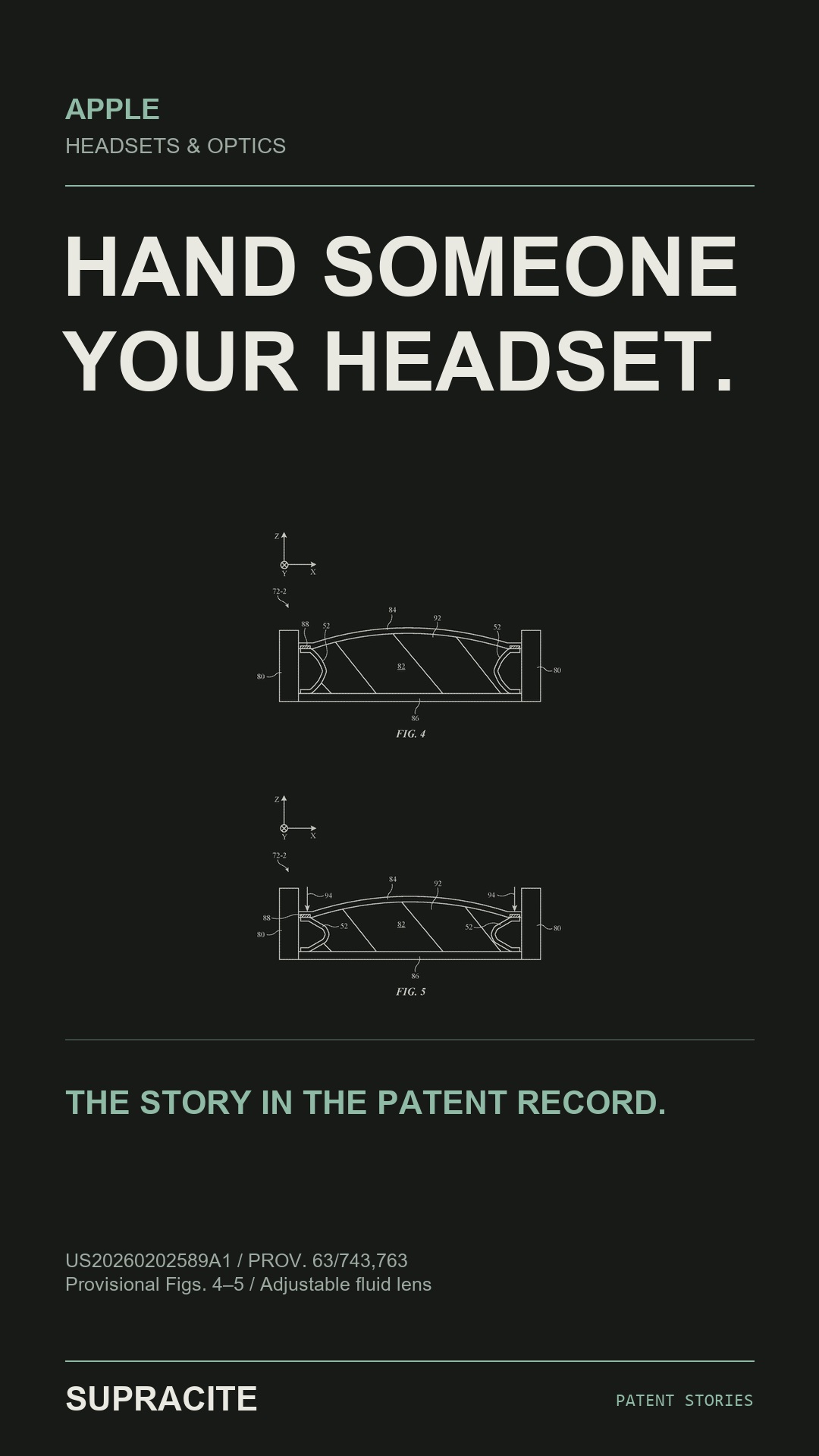
A headset you can hand to someone else
Imagine handing a headset to someone whose eyes need a different prescription. Instead of changing an optical insert, the headset reshapes a lens. Apple describes exactly that use case in a January 2025 provisional, including correction for astigmatism. That is the most interesting starting point in this search: making the optics adapt to the person.7
The confirmed product baseline is the M5 Vision Pro update and its revised headband. The patent record reaches beyond that hardware, into adjustable optics, compact mechanical fit and low-power capture. These are engineering directions to investigate, not specifications for an announced successor. Some of the documents expressly encompass glasses or devices without a display.1813
The lens moves. The actuator should not fight it.
US20260202589A1 describes a chamber of fluid between optical elements, with an adjustable element coupled to a shaping ring. Actuators around the ring change its shape and therefore the lens curvature. The useful detail is what resists that movement: deforming the lens and its surrounding structure takes force, which the actuator must supply.1714
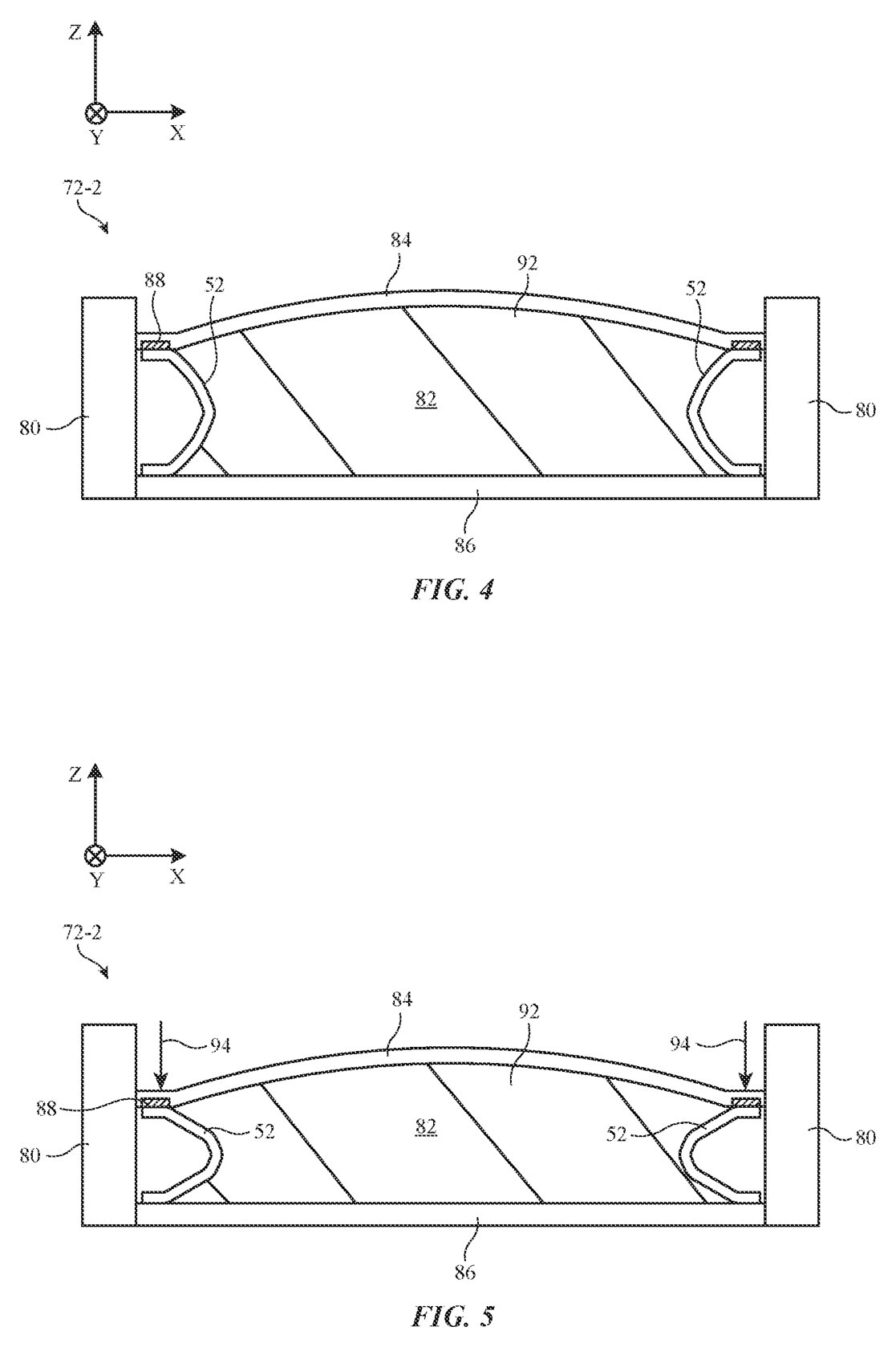
Apple proposes ways to bias that mechanical load, including tensioned bellows, magnetic attraction and spring arrangements. These are disclosed alternatives and possible combinations, rather than a single required assembly. Published claim 1 selects a particular combination: peripheral actuators, a shaping element, and an attached structure that remains in tension over at least part of the movement range. That combination also appears in the provisional’s claim text.18
The dates make this a recent research lead: provisional 63/743,763 was filed January 10, 2025; nonprovisional 19/413,938 followed December 9, 2025; publication was July 16, 2026. The original provisional gives us a way to inspect what was already described before the publication appeared.17
Then put a brake on it
A lens that can change shape also needs to keep the selected shape. US20260259401A1 tackles that separate mechanical problem. Its actuator rotates a main structure about a pivot; a brake fixes that structure by applying force parallel to the pivot axis. One embodiment uses opposing calipers, wedges and a spring mechanism, with release allowing the actuator to move again.2915
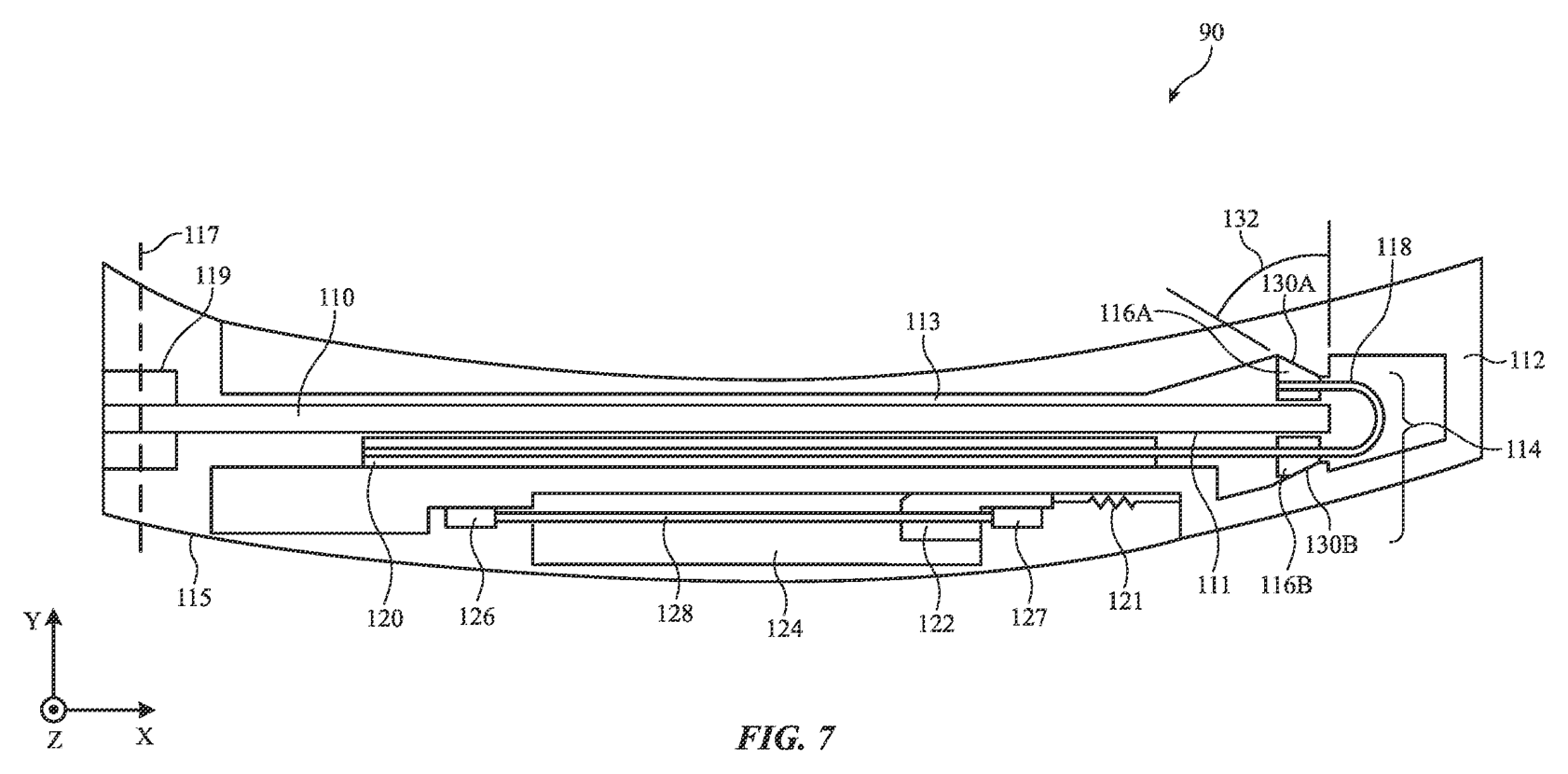
This is a useful companion to the force-reduction story: one mechanism helps make an adjustment, the other holds the result. The February 28, 2025 provisional, 63/764,822, already describes the caliper arrangement. Nonprovisional 19/444,631 was filed January 9, 2026 and published September 3. The drawings are evidence of the mechanism, not evidence that a particular Vision model contains it.29
Prescription adjustment is not the same as focusing a virtual world
Changing correction for a user’s eyes and changing the apparent focal distance of virtual content are different uses of adjustable optics. The original fluid-lens provisional explicitly describes changing users, changes in prescription, and astigmatism correction. It therefore supports a strong personalization story without requiring us to infer continuous gaze-driven varifocal operation.79
My reading is that the fresh pair makes the mechanics of adjustable correction the strongest Apple optics angle in this set. To claim a successor continuously refocuses virtual objects, we would need a specific control loop, optical architecture and product evidence. A tunable-lens title alone cannot supply those missing links.12
Move both eyepieces without filling the space between them
The other mechanical lead is US20260235874A1. It adjusts the spacing of the optical modules to fit the user’s eyes. A mechanism near one module transfers movement to the other through an intervening member; disclosed implementations include a cable with rack-and-pinion parts and a flexible shaft with lead screws. Routing the connection creates room to arrange other headset components.51217
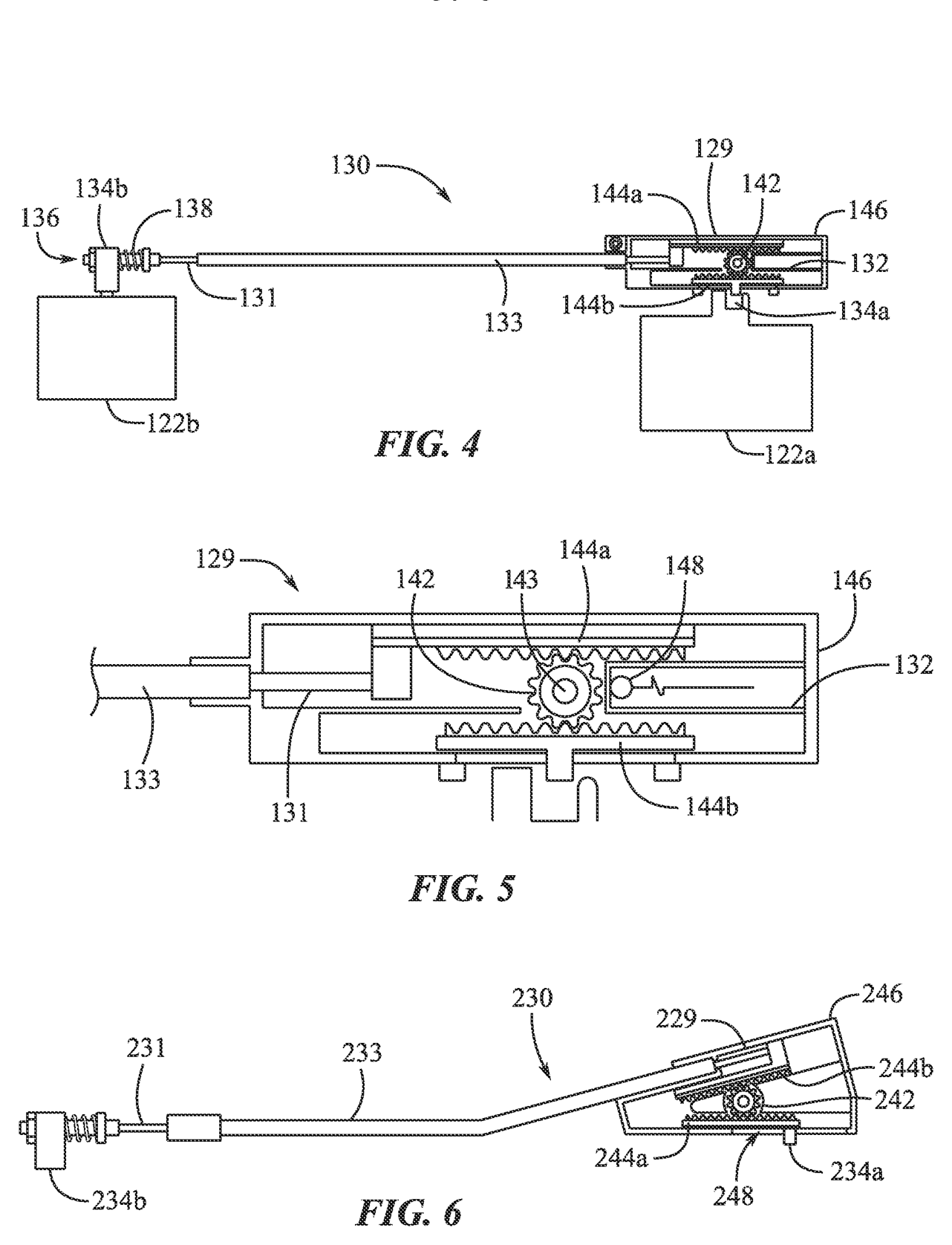
This adjusts interpupillary distance, or IPD: where the two optical modules sit relative to one another. It does not itself change lens power. The February 13, 2025 provisional, 63/758,214, precedes the August 15, 2025 nonprovisional and August 13, 2026 publication. As an article lead, it is about fit and packaging, without a supported numerical claim about weight saved.512
The camera starts before you finish asking
Apple’s September 10 camera publication makes a different kind of prediction. US20260270568A1 describes an always-on processor anticipating that the wearer is about to request a picture. Possible clues include motion associated with reaching for a button, a spoken phrase, or gaze moving toward a capture control. Camera processing can wake and begin buffering images while the main application processor remains asleep.31016
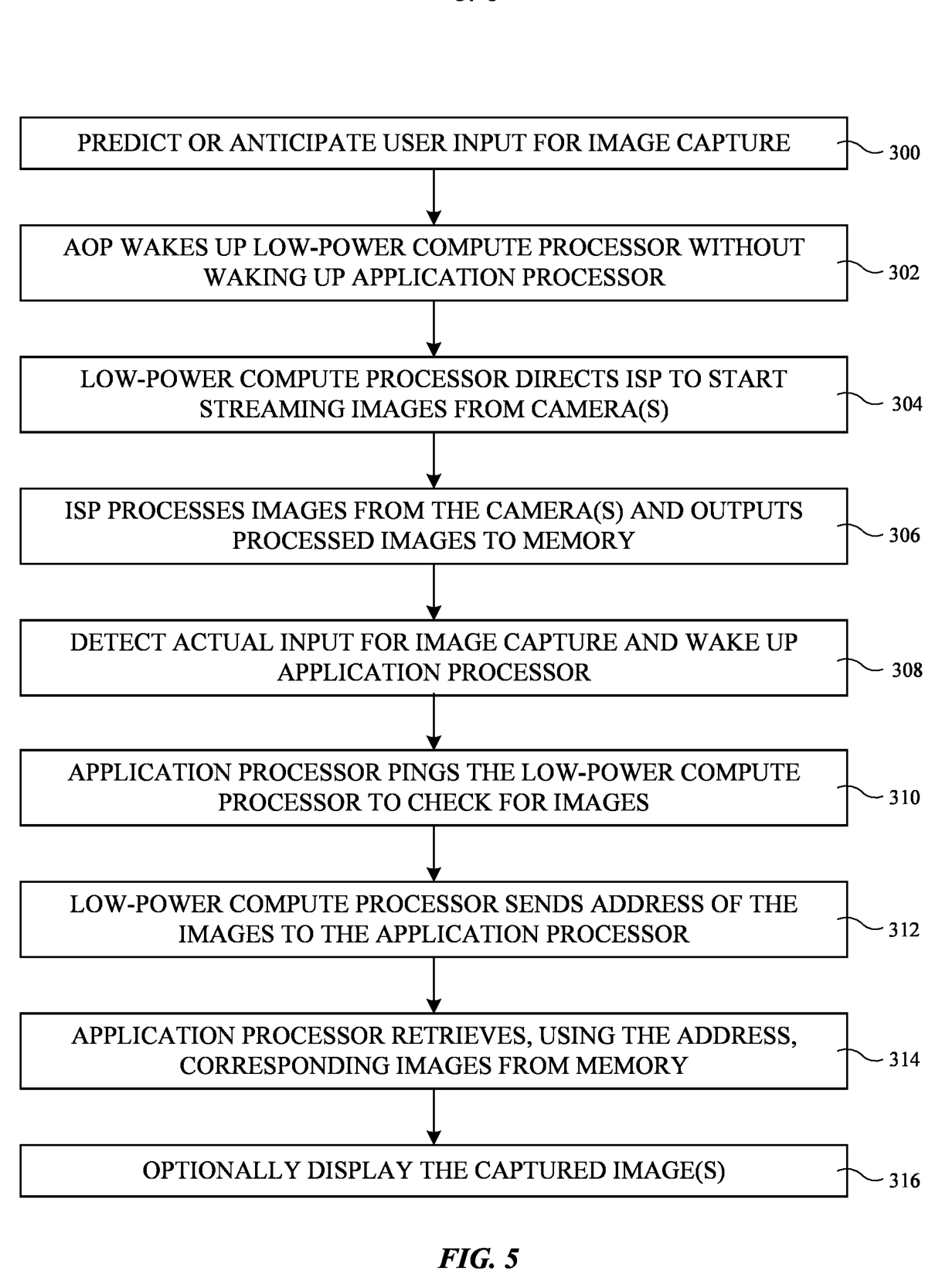
When the actual request arrives, the application processor wakes and receives the prepared images. This could help capture the moment just before the request as well as the moment afterward, without running the entire system continuously. That is the disclosed purpose; false triggers, energy costs and real-world reliability remain product questions.310
The record is particularly fresh: provisional 63/767,434 was filed March 5, 2025, the nonprovisional on December 4, 2025, and publication followed September 10, 2026. It sits beside US20260255054A1, whose February 26, 2025 provisional describes waking the camera path and application processor in parallel after an input. The distinction is practical: overlap the waiting, or start before the request.310411
The new gaze-tracking publication has a 2020 beginning
US20260194749A1 is a useful check on the word “new.” It pairs two ways of tracking the eyes: non-glint light measurements from photodetectors and image-based tracking of reflections. Its claimed arrangement includes see-through lenses. That matters because optical see-through glasses are a different architecture from a headset presenting camera passthrough on opaque displays.6
Although this application was filed March 4, 2026 and published July 9, its family reaches provisional 63/050,040, filed July 9, 2020, through two intervening U.S. applications. It is a recent publication of an older research direction. It should not be counted alongside the five early-2025 provisionals as six equally fresh inventions.613
The parent’s examination makes a sharper distinction than simply putting two trackers in one frame. In the December 2025 allowance for 18/603,462, the examiner singles out an operating-mode combination: the non-glint tracker is on and the glint tracker is off in the first mode; the glint tracker is on in a second mode. That distinction belongs to the allowed combination in the parent, alongside its other limitations. It should not be silently substituted for the newer continuation’s published claims. For the engineering story, it adds a useful question: when does the device need each way of watching the eye?19
What I would watch next
For Vision-style headsets, the strongest story here is optical personalization plus more compact fit mechanisms. For lighter glasses or camera wearables, the capture-wake work is especially relevant because its disclosure permits a device without a display. Those are different possible product paths, and the patents do not require Apple to put them into one machine.1253
The next useful evidence would be examination of the new applications, further related filings, and product-specific confirmation of the mechanisms. These records establish that Apple sought protection for concrete designs. They do not establish a launch date, a product name, manufacturing readiness or which design Apple selected.123456
Evidence notes, claim details and open questions
Research coverage and the provisional question
This research selection contains six focus publications and 14 connected U.S. application records, including six provisionals. All six focus publication PDFs and the accessible provisional specifications, claim sheets and drawings have been archived locally. Native family trees come from patent-platform’s refreshed renderer. This is a targeted selection, not a complete Apple portfolio census.
The original provisional PDFs are available through their associated public records; this research has not discovered private, unpublished applications. Five provisionals date from January–March 2025, while the dual-gaze family dates to 2020. Comparing their text supports the specific observations above, not a blanket conclusion that every later claim is entitled to every earlier date.
All indexed document codes were requested for every member. File acquisition, platform OCR and substantive reading are separate stages. Local OCR supplied a reading aid for selected original provisional documents while platform OCR continued. Some structured publication claims were truncated or absent, so the cited original pages were used. The refreshed indexes contain no merits rejection or allowance for the five applications based on early-2025 provisionals. This pass also checks the older gaze family’s December 2025 allowance against the original reasons pages. A complete amendment-by-amendment review remains follow-up work; this is why the article is a research draft.
Acquisition checkpoint, September 14, 2026 at 9:57 PM Arizona time: 364 of 364 indexed documents downloaded across 14 applications; 336 OCR-complete and 28 skipped, with none pending, processing or failed. The skips comprise 17 specification/abstract records routed to publication text, five actions routed to another text archive, and six records without a stated skip reason. The alternate-archive labels do not guarantee that the MCP text endpoint can return those actions. This is an acquisition checkpoint, not a full-corpus reading claim.
International coverage gap: the refreshed platform records identify PCT/US2026/010344 and PCT/US2026/012823, but their filing dates are missing upstream, so the native SVG omits those nodes. The manifests flag this limitation. Those PCT histories are not included in the U.S. download totals and remain to be acquired and reviewed.