The wrist is where the problems meet
Put the motors in the forearm and the fingers gain space. The work then has to reach them through a wrist that bends and turns. Tesla’s newer hand filings address that linked problem: pack the actuators, route their cables, and let compact finger joints move without losing alignment or damaging the connections inside them.6457
Five international applications divide the architecture among the forearm, wrist, cable routing, flexible joints, and whole-hand movement. A separate, older cable-finger application supplies the clearest examination result: Tesla narrowed its independent claims around a floating cable end, disputed the examiner’s reading of the earlier gripper, and received a favorable international preliminary report. The newer US applications remain in preexamination processing in the retrieved records.110113231
The documents support an architectural reading of Tesla’s hand work. They do not establish that every illustrated mechanism appears together in a production Optimus hand. The useful path through them is to follow the force first, then examine which details the patent record treats as consequential.64578
Packing the drives into the forearm
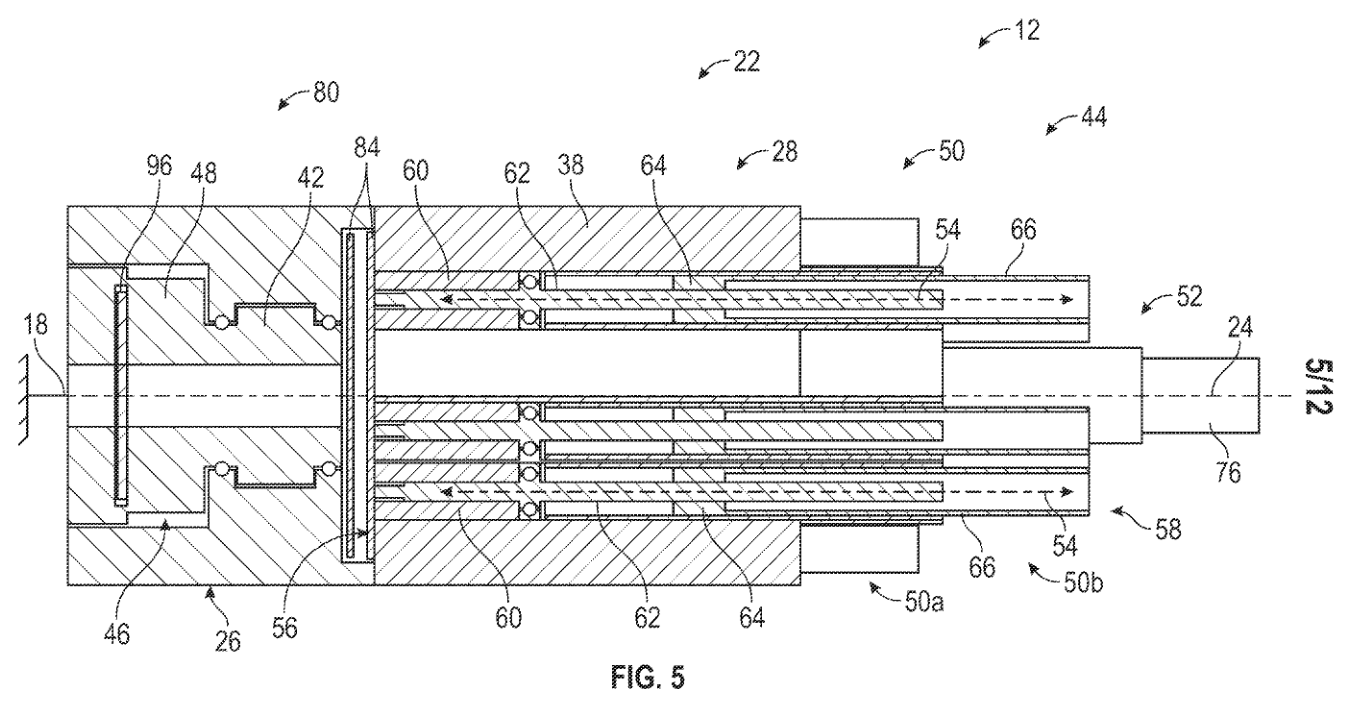
The first forearm embodiment places a rotary drive behind a bank of linear actuators. The rotary stage turns the connected housing sections relative to the arm base; the linear outputs extend toward the wrist and hand. Figure 5, above, shows these stages arranged back-to-back without axial overlap. The specification attributes assembly and manufacturing benefits to that separation.6
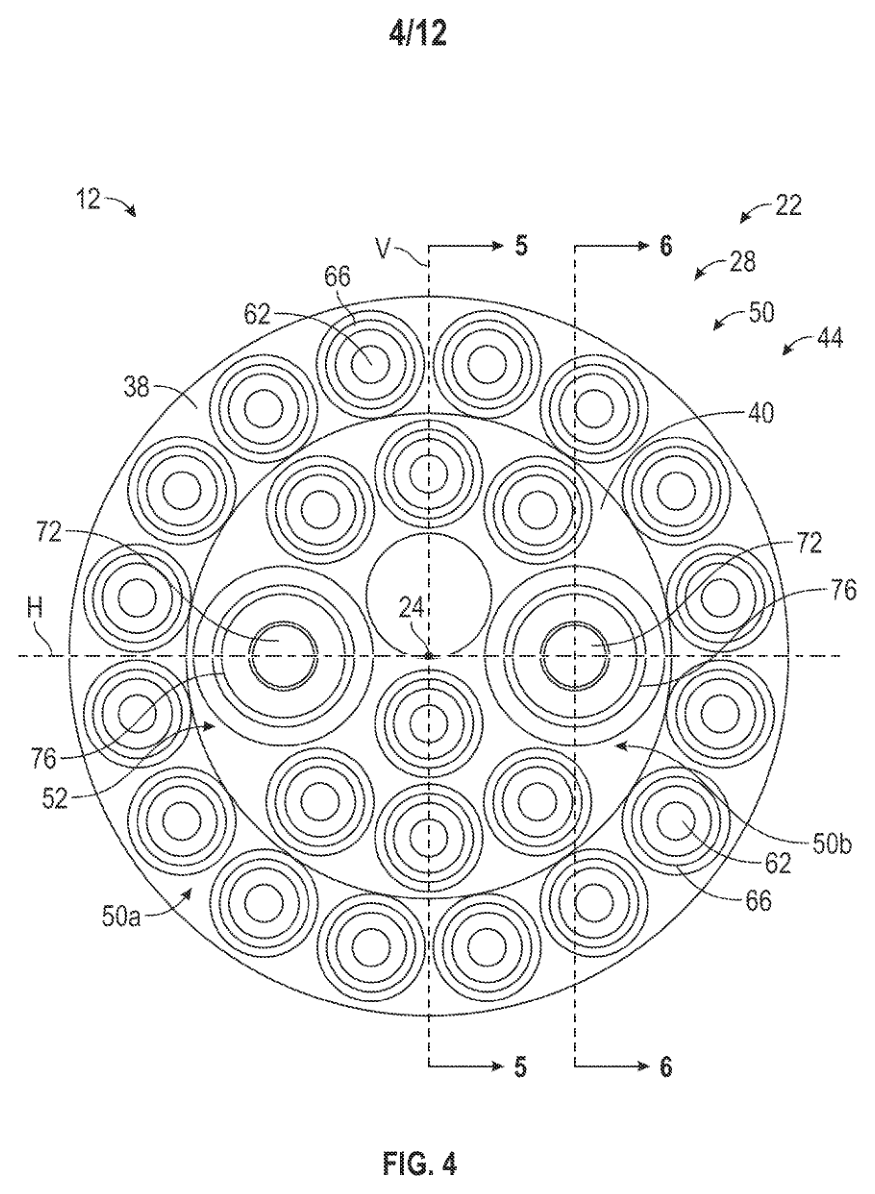
Figure 4 shows the other packing problem: filling the cross-section. An outer group of hand actuators surrounds an inner group and larger wrist actuators. The example uses roughly 12 mm hand actuators and 20 mm wrist actuators; other passages describe alternative dimensions and housing arrangements.6
Published claim 1 ties together housing sections, the rotary actuator, hand linear actuators, and a wrist linear actuator with outputs extending generally along the housing axis. Dependent claims add arrangements such as inner and outer subsets, circumferential placement, another wrist actuator, and internal control boards. Those details are where the broad idea of forearm actuation becomes a particular assembly.6
Counting drives is not counting movements
The first illustrated forearm embodiment has 25 linear actuators: 23 for the hand and two for the wrist. A separate rotary actuator supplies roll. The claims use different thresholds: dependent claims 10 and 11 require at least 17 and at least 23 linear actuators, while independent claim 16 starts at 17. The illustrated count is therefore neither a universal claim requirement nor the total number of all actuators.6
![Forearm Fig. 10: the second actuator-bank embodiment, read alongside the inconsistent count in paragraph [0066]. Original sheet 10/12, PDF page 39.](/research/tesla/forearm-alternative-array.png)
The separate whole-appendage disclosure describes 22 finger degrees of freedom, two at the wrist, and one at the elbow. A degree of freedom describes a movement coordinate; an actuator is a drive that produces motion. Counts from different embodiments and different documents cannot be substituted for each other.8
Even within the forearm document, one count needs care. Paragraph 0066 says nineteen linear actuators, then describes nineteen hand actuators plus two wrist actuators. Paragraphs 0067–0068 instead give 12 outer hand actuators, five inner hand actuators, and two wrist actuators: 19 total. Figure 10 accompanies this second embodiment. The surrounding text suggests a counting error in 0066, but the published inconsistency remains.6
Two actuators sharing two wrist motions
The wrist filing connects forearm and hand through a central universal joint, with an actuator and linkage on each side. In the described geometry, coordinated actuator motion produces pitch and differential motion produces yaw. Both actuators participate in both movements. Secondary universal joints and offset axes accommodate the linkage motion.5
The independent claims frame the arrangement differently. Claim 1 specifies the bracket, hand-side structure, joint, two actuators, and two links. Claim 10 describes a lower arm applying forces to opposite sides of the hand. Claim 16 expressly requires independent control about perpendicular yaw and pitch axes.5
Clearance matters alongside movement. A notch allows part of the forearm bracket to enter the hand-side structure at extension; a cantilevered joint arrangement can leave space underneath for control cables. These disclosed details help the wrist linkage share a crowded volume with the tendons.5
Getting cables through a moving wrist
Bending the wrist can change a tendon’s path length and disturb finger tension. Tesla’s mechanically actuated hand disclosure addresses that coupling by rearranging the cables between the forearm and hand sides of the wrist and routing them near the relevant rotational centers.4
Published claim 1 requires different cable configurations on the two sides. Claim 2 adds a transition from a lateral stack to a vertical stack; claim 6 connects the arrangement to limiting cable moment arms across the pitch and yaw axes. The specification attributes reduced cable-length change and cross-coupling to that geometry, without independently validated performance measurements for a finished hand.4
The same filing also pursues finger-level arrangements. Independent claim 16 describes three cables routed on different sides of successive joints. Claim 18 addresses channels opening toward joints, and dependent claim 19 adds lateral alignment with a termination structure. The proposed protection reaches several interfaces along the force path.4
A rolling joint with a flexible restraint
In the joint filing, curved contact surfaces roll as the finger bends, moving the effective pivot axis along the surfaces. A flexible composite member keeps the parts together while restraining unwanted separation, translation, or twisting. In some embodiments, its elastic bias also helps return the finger toward extension when tendon tension is released.7
The composite can place flexible layers around a stretch-resistant intermediate layer, with fabric or metal alternatives. It can also carry an electrical harness near a neutral bending region to reduce strain on the wiring. The joint thus has two jobs: constrain mechanical movement and accommodate connections that must bend with it.7
Claim 1 focuses on the curved surfaces, composite member, and moving pivot axis. Claim 11 specifies the layered member and resistance to longitudinal stretching; claim 16 addresses successive flexible members of different thickness. Harness integration appears in dependent claims. The disclosed durability aims are not a measured service-life guarantee.7
Changing the shape of the grasp
Curling fingers is only part of a useful grasp. Tesla’s whole-appendage filing links a forearm actuator through the palm to a finger phalanx, then develops arrangements for flexion, splaying, and opposition. Claim 19 distinguishes flexion toward the palm, abduction away from another finger, and adduction toward it.8
Claim 20 describes four tendon-actuation paths associated with opposition, two directions of splaying, and finger flexion. In the described hand, a separate opposition member gives the pinky another movement, helping reshape the grasp. Other dependent claims add features including wrist actuation, tactile sensors, and a glove.8
This brings the architecture into view: the actuator bank, wrist linkage, cable routes, and finger geometry constrain one another. The five filings illuminate those interactions, while each independent claim still defines its own combination.64578
An earlier finger lets the cable end float
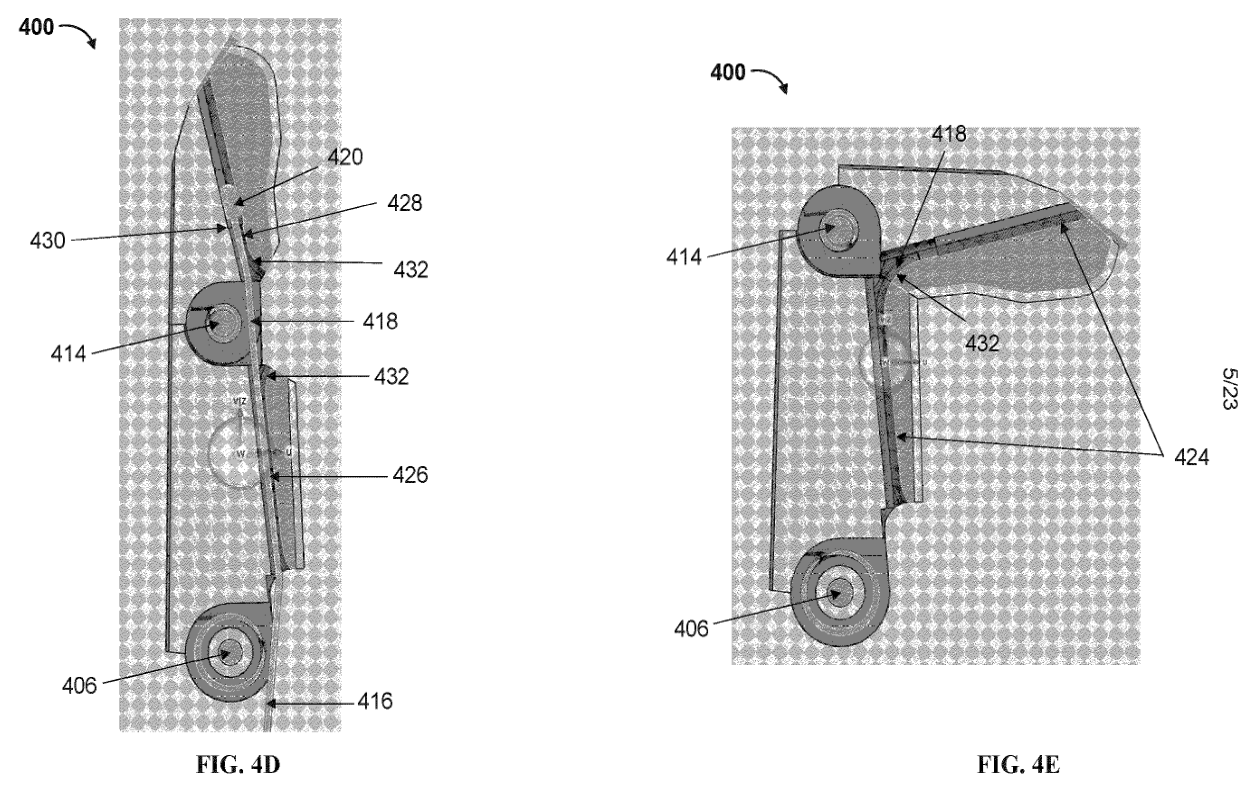
The older WO2024073138A1, associated with US application 19/113,898, starts closer to the fingertip. It claims priority to two September 30, 2022 provisionals through PCT/US2023/034306. Its finger has linked proximal and distal members and a cable routed away from their pivot axes. An enlarged termination engages the distal member when pulled, while the illustrated floating arrangement allows relative movement inside it.19
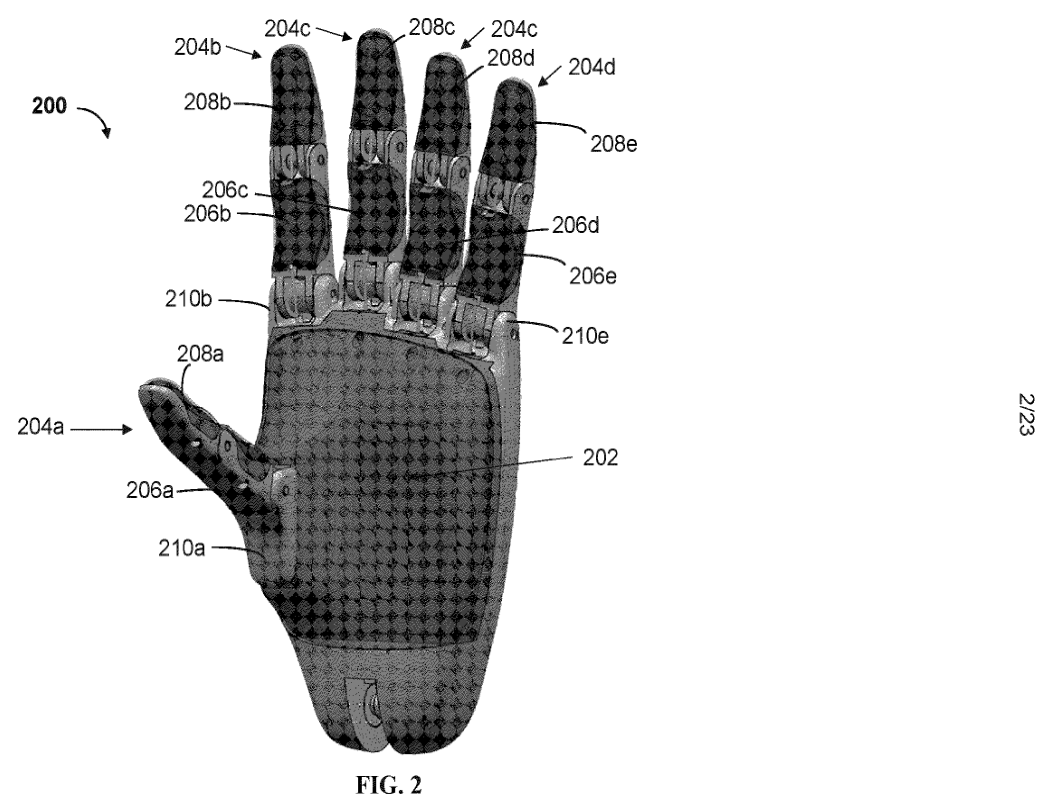
The specification says that freedom can accommodate contact forces and reduce cable damage; torsion springs bias and stabilize the finger. Those are the applicant’s stated benefits. The examination history supplies a separate reason to pay attention: the ability of that cable end to move became the distinction Tesla put into its independent claims.910
A floating end—and an argument about where it floats
The original publication put the floating-end feature in dependent claims 2 and 12. Independent claims 1 and 11 required an enlarged cable end that engages the distal member, without that additional limitation. The February 16, 2024 written opinion challenged both levels: claims 1–6, 10–16 and 20 lacked novelty over KUKA’s DE102020207037B4; claims 7–9 and 17–19 faced an inventive-step objection combining KUKA with US20130193704A1.9323324
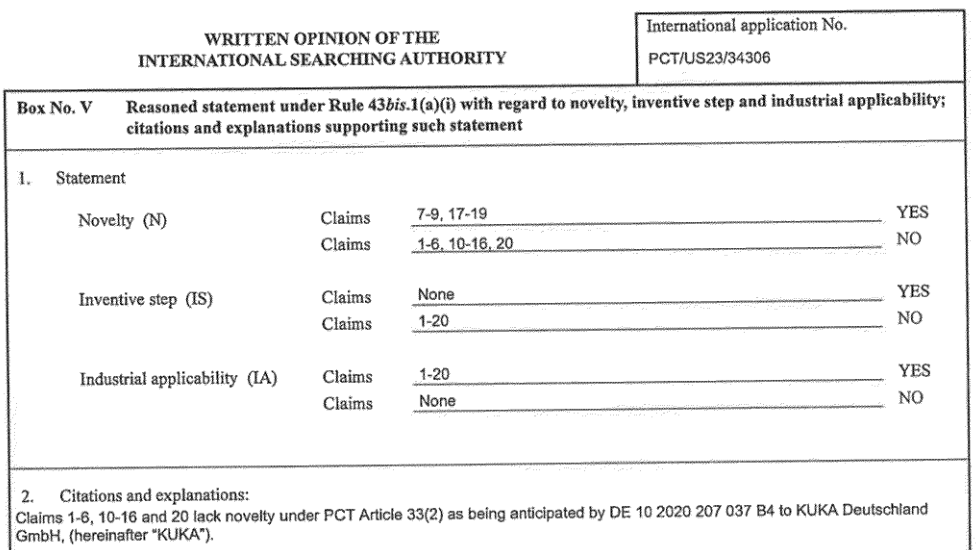
The earlier work has identifiable institutional origins. KUKA Deutschland GmbH is the named owner on the German publication. US20130193704A1 names GM Global Technology Operations, Inc. and the United States represented by NASA as assignees. The retrieved assignment records for its US application add a 2014 security interest involving GM Global Technology Operations LLC and a later release; they do not supply a complete ownership chain. The security holder should not be relabeled as the patent’s owner.33243
Tesla did more than move a dependent feature into an independent claim. Its July 30, 2024 Article 34 response amended independent claims 1 and 11 and canceled 2 and 12, but also contested how the searching authority read KUKA’s drawing. The initial opinion had treated KUKA’s cable tips as floating. Tesla argued that those ends were connected outside the fingertip, while its claimed end could move inside a region of the distal member.3210
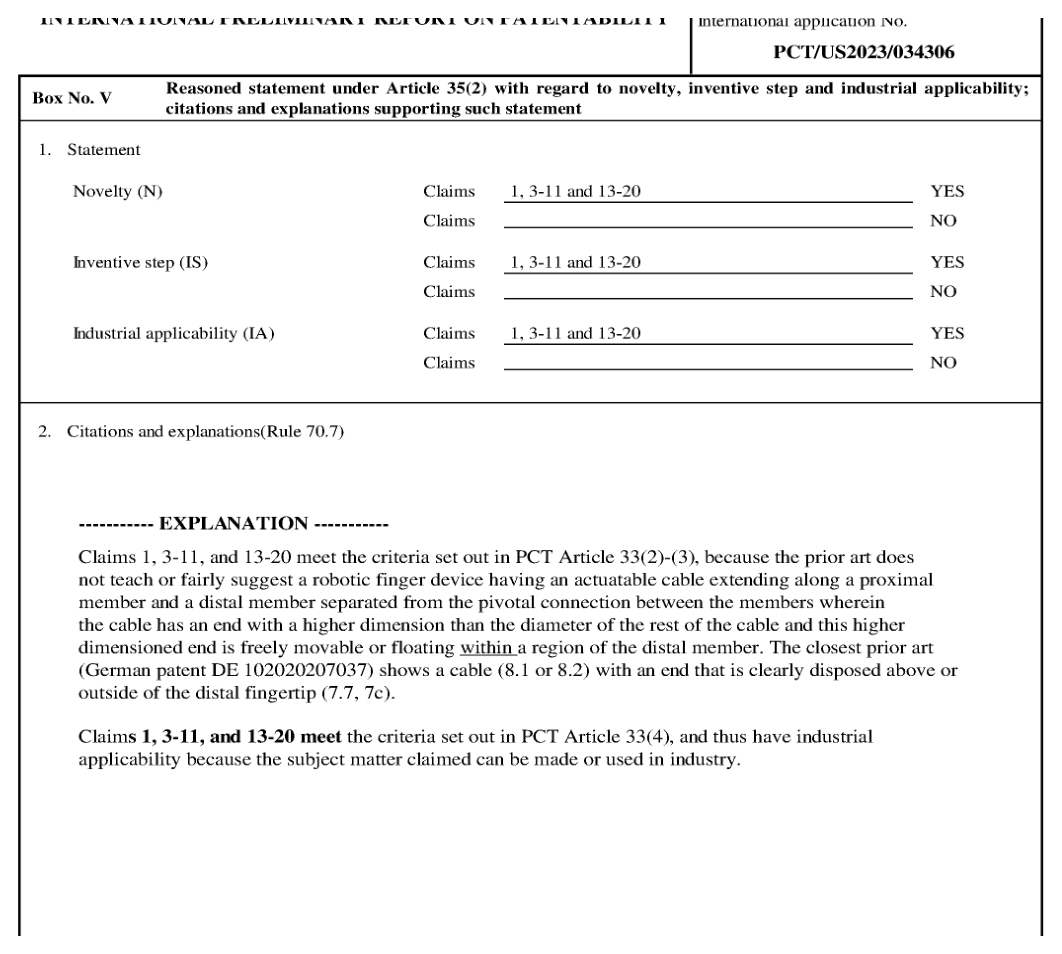
The October 3, 2024 Chapter II report accepted that distinction. It found amended claims 1, 3–11 and 13–20 positive for novelty, inventive step and industrial applicability, explaining that KUKA’s termination sits above or outside the distal fingertip. The documented change is an amended claim set together with a successful argument about the reference. The favorable result belongs to those international claims; it is not a US allowance.1110
The US entry papers do not yet tell one consistent story
The March 20, 2025 US claims copy still has twenty claims, with floating ends in dependent claims 2 and 12. Tesla’s accompanying remarks explicitly say no claims were amended or canceled and claims 1–20 remain pending. The July 14, 2026 worksheet also counts twenty total claims: two independent and eighteen dependent. Eighteen here is a dependent-claim count, not the total.273435
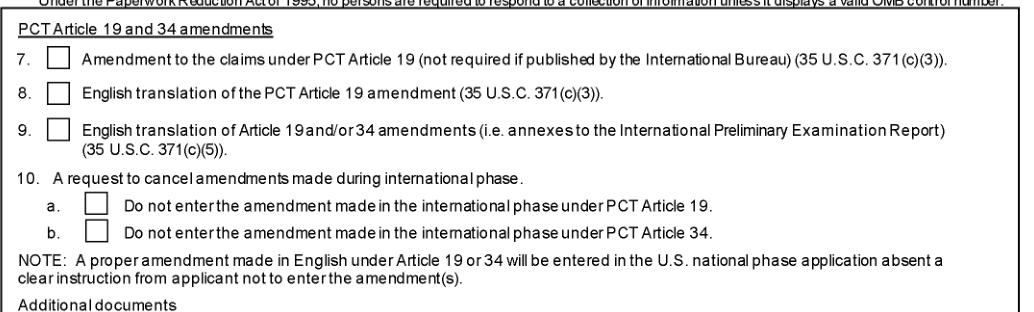
But the original transmittal leaves unchecked the box asking the Office not to enter Article 34 amendments. USPTO guidance normally calls for English Article 34 annexes to be entered absent a clear contrary instruction. The July 14 acceptance letter confirms national-stage entry and lists the preliminary amendment among received items; it does not expressly identify the operative claims or resolve the annex issue.372536
The broader US copy and twenty-claim paperwork therefore remain evidence of the filed US position, while the narrower eighteen-claim international set has the favorable report. An express entry record or substantive US examination addressing the claim set is still needed to settle the discrepancy. The platform’s selected claims copy alone cannot do that.343537361129
The newer forearm search covered only one branch
The forearm’s international search report divides its claims into three invention groups: 1–15, 16–19, and 20. The authority states that the additional search fees were not timely paid, so it searched only claims 1–15. The report was mailed February 12, 2026.12
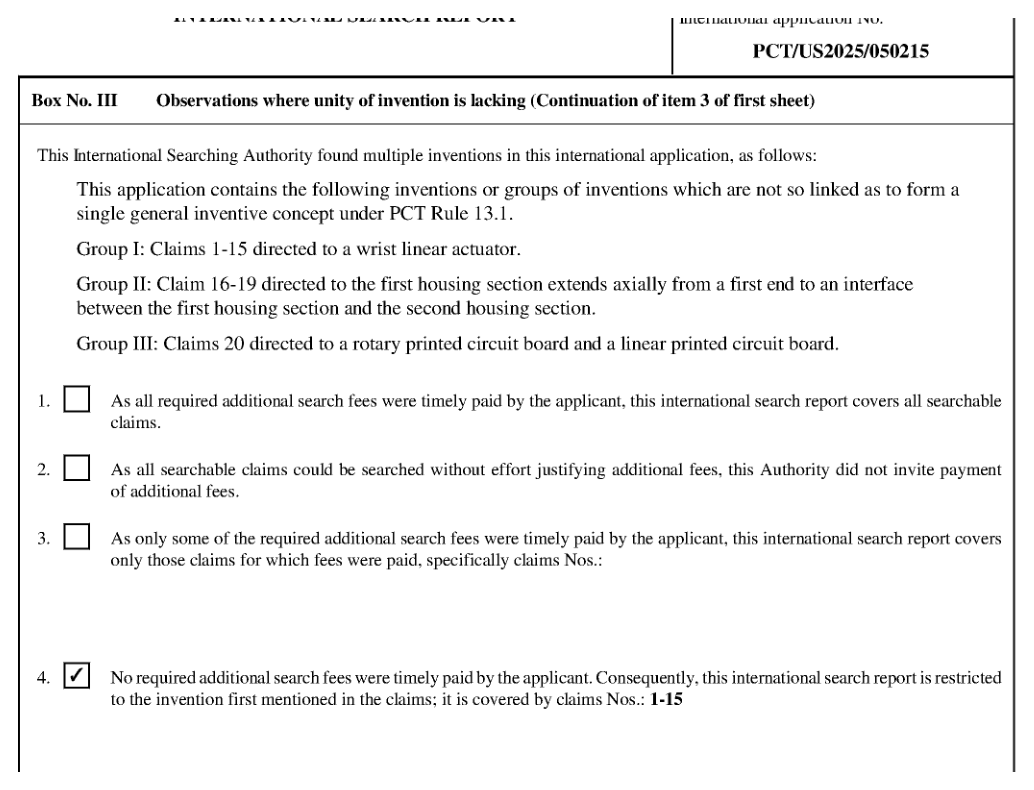
That leaves a precise boundary around the result. The published forearm document offers three independent starting points, but this report supplies no merits result for the claim 16 or claim 20 branches. The restriction establishes what was searched; it does not establish either allowance or lack of novelty for the unsearched groups.612
Which earlier work the search actually relied on
The most consequential forearm citation is Wang Pengbo’s CN106737789A, a bionic mechanical-arm publication naming Jiangsu Jingang Culture & Tech Group as applicant. The report marks it X against claims 1–2 and 9–12, indicating particular relevance considered alone, and Y against claims 14–15, where combination reasoning matters. That classification is stronger evidence of an examination obstacle than the document’s mere appearance in an applicant’s citation list.1223
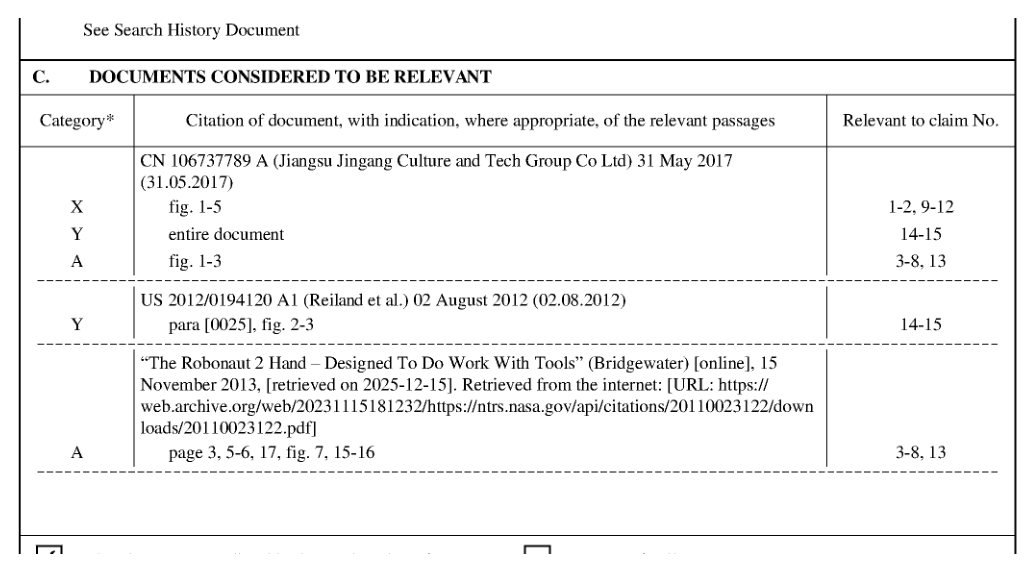
Reiland’s US20120194120A1 is also Y against claims 14–15, with paragraph 0025 and Figures 2–3 specified. Recorded inventor assignments identify interests in GM Global Technology Operations LLC and the United States represented by NASA’s Administrator. Later GM/Wilmington Trust security and release entries are not an outright ownership sale to the bank.12223
The Robonaut 2 hand paper is Y against claims 3–8 and 13. Friedl’s DLR wrist-and-forearm paper, by comparison, is A against claims 1–15: background in this report. These classifications put the Chinese arm and Robonaut material in more consequential positions in the available search record.12
The separate written opinion is still needed for the full element-by-element reasoning. Wang’s named applicant has been checked, but its current Chinese assignment chain has not. The foreign attribution therefore has a different evidentiary basis from the recorded US assignments.12233
Five filings—and the missing middle date
The five newer cases claim provisional priority on October 10, 2024. Their original US transmittals identify PCT filings on October 9, 2025, followed by US national-stage submissions on November 25, 2025. The WIPO publications appeared April 16, 2026.13151718206
The PCT date explains the apparent gap of more than a year between the provisional and the US submission. The international filings were made before the provisional anniversary; the later US submissions were national-stage papers. Under the USPTO’s national-stage guidance, the international filing date is the US national-stage application’s filing date. These dates do not, by themselves, establish substantive support for every priority claim.251315171820
Cable routing: WO2026080687A1, Mechanically Actuated Robotic Hand; PCT/US2025/050210; US 19/487,854; provisional 63/706,007.413
Wrist linkage: WO2026080690A1, Wrist Joint for Robotic Hand; PCT/US2025/050213; US 19/487,821; provisional 63/706,005.515
Actuator packaging: WO2026080691A1, Robotic Forearm Assembly; PCT/US2025/050215; US 19/487,844; provisional 63/706,004.617
Flexible joints: WO2026080693A1, Joint Assembly for Robotic Appendage; PCT/US2025/050217; US 19/487,877; provisional 63/706,009.718
Whole-hand movement: WO2026080701A1, Robotic Appendage; PCT/US2025/050227; US 19/487,696; provisional 63/706,010.820
Shared dates do not turn these into one continuation chain. The six original patent-platform diagrams now include the intervening PCT filings. Each newer case shows its provisional–PCT–US route. The older hand appears in a separate family with its PCT/US2023/034306 route and companion filings. Verified transmittal dates remain alongside the newer diagrams; the displayed families are still platform coverage, not a complete worldwide-family audit.281
Early papers, an empty examination checkbox
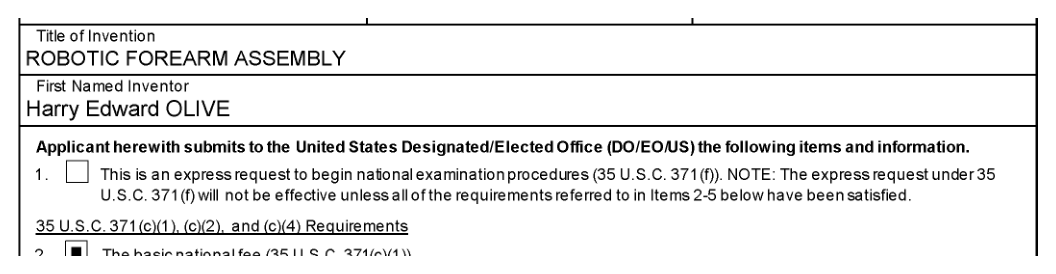
All five November 25, 2025 national-stage transmittals have an empty item 1 checkbox for an express request to begin processing under 35 U.S.C. §371(f). The standard form prints the request’s wording whether or not the box is selected. The original page image, rather than that sentence extracted in isolation, establishes what the form shows.1315171820
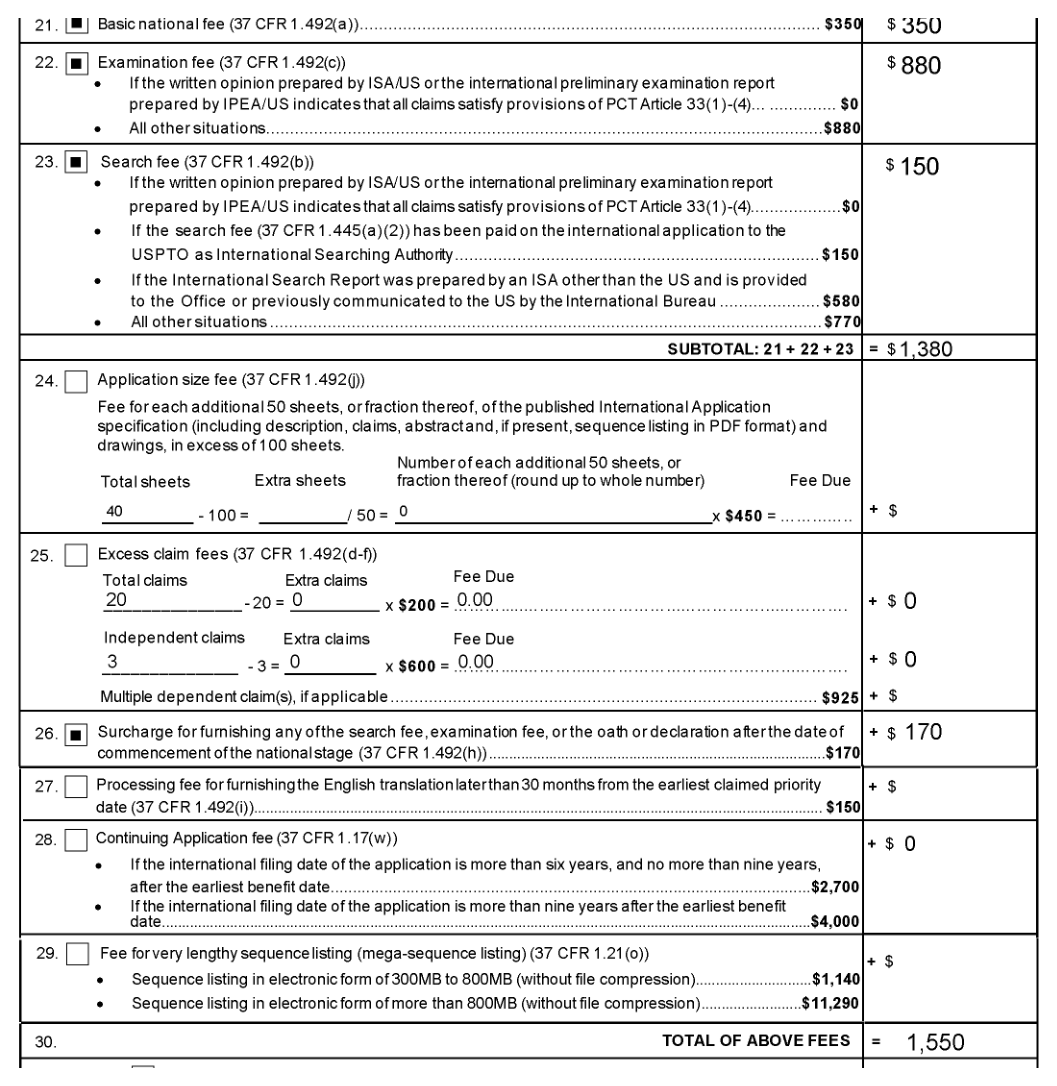
The forearm worksheet totals $1,550: a $350 basic national fee, $880 examination fee, $150 search fee, and $170 surcharge for late-submitted items. The surcharge is not an acceleration fee. These documents show national-stage papers submitted before the usual 30-month point; they do not establish an effective request for early commencement or a motive to accelerate examination. A separate request and acceptance record would be needed to settle that question.1725
A fee does not reveal the opinion
The $880 examination fee also cannot stand in for an adverse international opinion. The form offers zero under a specified favorable-opinion condition and places other cases in an “all other situations” category. The forearm worksheet predates its February 2026 search report. Paying that fee does not prove an examiner had already rejected the claims.1712
Later information disclosure statements, or IDS filings, identify search documents worth obtaining: January 30, 2026 material for the hand, December 29, 2025 material for the joint, and December 11, 2025 material for the appendage. The hand list also identifies an invitation to pay additional fees. These are document leads; the lists do not supply the reports’ conclusions.141921
The wrist IDS contains a date discrepancy: filed January 16, 2026, it lists a report/opinion dated December 15, 2026. That future date remains unresolved until the underlying document is obtained.16
Ownership and the present US position
The retrieved assignments record inventor-interest transfers to Tesla in the wrist, forearm, joint, and appendage applications. The forearm includes an April 7, 2026 record covering thirteen assignors and a June 9 record covering Huntington Shin Jasperson. The platform returned no assignments for the mechanically actuated hand or the older hand; empty results are a coverage limit, not proof of absent ownership.3
The September 13, 2026 MCP recheck leaves all five newer US applications in preexamination processing, with no examiner assigned in the returned records. Their available indexes contain no non-final or final US office action. International examination is a separate matter: the forearm search report directly establishes that a search occurred.31212
The older US application remains docketed and ready for examination. A September 3 notice projects its US publication on November 5, 2026, still a future event at this review. The retrieved records establish no US grant for any of these six applications.3126
What the expanded archive adds—and what it does not
This review screened the seventeen collected US members in Tesla’s six platform families and refreshed the six hand applications discussed here. It now includes the older hand’s initial written opinion, Article 34 response, favorable Chapter II report, US entry remarks, claim worksheet and national-stage acceptance letter. Companion knee and vision documents also appear in the older hand wrapper; their application numbers were checked so their findings were not attributed to the hand.31321011343536
Original PDFs are self-hosted for the forearm and older hand publications, selected cited prior art, and the key prosecution papers. The KUKA German publication is now included as it appears in the US file history. Four newer WO publication PDFs and the five newer separate written opinions remain outside this archive. Their technical descriptions still rely on the identified publication transcriptions; an IDS entry or downloaded foreign reference is not a substitute for the missing opinion.33457831
The native family diagrams retain the PCT routes. The bulk US family download is complete for the requested scope, but the reading and international-record coverage remain selective. September 13 platform snapshots are archived with the new sources; they do not certify a fresh upstream USPTO synchronization. The operative older US claim set remains a substantive unresolved question.28313736
The useful questions are now more specific
Tesla’s filings let us ask more precise questions than whether a robot hand uses tendons. How is the actuator bank packed? How does wrist movement affect cable length? What constrains a rolling finger joint, and where can a cable termination move? Each interface produces a different proposed claim boundary.6479
The older case shows one such boundary receiving a favorable international result: the floating cable end inside the distal member. For the newer forearm, the next examination question is how the searched claim 1 branch responds to the cited arm and Robonaut work, separately from the unsearched claim 16 and claim 20 branches.101112
Performance needs another kind of evidence. Tendon wear, heat, repeatability under load, harness life, and repairability remain open engineering questions. The patent record reveals mechanisms and claim disputes; it does not yet settle how these disclosed hands compare in sustained use.647