An assistant that does not need the whole room
You want to send a message from your glasses. The person next to you does not need to hear it.
That small social problem sits at the center of Meta’s US20260253591A1. The proposed interface listens for the physical work of forming words: electrical activity in facial muscles, vibrations through the face, and—when there is useful sound—ordinary audio. Its examples include silently composing a text and setting a reminder with little or no visible mouth movement.1
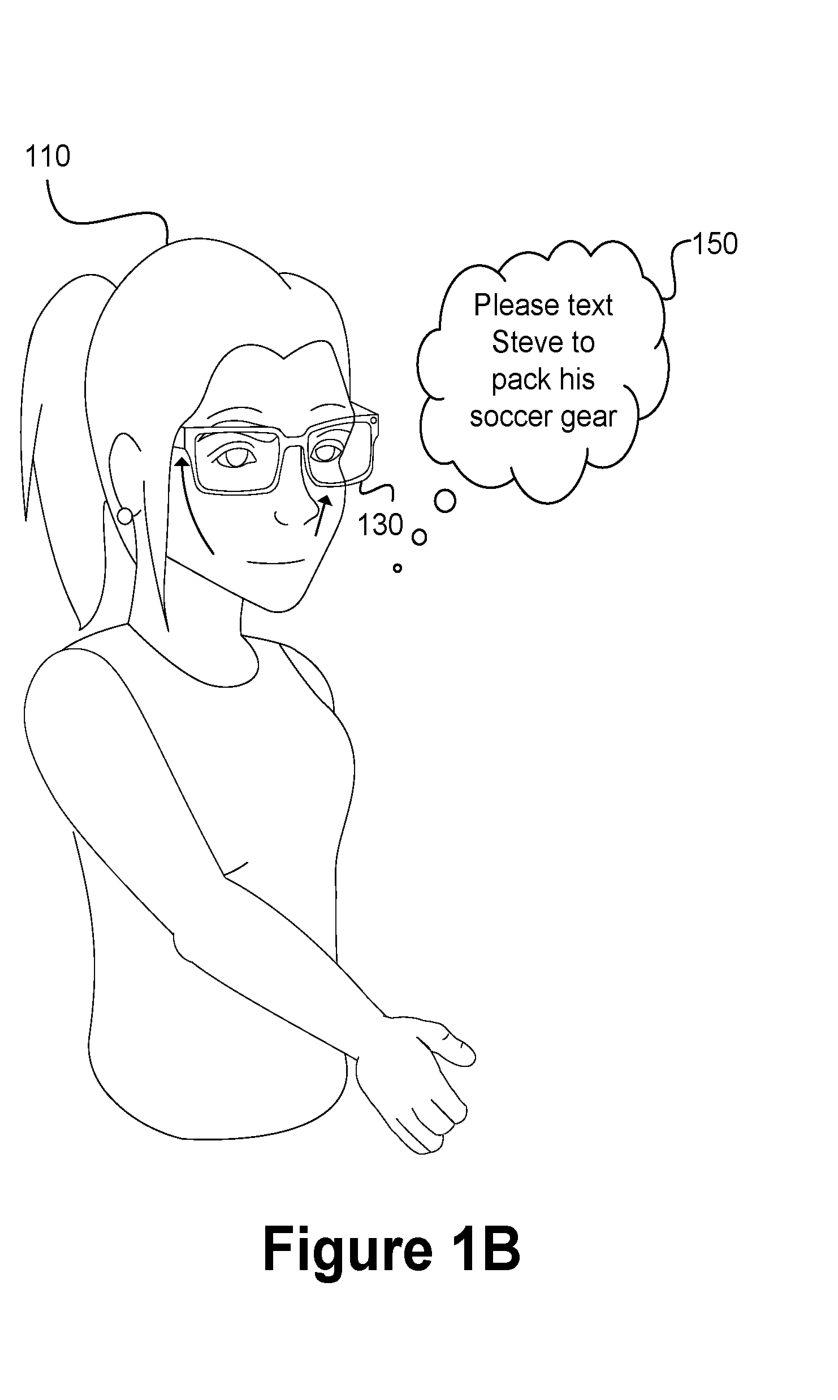
Figure 1B gives the idea a thought bubble. Read the accompanying description, though, and the mechanism is muscle activity associated with articulation. The device is intended to recognize a deliberately formed utterance. This is not evidence that a pair of glasses can browse your inner monologue.1
Meta already describes calling and messaging through voice commands on its glasses. This filing explores the next interface question: what happens when the user wants the convenience of voice without the public performance of speaking?8
The frame becomes part of the input device
A conventional microphone captures pressure waves in the air. This design adds routes closer to the person producing the words.
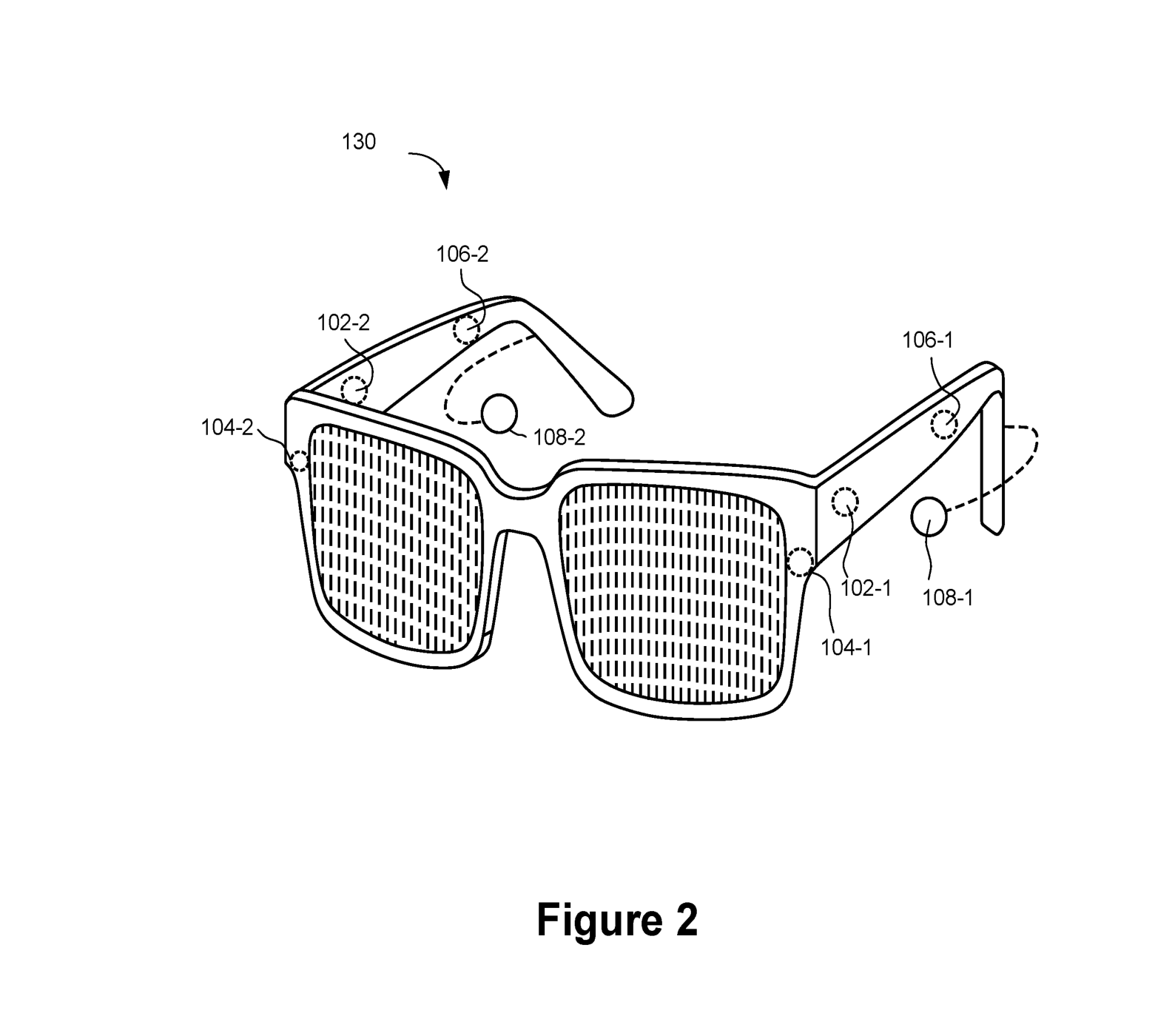
Electromyography—EMG—electrodes sense electrical activity associated with muscle contraction. Contact microphones pick up mechanical vibrations through contact with the wearer or frame. Inertial sensors can supply movement and vibration signals. The disclosure places sensors around the frame, including its arms, bridge and behind-the-ear regions; it also describes combining glasses with sensor-equipped earbuds.2
The engineering constraint is contact. A sensor on a diagram is easy to position. Keeping it against the right patch of skin through an ordinary day is harder. The specification addresses hair obstructing electrodes with proposed spring-loaded pins that pass between hairs, and channel selection based on contact impedance. That is a revealing detail: a better language model cannot recover a useful muscle signal from a contact that never captured it.2
Silent, whispered, spoken: three different jobs
The most interesting part is the handoff between sensing modes.
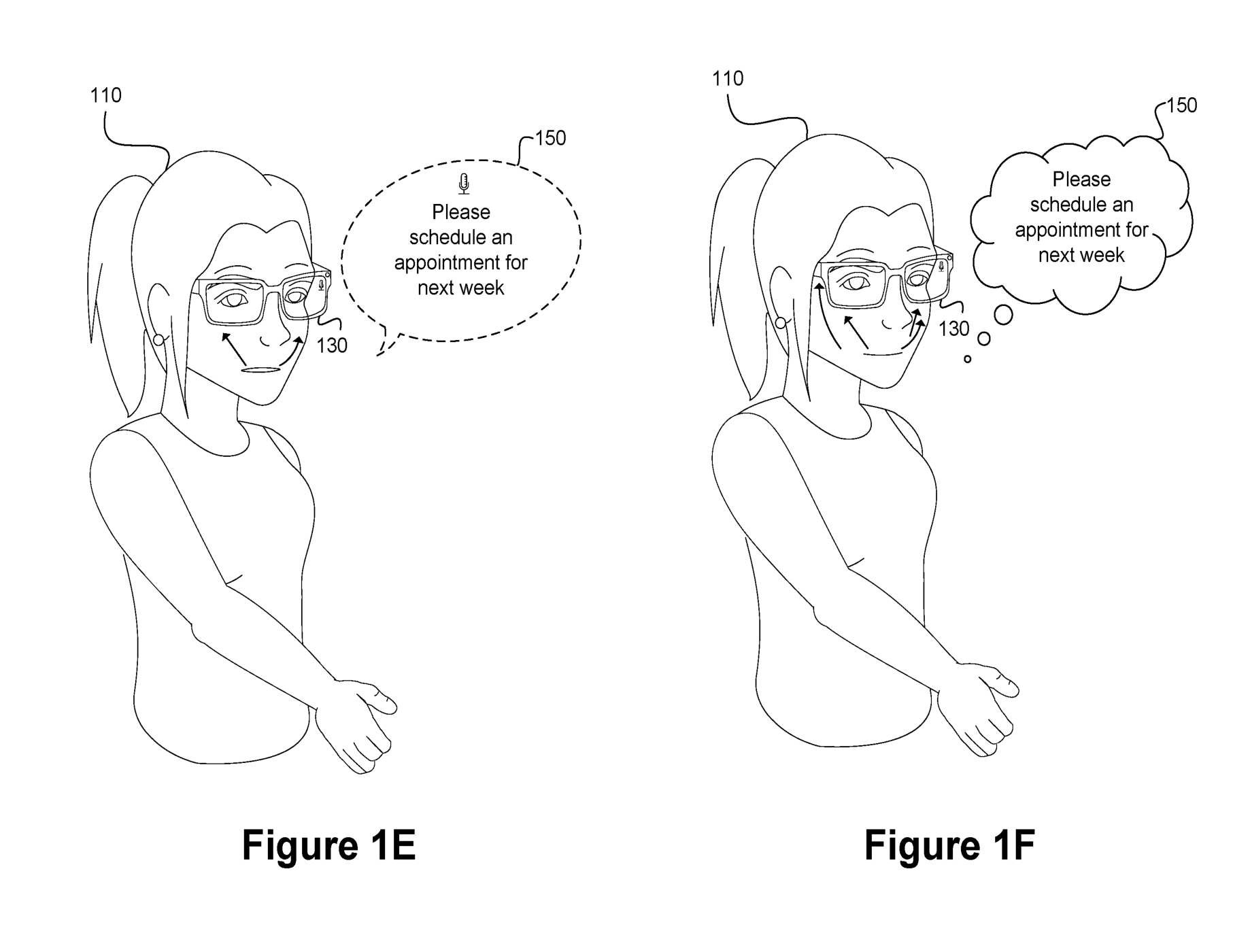
For silently formed words, the system can select neuromuscular electrodes. For a whisper, it can select contact microphones. For louder speech, acoustic microphones become useful. Environmental noise and the signal quality of individual sensors can also influence the selection. The aim is to choose a useful signal for how the wearer is communicating, rather than demand the same kind of speech in every setting.2
The publication distinguishes mouthing words, where someone may see your lips move, from sub-vocal articulation that may be visually imperceptible. Both still involve physical activity associated with speech. In a noisy train, an electrical muscle signal could avoid some of the competition that overwhelms an air microphone; in a quiet room, inaudible articulation could avoid disturbing other people. Those are proposed advantages, not measured everyday performance established by the drawings.12
The claims preserve an important distinction. Sensor switching appears in dependent claims. The independent claims are broader: receive signals from head- or face-contact sensors detecting articulatory muscle contractions or vibrations, then determine the corresponding speech. A reading of the article’s most engaging embodiment should not be mistaken for a requirement of every published claim.5
The dog is not talking to your assistant
One of the best drawings in the application is a dog barking beside a wearer with an open mouth. Sound is present. The system is supposed to decide that the wearer is not issuing a command.3
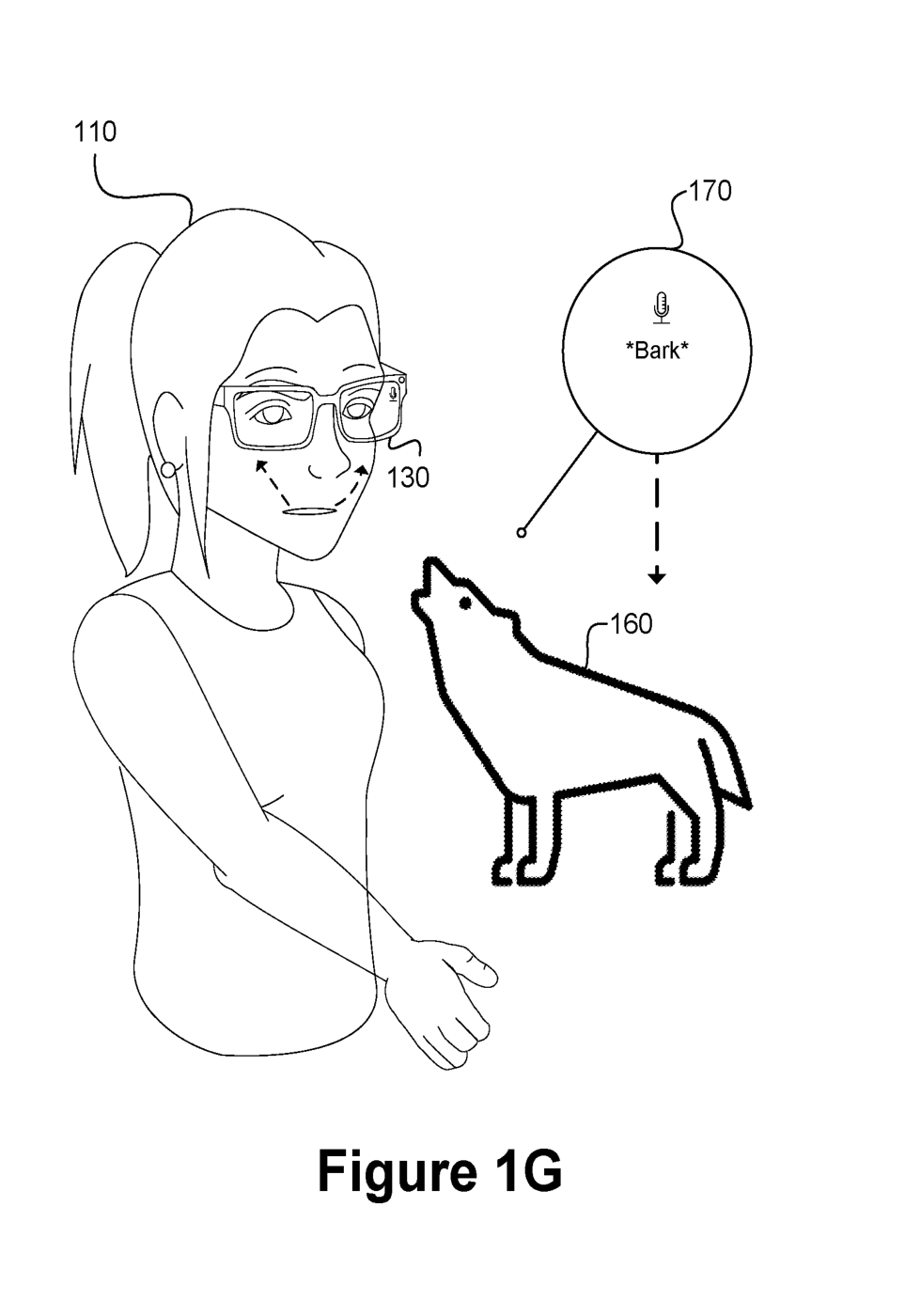
That example reveals a second problem beyond recognizing words: deciding when there are words to recognize. The proposed activity gate combines signals to reject nearby speakers and ambient sound. It also has to distinguish speech-related muscle patterns from chewing, coughing, yawning, facial expressions, head movement and adjustments to the glasses. A low-power monitoring stage can activate additional sensing only when it detects likely articulation.32
The publication gives illustrative figures of about 95% accuracy and precision, 88% recall and a 91% F1 score for detecting the wearer’s voice activity in some circumstances. That is an activity-detection result described in the filing—not a statement that 95% of silently articulated words were transcribed correctly. The two tasks must stay separate.3
A handful of commands is not a private conversation
Recognizing a small menu of commands and transcribing an arbitrary message are different targets. Meta describes both: a closed set of words or phrases, and an open vocabulary. The original provisional gives simple command examples; the later publication adds discussion of calibration, personalized training, language-model context and confidence scores.64
A limited command vocabulary is a plausible place to begin: the decoder has fewer alternatives to distinguish. That is an engineering inference, not Meta’s announced release plan. A convincing demonstration would disclose the vocabulary, how much personal training it needed, and how well it worked after the wearer removed and replaced the glasses.
The numerical boundary matters here too. Paragraph 0055 gives example word-error rates of approximately 6.6% for overt speech and 7.0% for soft speech on a particular dataset. It does not supply an equivalent silent-speech word-error rate in that passage. Instead, it describes silent recognition as dependent on training, personalization, placement and consistent articulation.4
A demo that recognizes a few rehearsed commands would be interesting. Reliable, spontaneous message composition would be a substantially stronger result. The patent gives us a way to ask which one has actually been shown.
Private from the room is only the first step
Silence can keep nearby people from hearing your input. It does not, by itself, answer where the decoded words go.
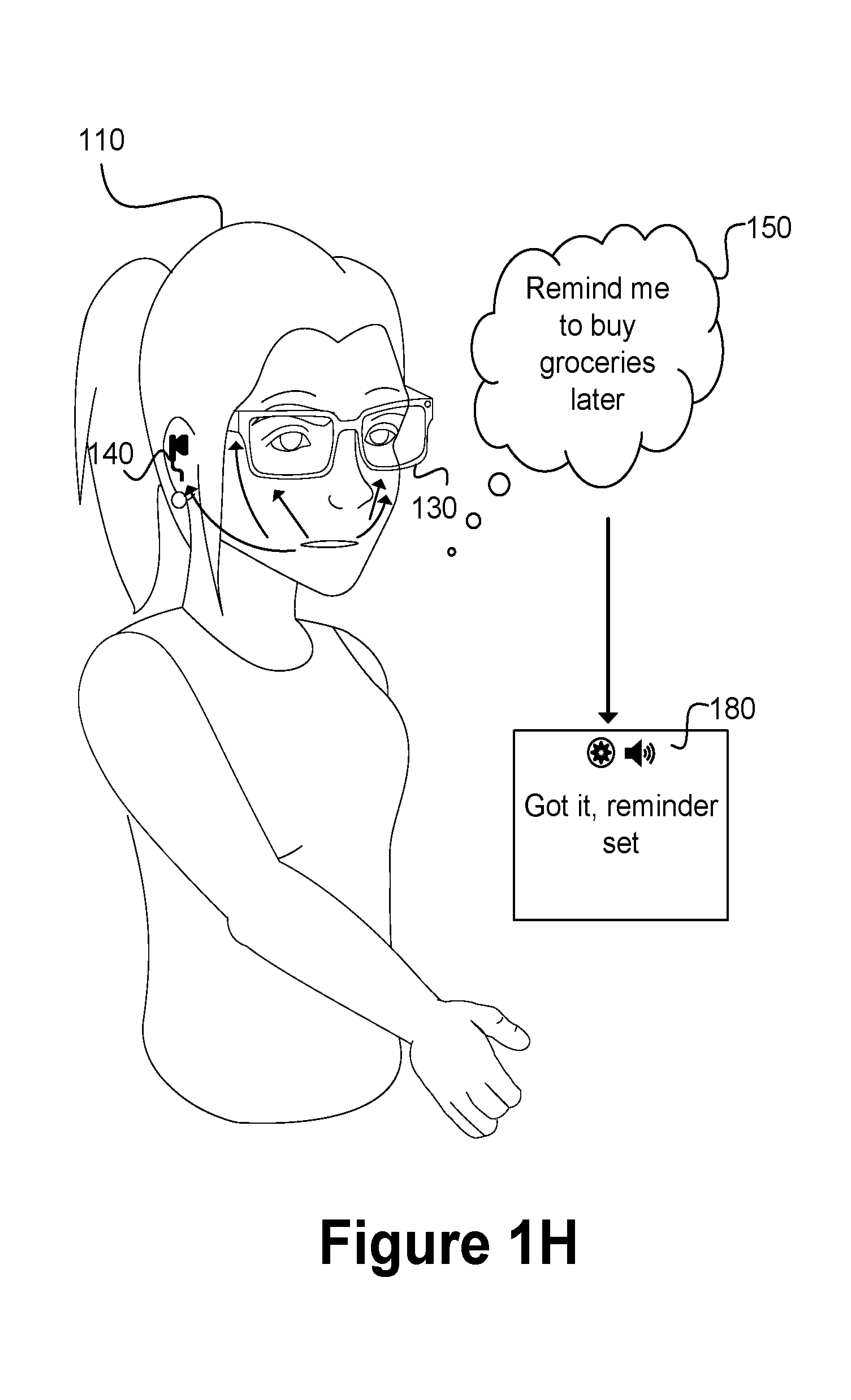
The specification allows different processing arrangements: on the wearable, on another device, or with cloud processing. It also describes asking for clarification when interpretation is uncertain and presenting a proposed action for confirmation. That distinction matters when a misread command would send a message rather than merely skip a song.4
Figure 1H shows a reminder followed by audible confirmation. The successful interaction is therefore a loop: detect intentional activity, recognize the utterance, interpret the request, and let the wearer know what happened. Making the input silent solves one part of that loop. User control, recognizable feedback and data handling still determine whether it feels private and dependable.14
The February 2025 sketch already had the central idea
The U.S. application was filed February 25, 2026 and published August 27, 2026. It claims the benefit of provisional 63/762,845, filed exactly a year earlier. That earlier specification already puts EMG and contact sensing into glasses, considers both limited and open vocabularies, and describes choosing microphone or muscle signals according to how the wearer speaks.56
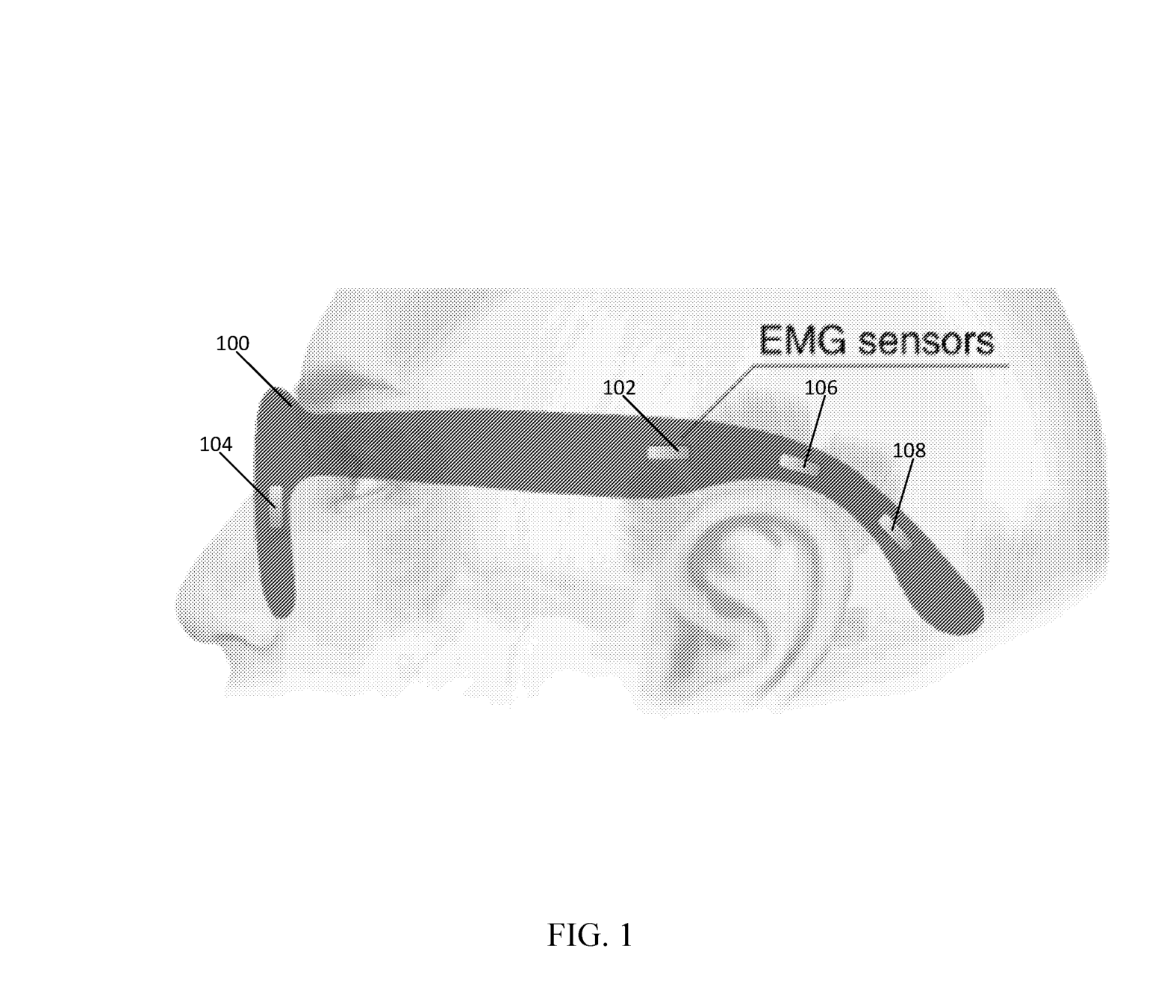
The earlier Figure 1 is a useful companion to the later frame drawing: the input device is built into places where the glasses already meet the wearer. This is a comparison of selected disclosed passages, not a conclusion that every later claim or added detail is entitled to the provisional’s date.76
For a future glasses demonstration, the revealing moment would be mundane: a wearer gives a quiet command, the device recognizes it, and a cough or nearby conversation does not trigger the same response. The promise is an assistant you can address without making everyone else part of the conversation. The test is whether it knows when you meant to speak to it.
Evidence notes, claim details and open questions
Record, boundaries and what remains to be demonstrated
Research through September 20, 2026. Patent-platform lists application 19/550,171 as “Docketed New Case - Ready for Examination.” The retrieved inventory includes 32 documents for that application and 16 for provisional 63/762,845. All 48 indexed records have files held by the platform; 46 have extracted text. The nonprovisional specification and abstract are intentionally sourced from publication text rather than redundant OCR. No substantive examiner rejection or allowance appears in this retrieved inventory.
The article reviews the publication’s claims and selected specification passages, the provisional’s central disclosure, and original drawing sheets. File acquisition is broader than substantive review. The family panel is patent-platform’s native SVG for the two-member U.S. family, including the provisional-benefit relationship. It is not a worldwide-family completeness claim.
The filing describes proposed implementations and selected illustrative figures. It does not establish shipping hardware, general silent-dictation accuracy, or an announcement at Meta Connect. The public product source cited above establishes voice interaction, not deployment of the silent-speech architecture.85