SUPRACITE

Meta / Neural Interfaces Draft

Meta wants to teach your hand a new shorthand

A newly granted Meta patent proposes teaching you shorter handwriting motions. Its original drawings show the feedback loop; its file history shows why biological-signal sensing became central to the claims.

Public draft · Research through 2026-09-19 · Updated 2026-09-20. This article is in review; findings and wording may change.

Watch an overview 1:12Narrated patent drawings · Captions included

A short summary of this article, with synthetic narration. The full analysis and sources follow below. Download video.

Read the video transcript

You can skip the second p.
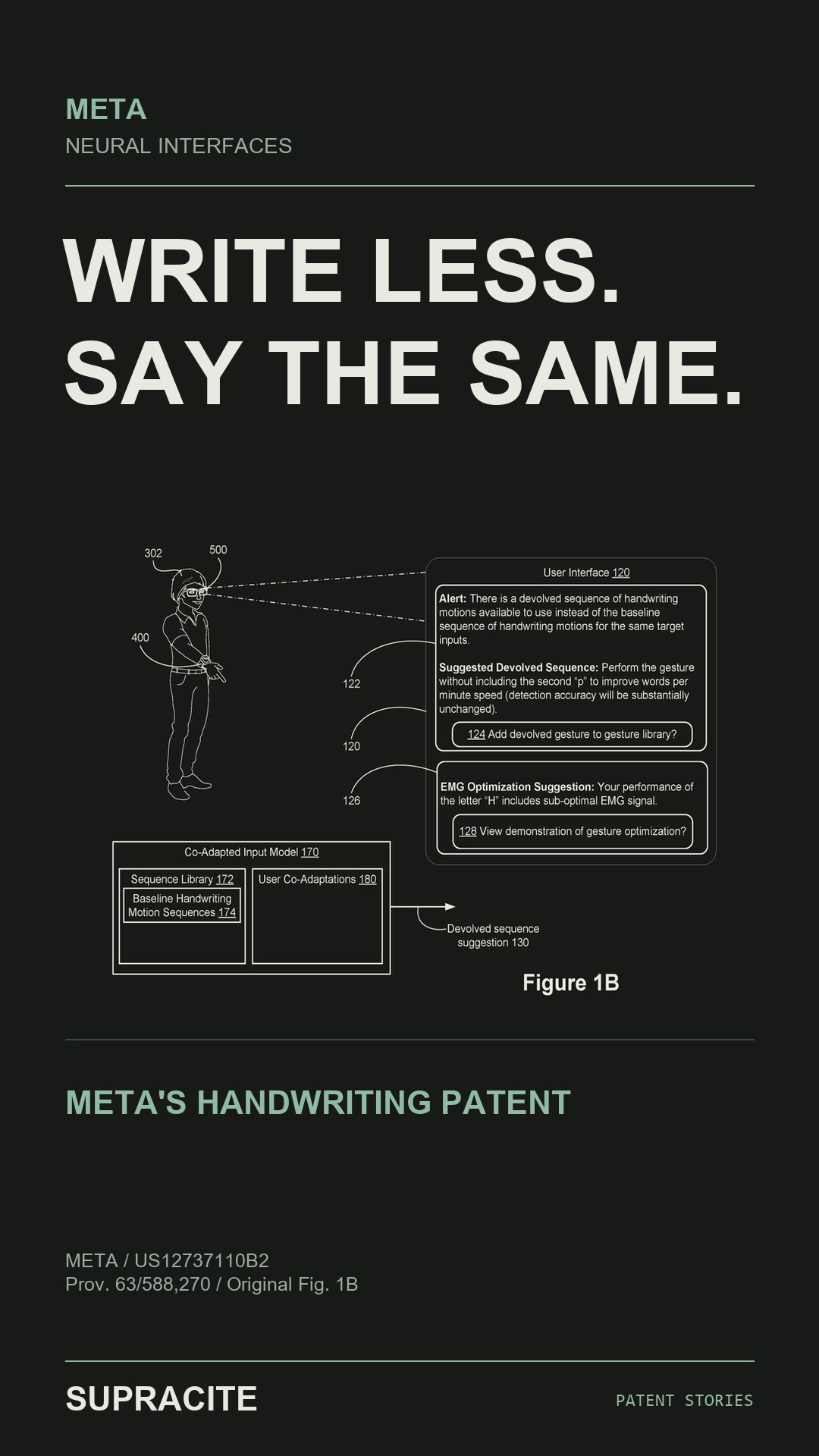
You write happy. Your wristband suggests skipping the second letter P. That is an actual example in Meta's newly granted handwriting patent. Same word. Fewer movements.

Your hand and the model learn.
The system links sensed handwriting movements to the output you intended. Then it suggests a shorter sequence and shows you how to perform it.

A shortcut you can refuse.
You can reject a suggestion and try an alternative gesture. The model can learn from those choices, building a shorthand around its user.

Less movement. More mistakes?
But fewer strokes only help if mistakes do not erase the time saved. One version checks an error threshold before dropping a motion. These drawing scores are examples, not test results.

The file history changes the story.
The examiner had already seen abbreviated handwriting. Meta narrowed its independent claims to require biological-signal sensing. That combination became central to the allowance.

At Connect, watch the coaching.
Meta has already announced neural handwriting. This patent does not prove adaptive shorthand is shipping. At Connect, watch for the next step: a computer that teaches your hand which movements it can leave out.

Explore the Meta patent families
People in this article · 2

Verified participation in the records cited here. Open a name for the full profile, or a PDF link for the original evidence page.

You can skip the second p

You write “Happy.” Your wristband has a suggestion: next time, leave out the second p. The computer can still produce the same word, and your hand has less work to do.
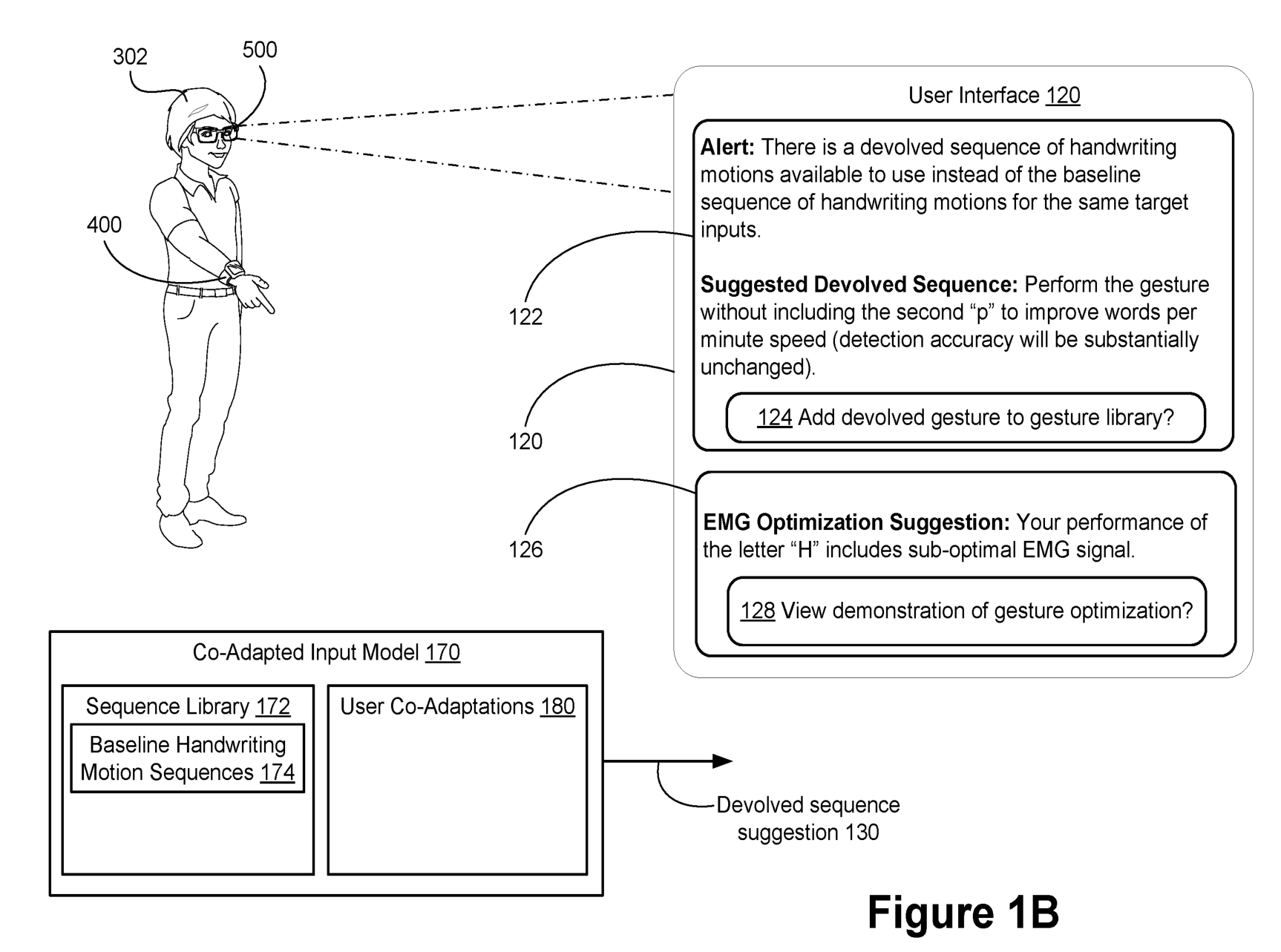
The interface suggests omitting a repeated letter while preserving the intended output. This is a proposed interaction, not a measured product result.
63/588,270 — Original Figure 1B, PDF p.2, filed October 5, 2023; later claimed by US20250117131A1 / US12737110B2. The interface suggests omitting a repeated letter while preserving the intended output. This is a proposed interaction, not a measured product result. Rotated upright; original labels retained. Application 63/588,270 Inspect original PDF

That is an actual example in Meta’s patent drawings. Figure 1B offers a shorter motion sequence and asks whether to add it to the user’s gesture library. Elsewhere, the system suggests a different way to form a letter, or an alternative hand gesture. The ambition is a shorthand that develops around its writer.31

Meta received US12737110B2 on September 15, 2026. The idea had already been published as US20250117131A1 on April 10, 2025, with a claimed provisional dating to October 5, 2023. This week’s news is the granted claim set—and the file history explaining how it changed.12

The compelling question is what happens after a computer learns to recognize your handwriting. Could it also teach you which parts you no longer need to perform?

The computer reads the movement behind the mark

On paper, your handwriting has to make sense to another person. A sensor-based interface can use a different test: whether it can reliably identify the input you intended. A flourish that helps a human reader might be unnecessary for a model trained on your motion signals. The specification explicitly proposes loosening that legibility constraint.1
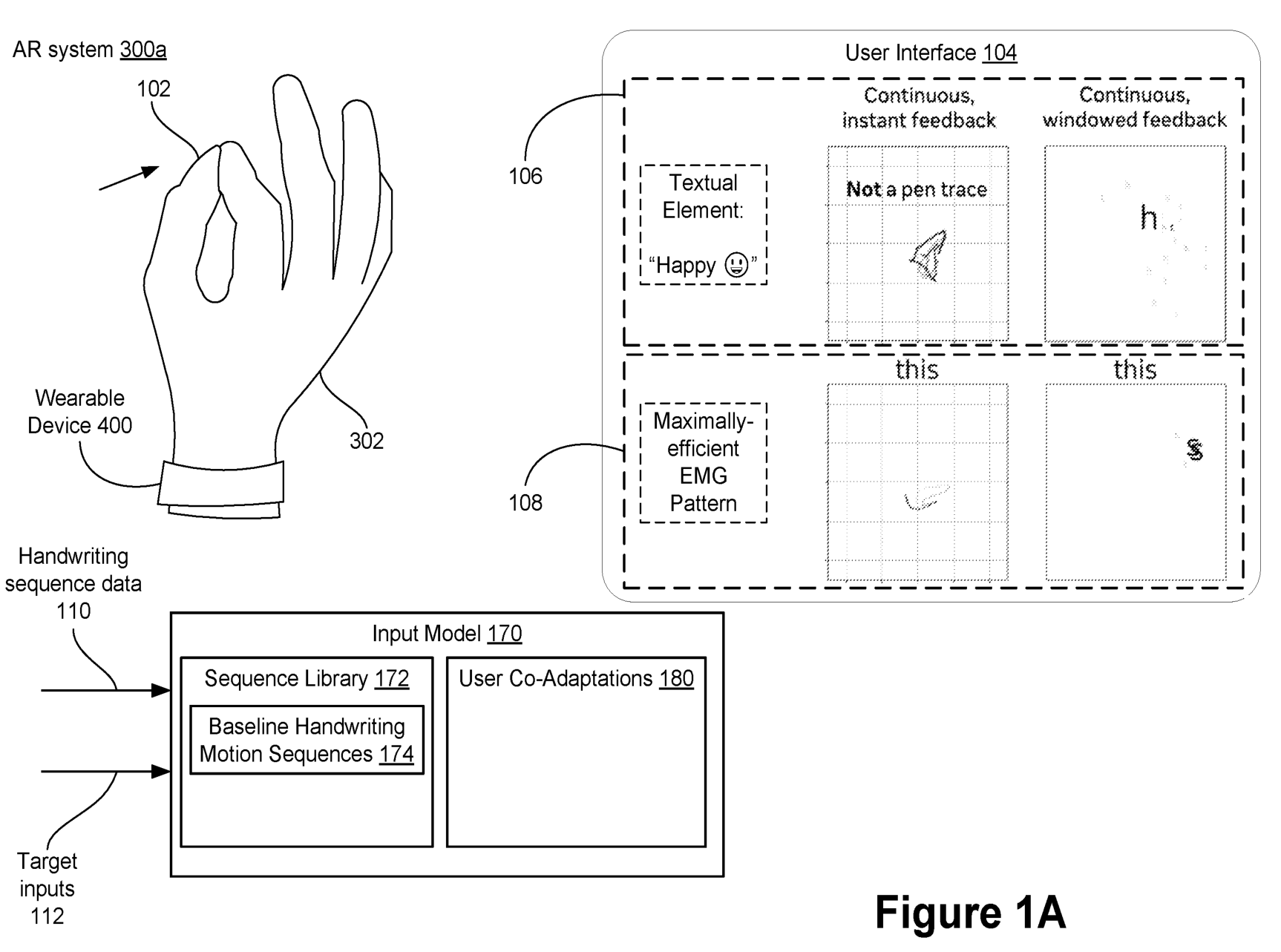
Handwriting data and intended inputs feed a model with a sequence library and user-specific adaptations.
63/588,270 — Original Figure 1A, PDF p.1, filed October 5, 2023; later claimed by US20250117131A1 / US12737110B2. Handwriting data and intended inputs feed a model with a sequence library and user-specific adaptations. Rotated upright; original labels retained. Application 63/588,270 Inspect original PDF

The illustrated system takes handwriting-motion data and the intended output, then identifies a different sequence with fewer motions. A display shows the proposed shortcut. The wearer can try it, accept it, ask for alternatives or decline it. The model can record those choices and use them to shape later suggestions. A sequence library and a separate user-adaptation component appear directly in the original drawings.13

In the wristband embodiments, electromyography—EMG—provides signals associated with muscle activity. The specification also describes combinations with other sensors. The issued independent claims expressly require a biological electrical-signal sensing component configured to supply data for determining handwriting motions. They are about sensed input and a suggested shorter sequence, not a computer reading an unexpressed thought.1

This makes the interface a two-way learning problem. The machine adapts to the wearer, and the wearer learns motions the machine can distinguish. The visible mark does not have to remain a conventional letter.

A shortcut you can refuse

The most revealing detail comes after the first suggestion. In Figure 1C, the wearer declines it. The system offers alternatives: adjust the motion used for a letter, including movement in another plane, or substitute an EMG-detectable gesture. The refusal itself can become information for future recommendations.31
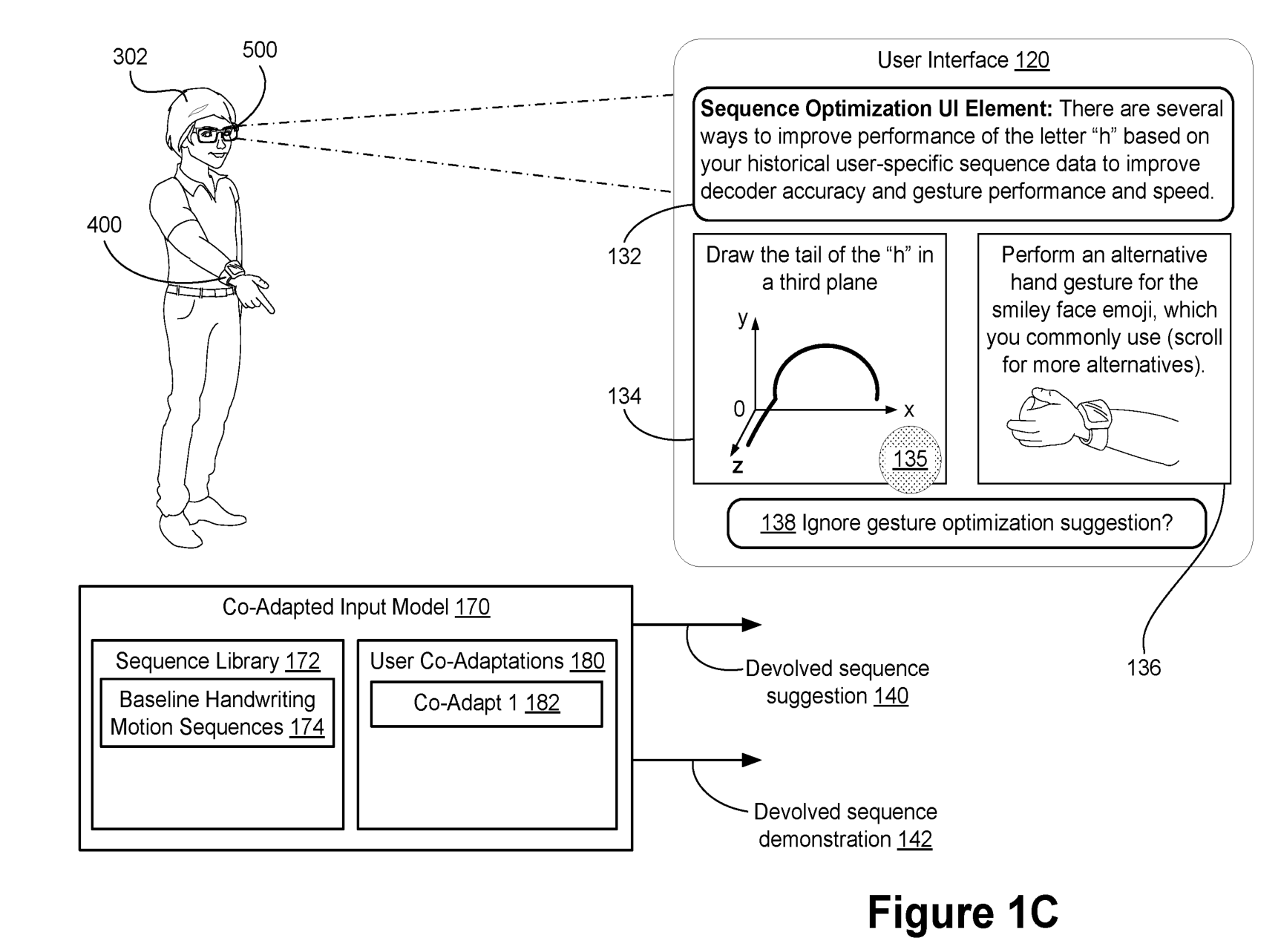
The wearer can decline a suggestion and see alternatives. The model records user-specific adaptations.
63/588,270 — Original Figure 1C, PDF p.3, filed October 5, 2023; later claimed by US20250117131A1 / US12737110B2. The wearer can decline a suggestion and see alternatives. The model records user-specific adaptations. Rotated upright; original labels retained. Application 63/588,270 Inspect original PDF

That matters because the shortest movement on a diagram may be awkward to remember or uncomfortable to repeat. The specification allows suggestions to reflect a person’s preferences, learning rate, historical performance and exertion. In a later step, a chosen shortcut can be refined again. Dependent claims 2 and 3 address iterative refinement and a model adapted through the user’s performed sequences.1

One possible endpoint is a library of compact gestures that produces familiar text. It is tempting to call that a private alphabet, but privacy is not established by personalization: a system that stores a person’s mappings and sensor history still has data to protect. The immediate engineering promise is a smaller motion vocabulary that its user can actually learn.

Fewer strokes can mean more mistakes

A shortcut only saves time if correcting it does not consume the saving. The patent confronts this directly: one embodiment removes a motion only if the predicted reduction in recognition accuracy stays below a threshold. Another checks whether the speed improvement compensates for the reduced accuracy. Issued dependent claim 5 includes the error-threshold condition; it is not a requirement of every independent claim.1
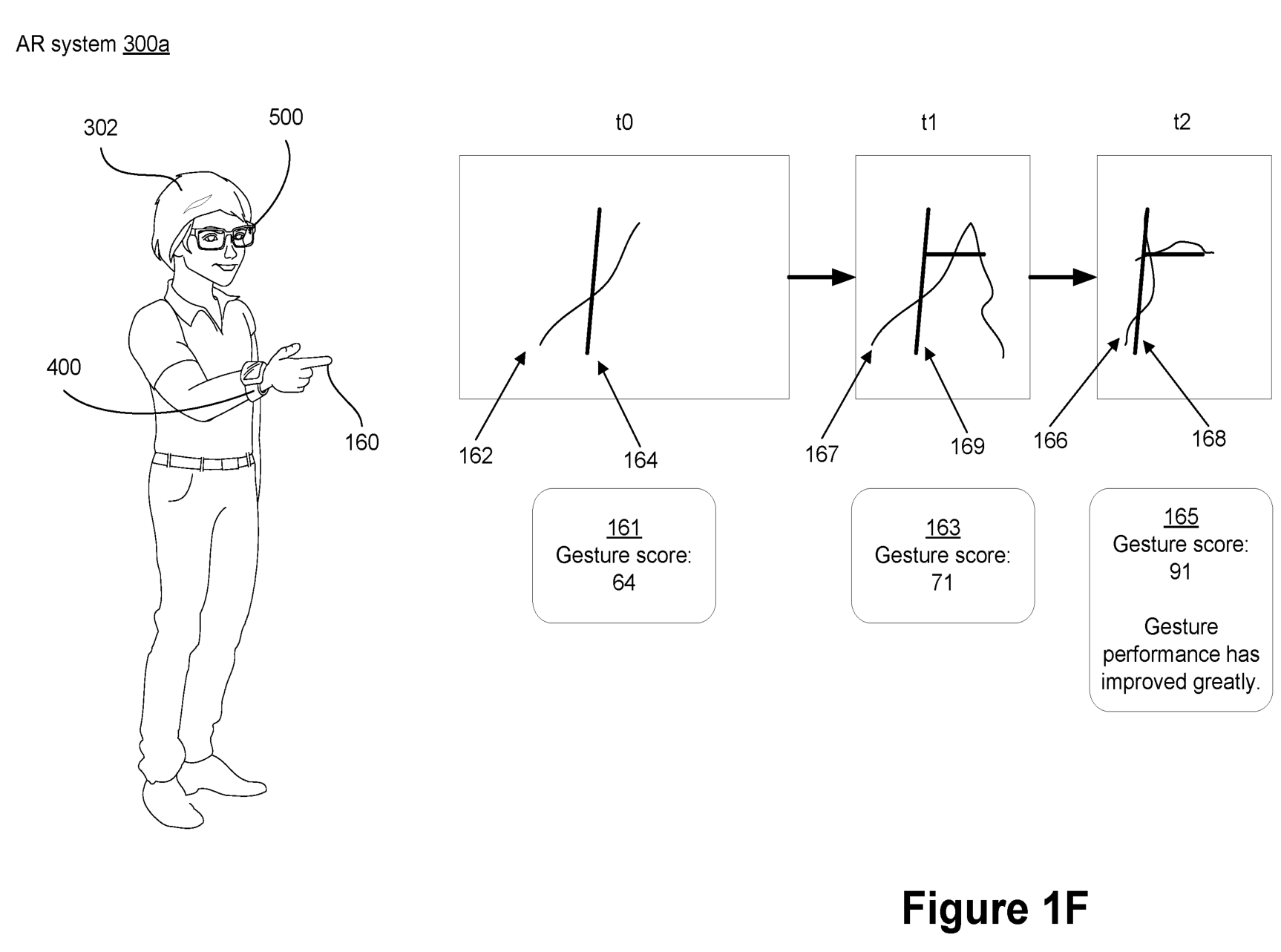
Illustrated gesture scores improve across attempts. These are example interface values, not measured study results.
63/588,270 — Original Figure 1F, PDF p.6, filed October 5, 2023; later claimed by US20250117131A1 / US12737110B2. Illustrated gesture scores improve across attempts. These are example interface values, not measured study results. Rotated upright; original labels retained. Application 63/588,270 Inspect original PDF

Figure 1F shows a training interface with gesture scores increasing across repeated attempts. Those numbers illustrate feedback in a proposed interface. They are not reported results from a controlled user study. Likewise, the specification’s numerical error examples do not establish a real-world accuracy rate.31

The useful performance question is total effort: learning the shortcut, recalling it, executing it and fixing the occasions when it produces the wrong output. A demo should test repeated words alongside unfamiliar names and punctuation, and show what happens when the wearer wants the literal letters rather than the trained shortcut. The patent supplies a design direction; it leaves those product tests to the implementation.

The examiner had already seen abbreviated handwriting

The file wrapper puts a useful limit on a sweeping “Meta patented shorthand” headline. On July 2, 2025, examiner Ryan A. Lubit rejected the then-pending independent claims using a combination of three earlier publications.5

Mannby, US20200065370A1, concerns abbreviated handwritten entry; the retrieved assignment record names Microsoft Technology Licensing, LLC. Missig, US20200356254A1, concerns handwriting entry on an electronic device and is assigned to Apple Inc. Huang, US20200201443A1, concerns in-air finger-motion input; its recorded assignee is the Arizona Board of Regents on behalf of Arizona State University. These are the examiner’s technical references—not evidence that those organizations intervened in Meta’s application.910115

The examiner mapped shortened entry, completion suggestions and wearable motion sensing across those references. Meta’s October 2 response amended the independent claims to require a biopotential-signal-sensing component that detects data used to determine the wearer’s handwriting motions. Its lawyer pointed to subject matter in an earlier dependent claim that the examiner had identified as allowable if properly rewritten.67

The May 14, 2026 reasons for allowance then emphasized that sensing requirement together with the shorter-sequence suggestion. The issued claims retain it. During examination, the independent claims were numbered 1, 10 and 16; after cancellations and renumbering, the grant’s independent claims are 1, 8 and 15.81

The broad idea of abbreviating handwriting met earlier work from major computing companies and a university. The claimed combination that emerged expressly included biological-signal sensing. Reading only the abstract would miss that boundary.

At Connect, look for the coaching

Neural Handwriting itself is already part of Meta’s product story. In its March 31, 2026 update, Meta announced a wider rollout for Meta Ray-Ban Display and support for replying in messaging services by writing with a finger. That announcement describes handwriting input; it does not establish that users are receiving this patent’s personalized, progressively shorter-motion suggestions.12

That distinction gives a Connect demonstration something specific to prove. Does the system merely transcribe what the wearer writes, or does it suggest a more economical way to produce the same result? Can the wearer decline? Do those choices influence later suggestions? Does performance hold up after the teaching moment has passed?1

The larger possibility is an interface that grows familiar through use. Your hand and the decoder develop a working agreement about which movements matter. The challenge is making that agreement save enough effort that learning it feels worthwhile. No announcement of this particular adaptive-shorthand feature is established by the records reviewed here.

Evidence notes, claim details and open questions

The record behind this story

Research checked September 19, 2026. Patent-platform reports all 69 indexed documents for U.S. application 18/905,099 and all 20 for provisional 63/588,270 available. OCR is complete for 67 application documents and all 20 provisional documents; two application documents are marked skipped. None is pending. This article substantively reviews the cited grant, application publication, original drawings, July rejection, October amended claims and response, and May allowance. The full-document acquisition count is not a claim that every administrative page received substantive review.245678

The native patent-platform family map includes PCT/US2024/050094. Its international prosecution has not been reviewed. One U.S.-to-PCT connection remains inconsistent between the renderer’s BENEFIT label and the underlying relationship record; the map flags that limitation. The original diagram is preserved, rather than replaced with an inferred tree.

Sources and original records

  1. US12737110B2 — Meta handwriting shorthand, issued September 15, 2026

    Application 18/905,099 · Publication US12737110B2

    Independent claims 1, 8 and 15; dependent claims 2–5; specification discussion of Figures 1A–1F and method 200. XML paragraphs 0031–0044, 0051–0054 and 0063–0064.

    Issued scope and disclosed personalization, shorter motion sequences, iterative feedback and accuracy tradeoff.

    Retrieved 2026-09-19

    Original-file fingerprint92258e4a191c3d4f7780de99a95fb421fdde859720cde700caf10fe400d265ec
  2. US20250117131A1 — The earlier application publication

    Application 18/905,099 · Publication US20250117131A1

    Front page, priority statement, and original claims 1, 8, 10 and 16. Published April 10, 2025, claiming provisional 63/588,270 filed October 5, 2023.

    This week brought a grant, not the first public disclosure.

    Retrieved 2026-09-19

    Original-file fingerprint8f063f936ae6a9b5908ab4ebd5a3957ab666b58d49916de3decb3426b8960c6a
  3. 63/588,270 — Original provisional handwriting drawings

    Application 63/588,270

    PDF pp.1–6, Figures 1A–1F. Article images are rotated 90 degrees clockwise and cropped at page margins.

    Original drawings show drop-a-letter suggestion, alternatives, user feedback and an evolving sequence library.

    Retrieved 2026-09-19

    Original-file fingerprint7e0c2cf577624c3af75407ecfc20004b1cca6740cf1f1eba9a1a3b036f711bf1
  4. 63/588,270 — Original provisional specification

    Application 63/588,270

    Title and October 5, 2023 filing record; specification associated with the original Figures 1A–1F.

    Underlying provisional is available for inspection; no claim-by-claim priority-support opinion is asserted.

    Retrieved 2026-09-19

    Original-file fingerprinted1bed12a5abc277725e031ff110b22a8c0240ac449ec7a853d77040e816599c
  5. 18/905,099 — July 2, 2025 nonfinal Office action

    Application 18/905,099

    PDF pp.3–7: principal §103 combination of Mannby, Missig and Huang; later pages address dependent claims and allowable subject matter.

    Examiner applied earlier handwriting and wearable-input teachings to broader pending claims.

    Retrieved 2026-09-19

    Original-file fingerprint5e06404a4629a298fc61e665e16dffe4c51f4510fb599c3c30ecf16e74279137
  6. 18/905,099 — October 2, 2025 amended claims

    Application 18/905,099

    PDF pp.1–8; then-pending independent claims 1, 10 and 16 add a biopotential-signal-sensing component. These became issued claims 1, 8 and 15.

    The actual amended text establishes the sensing limitation, rather than an inference from the grant date.

    Retrieved 2026-09-19

    Original-file fingerprint505afbe5fd3df8960b68828989610244603a96c5f0560236c40f4c7889bb2cf3
  7. 18/905,099 — Meta’s October 2, 2025 response

    Application 18/905,099

    PDF pp.1–3: amendment rationale and comparison with previously objected-to claim 8; p.5: signature of Alexander B. Stein, registration 71,397, Morgan, Lewis & Bockius LLP.

    Applicant explained the amendment and requested withdrawal of rejections.

    Retrieved 2026-09-19

    People in this record

    Original-file fingerprintb16207bbbcb18e6013cd6ebcbe764027a7dfffbe78222e65ec8a9bacc1fb4f13
  8. 18/905,099 — May 14, 2026 allowance

    Application 18/905,099

    PDF pp.7–8: reasons for allowance; p.9: examiner Ryan A. Lubit signature.

    Examiner identified the biological-signal sensing and shorter-sequence suggestion combination in allowing the claims.

    Retrieved 2026-09-19

    People in this record

    Original-file fingerprintdfbb99620d9aeb6160fbc0f587e36bd29f0615cf99f3de841b89e12bf73f911d
  9. US20200065370A1 — Microsoft’s abbreviated handwritten entry

    Application 16/110,820 · Publication US20200065370A1

    Cited in the July 2, 2025 action, PDF pp.3–7. Ownership attribution checked against patent-platform assignment chain on September 19, 2026: assignment to MICROSOFT TECHNOLOGY LICENSING, LLC, recorded 2018-08-23, reel/frame 46688/227. The retrieved chain shows one ownership transfer.

    Publication and recorded assignment identify the technical reference and the assignee in the retrieved record.

    Retrieved 2026-09-19

    Original-file fingerprint9d306201d1288499e4ec8032a9cf9c18141821c67f009286871fc9f4bc597e98
  10. US20200356254A1 — Apple’s handwriting entry interface

    Application 16/868,449 · Publication US20200356254A1

    Cited in the July 2, 2025 action, PDF pp.3–7. Ownership attribution checked against patent-platform assignment chain on September 19, 2026: assignment to APPLE INC., recorded 2020-09-16, reel/frame 53794/119. The retrieved chain shows one ownership transfer.

    Publication and recorded assignment identify the technical reference and the assignee in the retrieved record.

    Retrieved 2026-09-19

    Original-file fingerprintb842070df1648e1f3b1a8f7f29dc9fc7d55de1d6e2f8b75649e884b3c9deb520
  11. US20200201443A1 — Arizona State’s in-air finger-motion interface

    Application 16/715,059 · Publication US20200201443A1

    Cited in the July 2, 2025 action, PDF pp.3–7. Ownership attribution checked against patent-platform assignment chain on September 19, 2026: assignment to ARIZONA BOARD OF REGENTS ON BEHALF OF ARIZONA STATE UNIVERSITY, recorded 2019-12-20, reel/frame 51610/537. The retrieved chain shows one ownership transfer.

    Publication and recorded assignment identify the technical reference and the assignee in the retrieved record.

    Retrieved 2026-09-19

    Original-file fingerprint3adc2184c1b434abf0024831c10148c03d1aa0bebc7abd822006cfe9a4ba849e
  12. Meta — Neural Handwriting product update, March 31, 2026

    Even More Features and Meta AI Capabilities On the Way: announced wider Neural Handwriting rollout and messaging support.

    Company announcement establishes the existing handwriting product direction; it does not establish implementation of this patent’s adaptive shorthand.

    Retrieved 2026-09-19