The Capture problem, inside a phone
A camera sees one thing. The image everyone else receives can tell another story. The Capture builds a thriller around that gap; its third season brings in Veritas cameras to help sort genuine evidence from manipulated footage.12
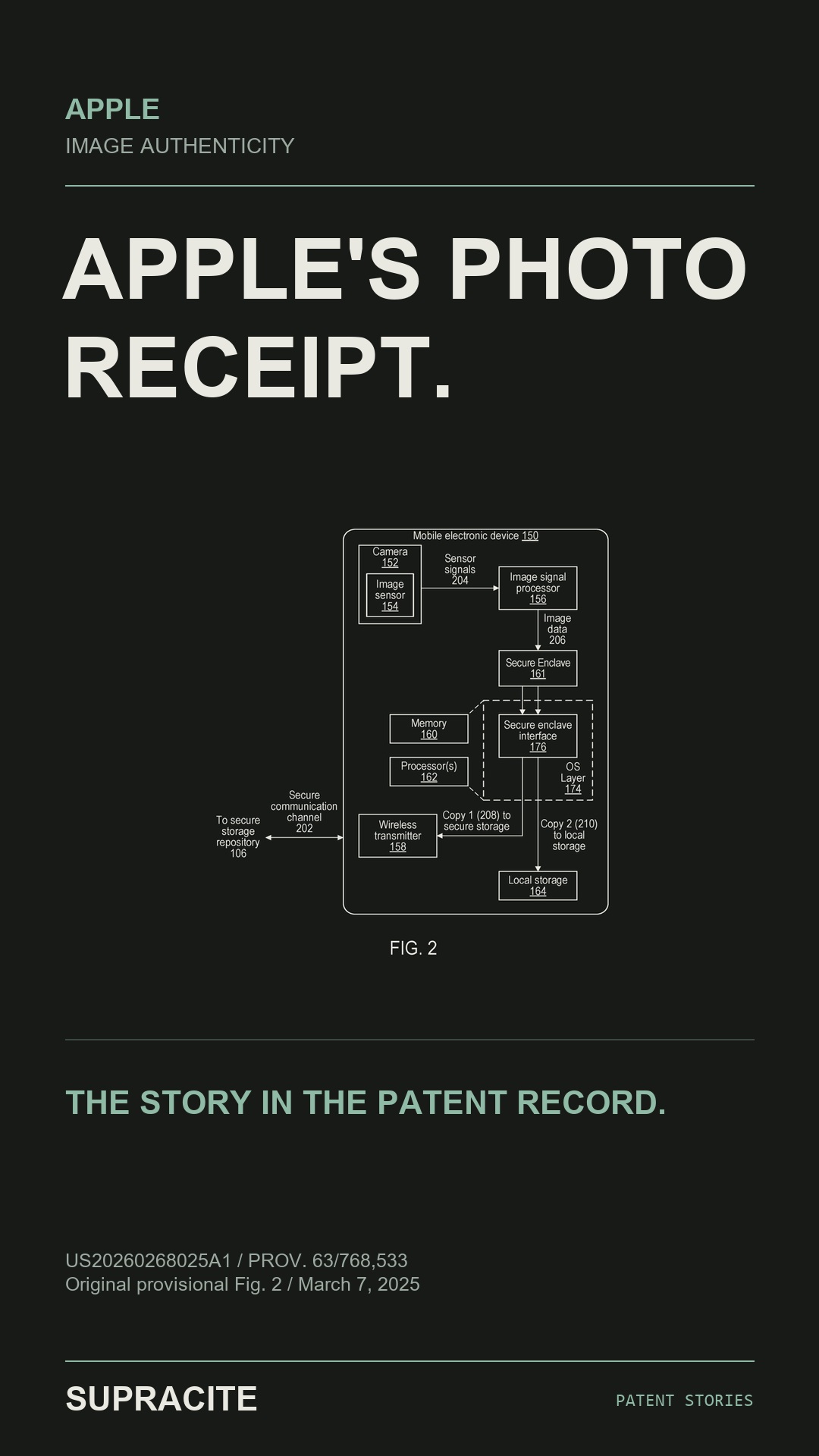
The connection to Apple becomes clearest in a plain patent drawing. Figure 2 gives a single capture two routes out: one copy can enter the world of apps, editing and sharing; another travels along a protected path, so someone can later ask to see what the camera originally recorded. The resemblance is the problem being solved: how do you keep a reference beyond the reach of whoever can change the circulating image?42
This became a product story in the same week the patent application appeared. Apple announced Reference Image for iPhone 18 Pro on September 9, 2026; US20260268025A1, “Authenticated Images,” was published on September 10. The feature offers a reference image that viewers can compare with the ordinary photo. The filing opens an earlier window onto the engineering, through a provisional filed in March 2025.912
The most unsettling part comes after that split. Preserve the camera’s original perfectly, and someone can still point the camera at a lie. Apple’s provisional had already considered photographing an AI-generated scene displayed on a screen.2
One capture. Two routes out.
Follow the arrows in Figure 2. Image data leaves the image signal processor and enters a secure enclave. There it is copied: one branch heads through an operating-system interface to a secure repository; the other heads to local storage, where apps can use it. The protected channel sits below the application layer, out of those apps’ reach.42
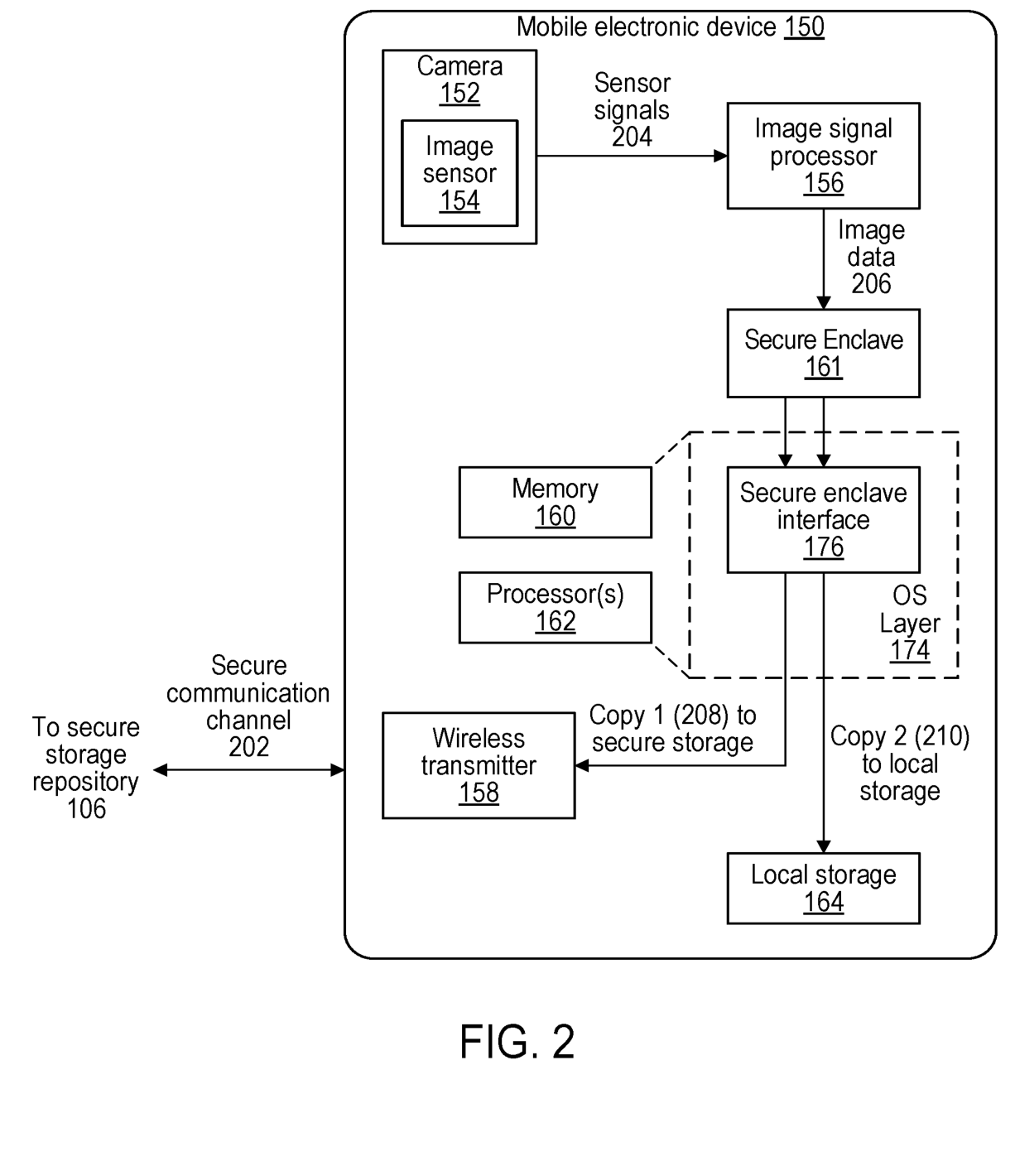
Imagine someone removing a person from a street photograph. Under the proposed design, they can edit the local copy and share the result. The repository is meant to preserve the comparison copy beyond that editor’s control. The scene in the circulating image can change without silently changing the reference alongside it.2
Both copies carry the same identifier. That gives an authorized viewer a way back: present the identifier, retrieve a representation of the protected image, and compare it with the version making the rounds. The crucial step is where the paths separate—before ordinary apps get access. Making a backup after an edit would preserve the edit.2
This is the engineering detail that makes the Capture comparison useful. A second record creates something to check when the first one is disputed. It is also reflected in the claims: claim 1 addresses the protected channel and identifier; claim 2 adds the second copy available to applications. The reference’s value depends on the protected path actually remaining protected.5
The announced system has two tracks, too
Apple’s September 15 security explanation describes a related separation in the announced product. A signed digital negative is stored on the device alongside the conventionally processed photo. The camera sensor signs capture data before the operating system handles it; when the user requests a reference image, Private Cloud Compute validates and develops the negative into a viewable image.10
That gives the reader a useful comparison. Figure 2 separates an editable copy from a protected repository copy. The product separates the ordinary photo from a sensor-signed negative that can later become a reference. The common purpose is to preserve something checkable while the ordinary picture goes through the usual photographic workflow.410
The distinction still matters: two copies in a patent drawing do not establish how every part of the product works. Apple describes two protected phases—capture and development—and says cloud processing keeps the image contents private even from Apple. The patent’s central repository should not be substituted for that account of the product’s storage and privacy behavior.10
What if the camera photographs a fake?
Suppose someone displays a generated street scene on a monitor and takes a genuine photograph of it. A working camera really did receive those pixels. The useful question is now whether the claimed street was actually in front of the camera.
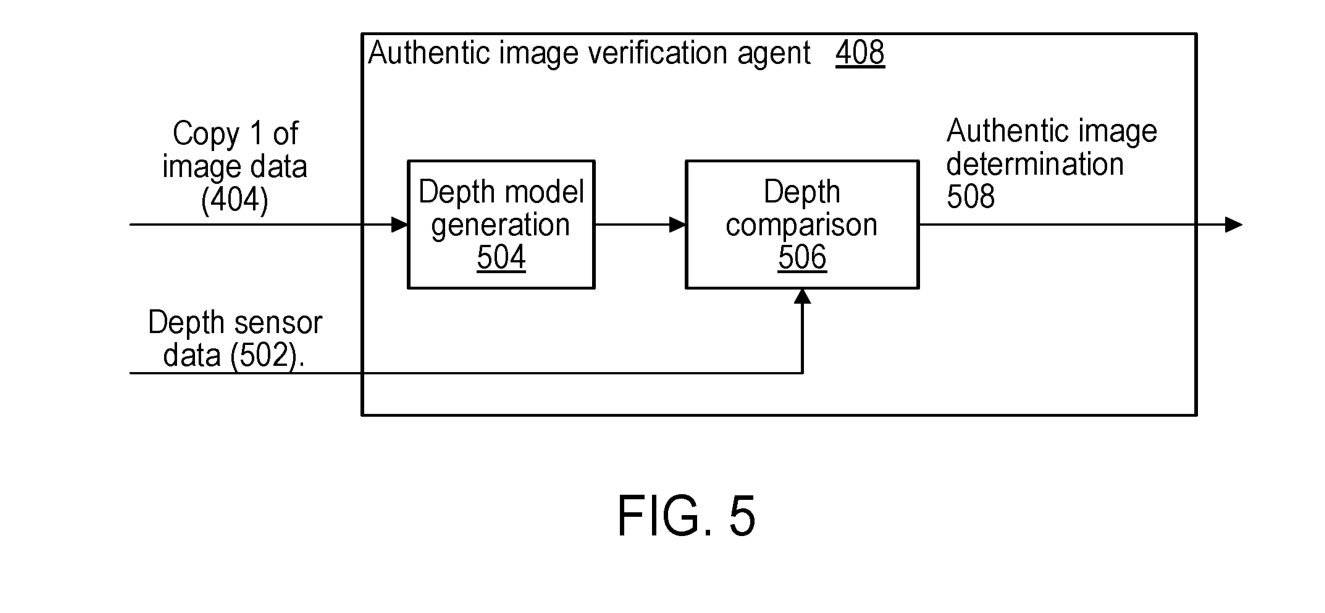
The March 7, 2025 provisional tackles this exact class of problem. Paragraph 0035 proposes estimating depth from the picture and comparing it with depth measured by another sensor, such as LiDAR. A depicted street implies objects at different distances. A monitor presents a flat surface. A sufficiently large disagreement can cause the device to withhold the image from the secure repository.2
Figure 5 makes the comparison explicit: image data enters a depth-model generator, separate depth-sensor data enters alongside it, and a comparison produces an authenticity determination. The later specification retains the example, and dependent claim 7 expressly recites the depth comparison and withholding step.435
This is a proposal for testing one way a photograph can mislead. The filing does not provide measured detection accuracy. A staged three-dimensional scene can have perfectly plausible depth, and a truthful photograph can still acquire a false caption. We also found no confirmation in the announcement or security explanation reviewed here that Reference Image implements this LiDAR-based test.910
An original is useful only if the viewer can inspect it
The patent also treats access as part of the design. Figure 3 gives each image a sharing decision. The specification allows authentication viewing to be opened to the public, limited to listed recipients, or tied to selected social relationships. Keeping an original and exposing it to everyone are separate decisions.42
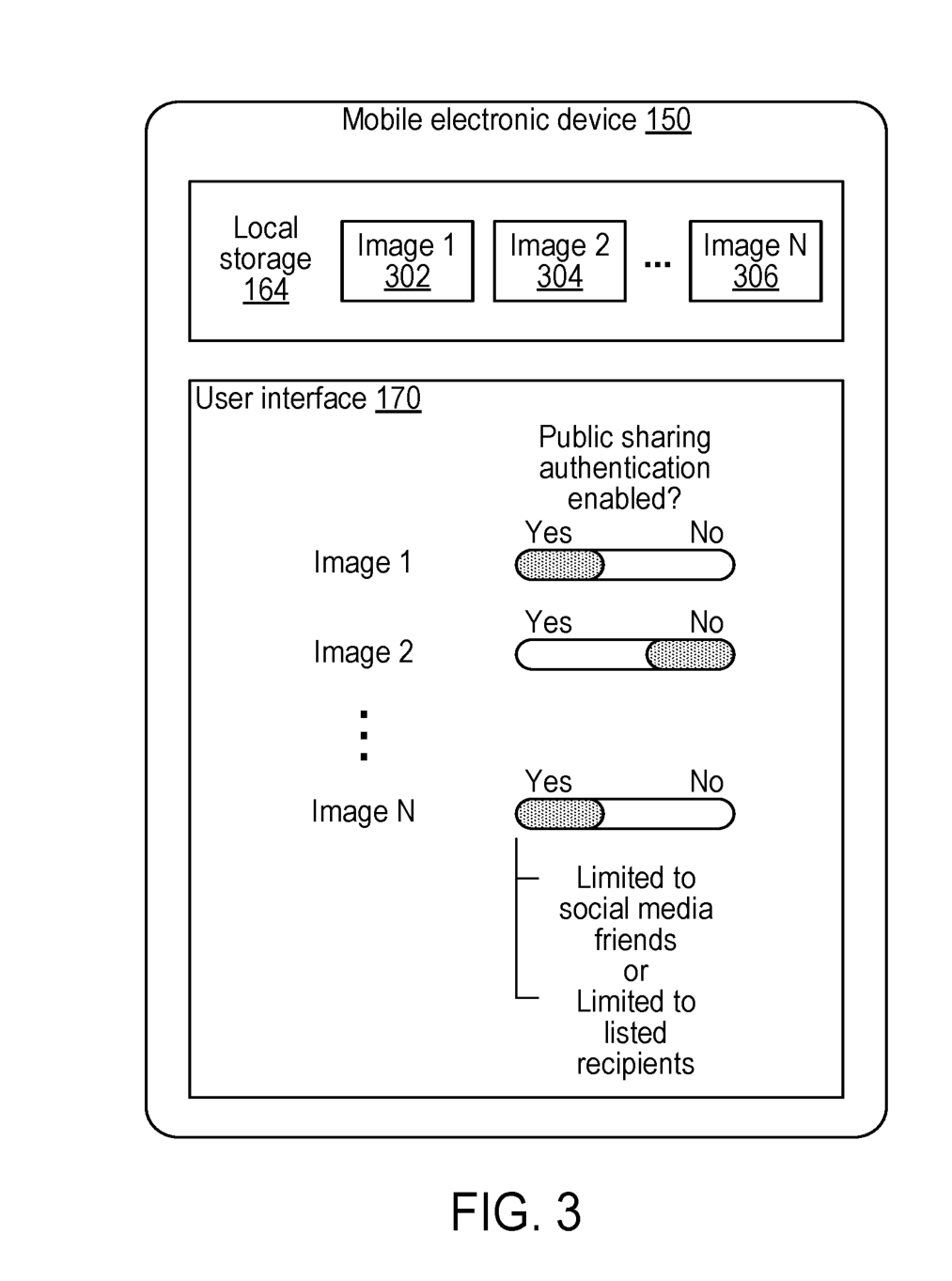
That makes sense for sensitive pictures. The person supplying evidence may want a recipient to check the image without granting everyone the same access. It also creates a practical dependency: a reference that the intended viewer cannot obtain will not settle the dispute in front of them.
For the announced feature, Apple’s support instructions describe developing the reference in Photos, which requires an internet connection, comparing it with the main photo, and choosing whether to include it when sharing. That is the workflow to test in practice: does the reference survive the route through which the audience receives the photograph?11
What the March 2025 file already contained
The original provisional is more than a date on a family tree. Its specification and drawings already contain the split between a protected copy and an app-accessible copy, authentication-sharing controls and the flat-screen depth example. Its attached claim text also describes the protected channel and depth comparison. Those selected mechanisms were in the March 7, 2025 file, roughly eighteen months before publication.264
The nonprovisional was filed March 5, 2026 and published September 10. The retrieved U.S. continuity component contains that application and its provisional, with no older published U.S. member. That is the scope of our first-publication check; it does not establish the first worldwide disclosure or prove that every later claim is fully supported by the provisional.1
This remains a pending application. The useful evidence here is the technical disclosure and the particular language Apple chose to claim. We are not treating publication as a grant, or the presence of a feature in a claim as proof that it shipped.5
A stronger starting point for checking a picture
The promising change is that a viewer can have a second object to examine: a protected record of capture, alongside the image circulating in the world. That can make an alteration visible without requiring the viewer to guess how an image model works.1
The patent’s screen-recapture example shows why the job cannot end at preserving pixels. There is the integrity of the record, the physical scene that produced it, and the story someone tells about that scene. A camera-authentication system can improve the first question while leaving substantial work in the other two.2
The practical test for Reference Image is therefore straightforward: can an ordinary recipient obtain and check the reference, understand what it establishes, and notice what it leaves open? That is where this feature becomes useful evidence.
Evidence notes, claim details and open questions
Sources, family and review scope
Research through September 17, 2026. This article compares Apple’s September 9 announcement and September 15 security explanation with application 19/557,480 and provisional 63/768,533. Original publication, selected filed specification and claim pages, and provisional drawings are archived and linked inline. The family panel uses patent-platform’s native SVG, with the provisional-benefit relationship preserved.1
All 32 indexed documents across the two U.S. files were downloaded; 30 had extracted text, with 30 completed and 2 skipped extraction records in the checked inventory. Acquisition is not a complete substantive review. The analysis relies on the specific passages identified in each citation and does not claim a full international file history, a security audit, or a claim-by-claim priority determination.
Geoffrey Stahl and Michael J. Rockwell are named inventors. The people panel connects their declarations and Alexander A. Knapp’s signed data sheet to the original records. These establish documented participation in this filing, not ownership of every product decision.87